

Duck Decoy Collectibles : Bauer Price List
average value
-
low
-high
-Found 20 out of 33,508 items matching 'bauer'
Sold on eBay February 11th, 2025
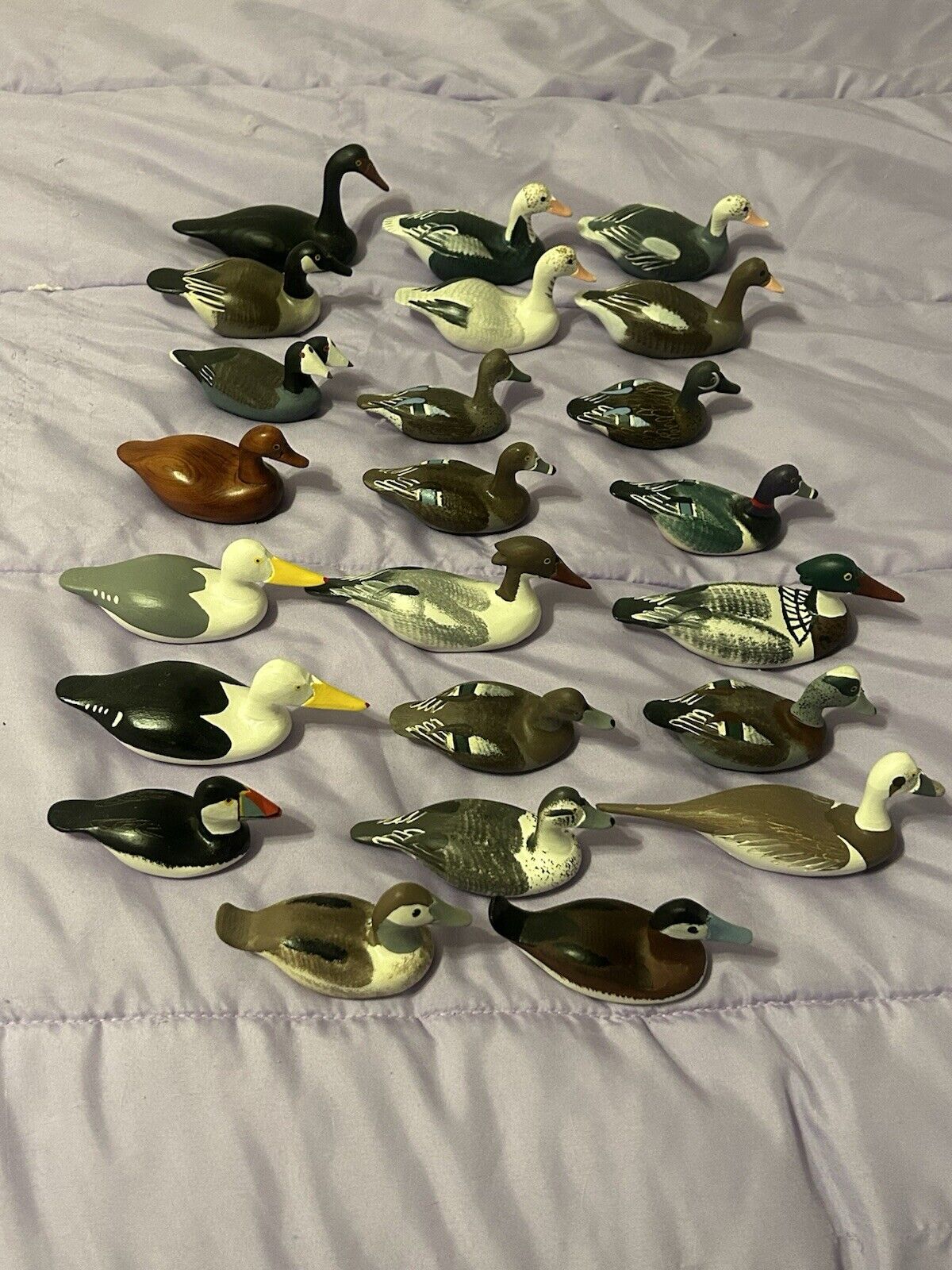
Clarence Titbird Bauer Harve De Grace Md Miniature Vintage Decoys
Clarence Titbird Bauer Harve De Grace Md Miniature Vintage Decoys. Lot of 23 minis. All signed by Clarence. No breaks or repairs to any of them. Have any questions feel free to ask (Condition: New (Other))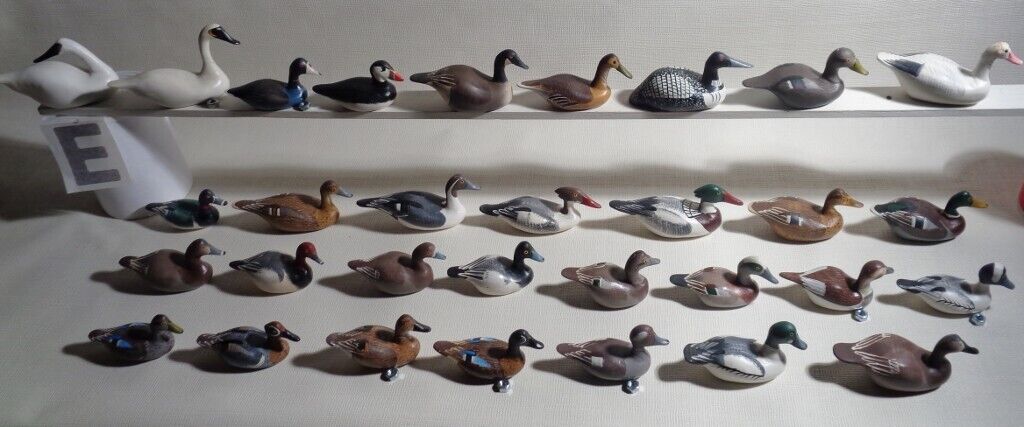
Sold on eBay February 3rd, 2025
Lot of 31 CLARENCE BAUER harve de grace MD miniature wooden duck decoys
Lot of 31 CLARENCE BAUER titbird harve de grace Maryland miniature wooden duck decoys these all will be sold as one lot/price and range in size from 3 to 5 inches all are original paint and condition with no damage or repairs.. (except the 7 decoys with a hardware nut near the body they have a cracked/reglued neck) MOST are signed and dated from the 1980s-1990s..i will honor a 10 day return for a full refund less all shipping costs shipping $30NOTE if these do not sell i will relist as a best offer sale also see my other decoy listings (Condition: New (Other))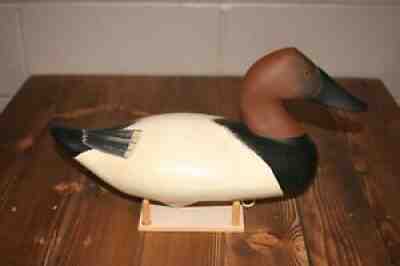
Sold on eBay Feb 10, 2022
Vintage Clarence "Titbird" Bauer Canvasback Duck Decoy Havre de Grace Mitchell
Born inHavre de Grace, Maryland November 4th, 1924, he spent much of his childhood inand around the marshes of the Susquehanna River. That is where his interest inwaterfowl began. Titbird worked for the late Madison Mitchell for over thirtytwo years and is well known for the miniatures he carved but he also carved alesser amount of full size working decoys.
Sold on eBay August 26th, 2024
MINT RARE SIGNED & DATED 2002 HERB MILLER ~HOLLOW Wood Duck Decoy DELAWARE RIVER
RARE, PRISTINE MINT, SUPERB, NEVER HUNTED-OVER, 22-YEAR OLD, TUCKED & TURN-HEADED, SLEEPING DRAKE MALLARD HOLLOW WOODEN DUCK DECOY with HALF-CLOSED, GLASS EYES & EYELIDS ~AWESOME 100% ORIGINAL PAINT, CARVING DETAIL & CONDITION TO A EGG-SHELL "HOLLOW" GUNNING DECOY by MASTER CARVER HERB MILLER of SHIP BOTTOM, NEW JERSEY ~STUNNING 100% ORIGINAL CONDITION with a NICE MELLOWED PATINA & BEAUTIFULLY AGED & AMAZING ORIGINAL OIL-BASE PAINT THAT ADDS TO ITS AURA ~SUPERB CARVING to the HEAD, TAIL, BODY & WINGS ~ORIGINAL RIGGING with LEAD PAD WEIGHT, SIGNED & DATED, LEATHER LINE-TIE & HOT BRANDED ~SUPERB LIFE-LIKE CARVING & PERFECTLY CARVED IN & LOCATED BROWN GLASS TAXIDERMIST DUCK EYES ~This DRAKE MALLARD ON EBAY IS YOUR CHANCE TO OWN AN AMAZING DELAWARE RIVER DECOY ~ IT IS AN ABSOLUTELY STUNNING SLEEPING MALLARD DECOY BY ONE OF THE MOST RENOWNED DECOY CARVERS & A DECOY THAT WAS CARVED AND WENT RIGHT INTO A GREAT DISCRIMINATING COLLECTION ~JUST GREAT DECOY TO OWN & GREAT INVESTMENT AS WELL! MINT RARE SIGNED & DATED 2002 HERB MILLER ~HOLLOW Wood Duck Decoy DELAWARE RIVER MINT RARE SIGNED & DATED 2002 HERB MILLER ~HOLLOW Wood Duck Decoy DELAWARE RIVER Click images to enlarge Description Decoys of: "Delaware River" & "Jersey Coast" are Basically Cousins!! (photo below): c1953 Photo of HERBERT "HERB" MILLER (~Age 18) ..... The Decoy Carver, Waterfowl Hunter, Hunting Guide & Award Winning Carver ..... and Later a "Police Officer" in the "Ship Bottom, New Jersey" Department! Herbert H. "Herb" Miller Born: ..Nov. 8, 1935 ..Roebling, New Jersey ? Died: ..Dec. 30, 2021..Ship Bottom, New Jersey. (age 86) Miller Lived & Hunted the Delaware River & then the Atlantic Coast as Well; But Always Liked to Carve in the Fashion of the Delaware River Decoys .... At the Age 21, he Moved from the Shores of the Delaware River to the Atlantic Ocean Coast; when Army Corp. Engineers Began Dredging the River & Changing it Forever: Herb Miller Grew up in Roebling, New Jersey, which at the Time was a Hunting & Carving Mecca! Then Herb Spent the Remainder of His Life in Ship Bottom on the Jersey Shore, But Still Carved Delaware River Style Decoys! __ This Outstanding, Mint Condition, "Buried-Head; Half-Closed Eyes", HERB MILLER of "Ship Bottom, New Jersey" Drake Mallard up for auction: (photo below): The "LATE HERB MILLER" was a Gunning Decoy Carver, Waterfowl Hunter ..... Duck Hunting Guide, World Champion Wood Decoy Carver -and- Ship Bottom, New Jersey "Police Officer"! (Photos Below): REAL PAIRS of "SLEEPING MALLARDS" in the WILD SO YOU CAN SEE HOW this DRAKE MALLARD WOOD DUCK DECOY by: "HERB MILLER" up for auction REPRESENTS the SPECIES VERY REALISTICALLY and is a PERFECT CARVED & PAINTED WOOD SPECIMEN of this WATERFOWL SPECIES!! _ - This Rare, "Pristine", Signed & Dated, "Hot-Branded", Super-Tucked Head Sleeping", 22-Year Old, 2002 "Herb Miller" Drake Mallard "Hollow" Wood Decoy up for Auction: Herb Miller's Love for Duck Hunting Forced him to Start a Carving Career at Age 14 in 1949 ........ When he Began 75 Years Ago He Carved Because Herb Needed his Own Decoy Rig to Gun Over! Herb Miller discovered he possessed a unique talent for carving and eventually began making decoys full-time ....... in 1968, at the Babylon, New York Decoy Championships he Won 3rd in the Professional Class ........ in 1970, Herb Won 9 More Ribbons at the Championship Show ......... But in 1971 He Topped them All Winning the "Best Of Show" at the Babylon Show on Long Island with a Hen Goldeneye. Herb Miller Started Making Decoys at Age 14 & were All Over-Sized Black Ducks & Mallards ....... Later, when it Was Too Cold to Duck Hunt, He & Fellow Roebling Gunning Partner "Joe Bauer" Would Carved Decoys ....... All were for Personal Use Until 1961. _ This Rare, "Pristine", "Signed & Dated", Hot-Branded, Buried-Head Sleeper, 2002 "Herb Miller" Hollow Drake Mallard up for Auction: Awesome Carved-In, Raised Wings with Primary Feather Grooves ...... Amazing Fluted or Lapped, Curve-Carved Tail Feathers ...... and Stunning "Twisted Breast & Neck", Turned & "Buried into the Back-Feathers" Head!! (photos below): This MINT & OUTSTANDING "SIGNED & DATED", "HOT-BRANDED", DELAWARE RIVER; "EGGSHELL HOLLOWED"; DRAKE "MALLARD" DECOY up for auction!! This Scarcely-Posed, Mint & Pristine, Fully-Rigged, "HERB MILLER" Drake Mallard Perfectly Exemplifies his Best Style & Form and Maybe One of the Best Specimens of his Best Work that You'll Come Across ......... It is Just Gorgeous & Yet Formidable: _ (photo below): A Group of Herb Miller's Decoy's from a Past Auction, Giving a Nice Cross-Section But Small Sample Size of Only a Few Species: _ The Late Herb Miller (1935-2021) is Featured in the Book: "One of Today's Most Outstanding Living Gunning Decoy Carvers" (photos below): A GREAT INDICATION of the PROWESS of the LATE HERB MILLER is HIS INCLUSION in the BOOK BELOW: LOY HARRELL JR. "2007" BOOK: "SIXTY LIVING and OUTSTANDING NORTH AMERICAN CARVERS" __ (photos below): PICTURES of OTHER OUTSTANDING DECOYS by THE LATE GREAT "HERB MILLER", FOR DECADES, ONE of the COUNTRY'S MOST HIGHLY REGARDED CARVERS of HOLLOW "DELAWARE RIVER" GUNNING DECOYS!! This Exquisite "Very Neatly Posed", Fully-Rigged, Eggshell Hollow Sleeping Drake Mallard Wood Decoy up for auction: (photo below): RARE, 100% ORIGINAL and an AMAZING EXAMPLE of One of his RARELY-POSED DECOYS of ANY SPECIES ...... STUNNING FORM & MAGNIFICENT, PRECISELY PAINTED with "STUNNING VERY FINE DETAIL-PAINT" ....... SPECTACULAR CARVING; ESPECIALLY the HEAD, RAISED WINGS, CARVED PRIMARY FEATHERS & FLUTED TAIL ....... and the SEAM WHERE the TWO HOLLOW BODY HALFS were ATTACHED is an ALMOST IMPOSSIBLE to SEE SEAM!! _ This Incredibly Carved "Herb Miller (1935-2021) Drake Mallard with an Amazing & Stunning Paint Job and Outstanding Detailing: (Below Photos): SUPERB FEATHER BLENDING & INDIVIDUAL FEATHER PAINT to ALMOST ALL FEATHER GROUPS ....... with BEAUTIFUL FEATHER BLENDING WITHIN a FEATHER GROUP LIKE the GREEN & BLUE FEATHER HIGHLIGHTING ....... and RICH "LIFE-LIKE" VERY FINE, DETAILED PAINT EVERYWHERE ....... and REALISTIC SMALL & TIGHT SPECULUMS on a FLUFFED FEATHER RELAXED DUCK ....... ACTUALLY EVERYWHERE!!! MAYBE the MOST INCREDIBLE ASPECT of this DECOY ......... is the AMAZING, "PAINT BLENDING" to the BREAST, BACK, SIDES, HEAD, TAIL & WINGS ......... MUCH LIKE the FINEST EARLIER EXAMPLES of EARLY DELAWARE RIVER'S BEST DECOYS ....... as HERB MILLER ALSO USED THEIR BLENDING, STIPPLING, DAUBING & SWATHED SOLID PAINT to FEATHER GROUPS as WELL as INDIVIDUAL FEATHERS ........ GIVING it a PERFECTLY REALISTIC & "LIFE-LIKE" APPEAL, SURFACE & APPEARANCE .......... YOU CAN SEE EVERY PAINT BRUSH MARK on this AWESOME & RARE DECOY!! Look at Herb Miller's Perfectly Carved-In "Twisted Breast & Neck", Buried "Half-Asleep" Head, Ice Groove Separation on the Back, Raised Wing Feathers, Fluted Tail Feathers ...... Painted on Back, Side, Breast, Tail, Wing & Head Feathering with Gorgeous "Blue, Black & White" Tiny Painted Lines for the Speculums: The Precise Knife Cuts to the Raised-Wings, Individual Primary Wing Feathers and Lapped, Tail Feathers is Amazing .......... and Like the Best Made "Hollow" Decoys from Anywhere the Seam Where the Hollowed Half's were Attached is "Invisible" ....... and the Seam Where the Tucked & Sleeping Head, Incised Neck Seat & Where the Neck is Attached to the Body is Nearly Invisible!! This Very Rare & Possibly One of a Kind "Buried-Bill", "Half-Closed" Eyed, Sleeping Drake Mallard up for auction: (photos below): Just Look at the Stunning & Extremely Detailed Carving and Paint From a Top & Bottom Angles and From Different Directions!! (photo below): Note the Infinite Gorgeous Feather-Blended Browns, Grays and Black to the Entire Body .... Also, the Feather Blending & Each Individual Painted Feathers were Precisely Painted on to the Breast, Back, Sides & Tail: (photo below): Note the Carved-In, Raised Wings that Goes from the Tips to the Carved-In Side Feather Group: (photos below): This Group is of the Decoy's Bottom from the Same Angles as those Above: (photo below): Note the Beautiful, Deeply Carved-In Wings: Between the Brown & Tan Wing Primaries and the Tail Section with its Tiny Tan Feathers ........ It Forms a "V" where the Wing-Feathers & Top of the Tail Meet: (photo below): Note the Superb, Carved-In Fluted or Lapped Tail Feathers ..... and How they Flow Perfectly Out of the Black Upper-Tail Coverts: (photo below): Note the Precise & Perfectly Carved-In "Fluted" Tail Feathers: (photo below): Note the Carved-In, Raised Wings that Goes from the Tips to the Carved-In Side Feather Group with it Relief Carved Out in Between the Wings: (photo below): Note the Darker Gray Individually Painted on Feathers on the Back & Sides ........ as Well as the Very Tiny Brush Stroked Light Tan Feathering to the Dark Brown Breast: _ (Below Photos): The BOTTOM of this RARE & EXOTIC "HERB MILLER" DECOY SHOWS the PRECISELY LOCATED "LEATHER" LINE-TIE attached with 2 SOLID-BRASS WIRE NAILS ....... and his "SOLID-LEAD", BEVEL-EDGED, "PAD WEIGHT" ATTACHED with 4 SMALL BRASS BRADS!! Also, His Typical Branding Iron, "HOT BRANDED", Name "H. MILLER"!! BOTTOM of this SUPERB DECOY was HAND-SIGNED & DATED in BLACK INK:? "Herb Miller & '02" PERFECT ORIGINAL RIGGING: MINT RIGGING with LEAD PAD WEIGHT HELD on with SOLID BRASS BRADS & LEATHER "THONG" LINE-TIE also HELD on with 2 BRASS NAILS: SIGNED & DATED: HAND PAINTED, IN BLACK: HERB MILLER & '02 "HOT BRANDED ON": H MILLER + (below photos): The HEAD of this RARE & PRISTINE "TWISTED & TUCKED"; "HALF-SHUT EYED" DRAKE MALLARD from SEVERAL ANGLES and the BILL-LESS HEAD is BURIED in the BACK & WING ........ and the HEAD is PERFECTLY CARVED with SUPERB LENGTH & FORM, PRECISELY CARVED & PERFECT, BROWN GLASS TAXIDERMIST EYES ..... PAINTED "HALF- SHUT" with the 2-COLOR, EYE LIDS & LASH LINE!! This is a PERFECTLY FORMED, HERB MILLER DRAKE MALLARD that was NICELY "FILE & KNIFE-CARVED" & SMOOTHLY SANDED ........ with a "STUNNING" & TUCKED HEAD with a NECK & BREAST that TWIST SLIGHTLY to MAKE the POSE LIFE-LIKE ......... IT'S PHENOMENAL & RESEMBLES a RELAXED, FEELING-SAFE, MALLARD that is ASLEEP or HALF-ASLEEP!! ? -and- GORGEOUS EYE-LIDS & AMAZINGLY PAINTED "WHITE NECK RING" ....... and BLACK-GREEN HEAD HIGHLIGHTED with IRIDESCENT TINTS of BLUES, PURPLES & GREEN COLORS LIGHTLY BLENDED IN!! The Head is Attached by at Least One Large Screw Up-Through the Upper "Hollowed-Half" of the Body Before the 2 Body Half's were Attached ..... and Both the Neck & Body Seams are So Tight and Hard-to-See It is So Pristine it Looks Like it Just Left his Work Shop! _ (Below Photos): This MINT & RARE "MALLARD" DRAKE ..... is EGG-SHELL "HOLLOWED" & is MODESTLY-SIZED LIKE ALMOST ALL "DELAWARE RIVER SCHOOL" DECOYS!! IT LOOKS "SPECTACULAR" with ITS "LONG BODY" STYLE & WELL-ROUNDED FORM & LIGHT WEIGHT: This VERY RARE MALLARD MEASURES & WEIGHS: This "One-of-a-Kind" Herb Miller Drake Mallard Weighs & Measures a Real-Life Sized: ? 14-1/2" long..x..5-1/8" wide..x..5-1/2" tall ? -and- Weighs a Well-Hollowed: ...1-lb. 9-oz. _ THAT is FANTASTIC & MAKES for ONE of the LATE HERB MILLER'S FINEST & MOST UNIQUE WOOD DUCK DECOYS!! That Makes for an Awesome & Very Unique Gunning Decoy that is So Well Made that the Seams Between the 2 Hollowed Body Half's and the Head/Neck & Body are So Original & Tight that Both Seams are Close to Invisible!! That Makes for a Superb Decoy that Has Been in the Protection of a Climate and Light Controlled Collection or Collections Since the Day it Left Herb Miller's Work Shop as Maybe a Special Order!! _ This RARE & OUTSTANDING "HERB MILLER" DRAKE MALLARD'S HEAD is as REALISTIC & LIFE-LIKE as ANY CARVER CAN MAKE!! NOTE this MALLARD'S AWESOME, PRECISELY CARVED-IN & ACCURATELY LOCATED, "BROWN" GLASS TAXIDERMIST EYES .......... and AMAZINGLY PAINTED "HALF-SHUT"!! This MINT, RARE and MARVELOUS "HERB MILLER" "DRAKE MALLARD" WOOD DUCK DECOY up for auction: ? This DECOY is MINT, PRISTINE CONDITION ...... It DOESN'T HAVE a SINGLE CHIP, NICK, CHECK, DENT, CRACK or RUB of ANY KIND ...... It DOESN'T EVEN HAVE a SINGLE PAINT SMUDGE!!!!!!! _ Description of this STUNNING DRAKE "MALLARD" DECOY Up For Auction: MINT, RARE, SPECTACULAR; 100% ORIGINAL; HAND SIGNED & DATED; HOT BRANDED; 2022 The LATE HERBERT H. "HERB" MILLER; EGGSHELL "HOLLOW" & 22-YEAR OLD; "DRAKE MALLARD"; FULLY-RIGGED, WHITE CEDAR; WOOD "DELAWARE RIVER", "GUNNING" DECOY ? Ship Bottom, New Jersey on Long Beach Island ? HERB MILLER CARVED using EASTERN WHITE CEDAR, which NATURALLY REPELS WATER and is EASY to WORK!! ? MODESTLY "LIFE-SIZED" DECOY in TRUE FASHION of the DELAWARE RIVER, which on OCCASION, OFTEN MADE SLIGHTLY SMALLER that LIFE-SIZED DECOYS DEPENDING; OFTEN on SPECIES!! Carved Life-Sized, Raised Primaries, Fluted Tail, Carved-In Primary Feathers, Very Exquisite Carving Detail to Tucked Head, Eggshell Hollowed Close to Middle of Two Body Halves & the Seam is Practically Impossible to See!! ? Just Outstanding & Incredible Wing, Head, Body & Tail Carving with Precise Symmetry!! Perfectly Carved-In & Located, Brown "Mallard", High-End, Hand-Made, Taxidermist Eyes!! Excellent Herb Miller Decoy by this Late Master Carver with an Awesome "Turned & Buried, Sleeping" Head Posed, Raised & Carved Primary Feathers, Raised Wings and True, Fluted Tail Carving! _ PERFECT CARVING DETAIL: AWESOME HEAD, PRECISE RAISED WINGS with CARVED-IN PRIMARY FEATHERS & SUPERB FLUTED TAIL FEATHERS!! ??? INCREDIBLE PAINT: AWESOME, IMMACULATE, MINT 100% ORIGINAL PAINT with INDIVIDUAL FEATHERING to ENTIRE DECOY & FEATHER BLENDING to HEAD, NECK, SIDES, BREAST, WINGS, BACK & TAIL!!!! OUTSTANDING FORM: ABSOLUTELY PERFECT CARVING to the PERFECTLY CONTOURED BODY, HEAD & OUTSTANDING TAIL and BREAST!!! _ RARE: INCREDIBLE PATINA to the OIL-BASED ARTIST'S PAINT!! RARE: The LATE HERB MILLER'S DECOYS are SOME of the NICEST BALANCED, SYMMETRICALLY CRAFTED and OUTSTANDING CARVED and PAINTED ROUGH-WATER DECOYS MADE! A Perfect Specimen of a Rare Posed Sleeping, "Egg-Shell Hollow" Large-Sized, Dabbling or Puddle Duck Hunting Block Made by One of The Late, But Great Gunning Decoy Makers!! This DECOY is PAINTED in a LATE FALL - EARLY WINTER, COLOR SCHEME and How We SOMETIMES SEE THEM DURING the HUNTING SEASON in MICHIGAN; BUT WE ALSO OFTEN SEE THEM NOT QUITE YET in BREEDING PLUMAGE EARLIER!!!! This DECOY Has the NICEST HEAD CARVING, TAIL -and- RAISED WING & PRIMARY FEATHER CARVING -and- Some of the Finest Work You Will See from One of the Late, But Finest Carvers!! Lead "Pad" Ballast Weight Held on with 4 Small, Solid Brass Brads or Nails! OUTSTANDING PATINA to the BEAUTIFUL, 100% ORIGINAL ARTIST'S OIL PAINT!! ? This DECOY Has SOME of the LATE MR. HERB MILLER'S MOST AWESOME "CARVING" to the RAISED WINGS, DEEP INDIVIDUAL WING PRIMARIES, LATH OVERLAPPED FLUTED-TAIL and SUPER-TUCKED-IN HEAD!! If You Like Decoys from Famous Master Carvers and Are in "MINT CONDITION" ........ THIS IS A VERY VALUABLE DECOY to ADD to Your COLLECTION!! Great Breast Bulges Up & Sideways Like a Real Duck in the Wild When the Head is Twisted Backward & Tucked!! _ _ (photos below): This HERB MILLER DRAKE MALLARD WOOD DUCK DECOY up for auction!! DON'T MISS OUT ON THIS OUTSTANDING & SCARCE DECOY: This DRAKE MALLARD on Ebay has the Perfect Weight and Dimensions for DELAWARE RIVER Decoys that Could Be Gunned Over in the Often Unpredictable Currents of the River & Inclement Surface Weather & Swim Perfectly and Right Themselves Immediately!! ? ? ?This is Just An Awesome "Drake Mallard" Wood Duck Decoy That Was Carved and Has the Perfect Form, Style & Dimensions for the Delaware River Decoys of a "Wood Duck" Decoy and Live Duck as Well!! ? The Dimensions & Weight are Perfect & Typical for a Decoy by the Late Herb Miller, Large-Sized Puddle or Dabbling Duck, Eggshell Hollow-Bodied, Wooden Duck Decoy!!! This Drake Mallard on ebay Shows that it Came from Climate Controlled, Direct Light-Free Collection or Collections and Has Been Kept Protected for the Past 22-Years and It Has Been Carefully Cared For In!! It Clearly Has Been Very, Very CAREFULLY HANDLED & Certainly "WAS NEVER USED" as it is in "TRULY MINT CONDITION" as well as "100% ORIGINAL"!! ? It Looks to Have Hardly Been Handled as well as NEVER RIGGED ? IN THE NEXT FEW WEEKS I AM PUTTING ON EBAY MORE LAWRENCE BETHEL FISH DECOYS, A MINT SIGNED CHARLIE JOINER CANVASBACK, A PAIR OF THE ONLY KNOWN PROTOTYPES MADE OF THE VERY FIRST PRE-PRODUCTION FIBRE DECOYS EVER MADE, A NEAR MINT 1927 HEDDON GIANT VAMPIRE FISHING LURE IN RARE SHAD, A PAIR of LATE PHASE DODGE MALLARDS, EXQUISITE AND RARE PAIR OF "SPECIAL ORDER" MALLARDS, A RARE PAIR OF RALPH MALAPAGE GREEN-WINGED TEAL, A VERY RARE c1893 100% ORIGINAL TRANSITION PERIOD MASON DRAKE BUFFLEHEAD, A MINT RALPH MALPAGE CANADA GOOSE GUNNING DECOY, A MINT c1905 HEDDON ARTISTIC MINNOW, A VERY RARE PADCO OF MISSISSIPPI GOLDENEYES, A YELLOW WITH RED EYE BLUSH MOONLIGHT SINGLE-HOOK PIKAROON, A NIB CREEK CHUB MULLET COLOR STRIPER PIKIE IN CORRECT BOX, A PAIR of INCREDIBLE CHALLENGE GRADE MASON BLUE-WINGED TEAL, A NICE PAIR OF MASON GLASS EYE BLUEBILLS, AN AWESOME ERNIE NEUMANN SUCKER FISH DECOY, A RARE DOUBLE SPECIAL CREEK CHUB BEETLE FISHING LURE, A VERY NICE ERNIE NEUMANN SUCKER, A RARE 12-1/2" CHET SAWYER MINNESOTA FISH DECOY, A NEAR MINT OSCAR PETERSON PERCH FISH DECOY, A MINT PAIR OF WRAGG & BURRELL WIGEON, AN OUTRAGEOUSLY HARD TO FIND PAIR OF CHARLIE POZZINI BLUEBILLS, A CHET SAWYER 13" CHET SAWYER FISH DECOYS, A VERY BIG & BULL-NECKED EARLY FERDINAND BACH DRAKE CANVASBACK FROM HIS PERSONAL RIG AND MORE!! ? Shipping Includes Insurance! I Don't Believe in Making a Profit on Shipping, You Pay What I Pay. If it's Less Than You Paid I Refund the Difference, If More I'll Pay For It. I COMBINE SHIPPING. I am also loading over 150 Duck Decoys, 150 Fish Decoys, 70 Scarce Fishing Lures, etc. so keep checking back. ________________ This Outstanding, 100% Original, Well-Hollowed & Long-Body Styled, "Almost Fully Asleep" 2002 "Drake Mallard" Gunning Decoy with the Late Herb Miller's Signature, Date & with his "Hot Brand"!! ITEM DESCRIPTION This 22+ Year Old, Very-Rare Sleeping-Posed, Very-Hollow and Nicely Carved and Painted Drake Mallard decoy was made by Herbert H. "Herb" Miller (born: Nov. 8, 1935 ~ died: Dec. 33, 2021) of Ship Bottom, New Jersey and Formerly of Roebling, New Jersey. Much of Herb Miller's life was lived in Roebling during the tail end of the days when huge numbers of ducks found food and safety on the Delaware River during their migrations. But at the age of 26 Herb moved to the Jersey Coast when the Army Corp. of Engineers was dredging the Delaware River for shipping, and all but destroyed most of the great gunning areas. The Roebling Florence community is located in Florence Township and is within Burlington County. Roebling Florence is located on the banks of the upper portion the Delaware River, around eight miles south of Trenton, New Jersey and directly across the Delaware from Levittown, Pennsylvania. In addition to being the original home of Herb Miller, it was also the home to the Famous English family of decoy carvers, a couple of which helped him learn carving decoys. Florence Township is located on the traditionally rich duck hunting banks of the upper portion of the Delaware River and directly across the Delaware River from Tullytown, Bristol and Levittown, Pennsylvania, which were also home to a myriad of Delaware River duck hunters and decoy carvers. In 1961, Herb Miller and his wife Carol moved from Roebling, New Jersey to Ship Bottom, New Jersey. Ship Bottom is a borough and is known as the "Gateway to Long Beach Island", as Route 72 provides the sole road access from Manahawkin in Stafford Township, ending in Ship Bottom as it crosses Manahawkin Bay via the Manahawkin Bay Bridge and ends on Long Beach Island. When the Late Herb Miller (1935-2021) began duck hunting, it was in the tail end of an era that including hundreds of thousands of waterfowl using the relatively slow moving and food laden wetlands of the Delaware River as a perfect stop during migration to feed and rest. A young Herb Miller started making decoys at the age of 14, around 1949, and made decoys into his 80's, and he sadly passed away at the age of 86. Herb Miller's earliest decoys were made over-sized and he only made black ducks and mallards. He was constantly hunting, fishing and trapping with his good friend and fellow Roebling youngster, Joe Bauer. When it got too cold outside to hunt, the two of them stayed indoors and took advantage of the time to carve new decoys. Like many rivers around the country, there came a time when the Delaware River was entirely redeveloped so that larger and larger ships could get to Trenton, one of the strongest manufacturing cities in the region at the time. In the 1950's, the Army Corp. of Engineers oversaw the dredging and use of that sand, sludge and silt to fill in some of the best hunting areas and also straighten sections of the river. This was the final straw for some waterfowl hunters, including young man Herb Miller, so in 1961 Herb Miller and his wife moved to Ship Bottom on the Jersey Shore where he felt he would be close to good duck hunting once again. Every decoy that Herb Miller made before 1961 was for personal use, partially because there was no shortage of guys carving and selling decoys on the New Jersey and Pennsylvania sides of the Delaware, both up and down the river from Roebling, New Jersey. After his move the Ship Bottom on the Jersey Shore he saw a market for his decoys, in addition to his income as a Ship Bottom police officer for a portion of that time. The Great Herbert H. "Herb" Miller entered his first decoy contest in 1963 in Babylon, New York, where he won 3rd prize in the "Professional Class". In 1970, he won 9 more ribbons at the show, and in 1971 he topped them all, as he won the "Best of Show" at the Babylon show on Long Island, with an amazing hen goldeneye. As stated, prior to 1961, Herb Miller carved decoys only for personal use, but gradually that changed and he not only began selling decoys, but by 1972 Herb was guiding duck hunting parties with a large rig of Herter's decoys. It was shortly before this that his decoys were being bought by collectors, so he figured he would no longer hunt over decoys he was making as they were far more valuable to risk damaging them while hunting over them. MORE ABOUT ROEBLING, NJ: Roebling was founded by Charles Roebling, son of John A. Roebling. John A. Roebling & Sons company built and provided the steel for the Brooklyn Bridge, the Golden Gate Bridge, as well as numerous other bridges including one over Niagara Falls. The steel mill was also responsible for the production of the elevator cables for the Empire State Building in New York City, the Chicago Board of Trade Building in Chicago and the Washington Monument in Washington, D.C. John A. Roebling & Sons company made the wire for the original slinky as well. _ Herbert H. Miller's 2o21 Obituary Herbert Miller, 86, long-time of resident of Ship Bottom and former Ship Bottom Chief of Police, passed away on December 31, 2021 at Southern Ocean Medical Center. Herb was born and raised in Roebling, NJ. He served in the U.S. Navy and moved to Ship Bottom in 1961 where he attended the Ocean County Police Academy. After moving through the ranks in the Ship Bottom Police Department, Herb served as Chief of Police for 10 years, retiring in 1991. The Late Herb Miller was an accomplished marksman, dedicated hunter, fisherman and renowned master decoy carver. Herb carved his first rig of decoys, comprised of Black Ducks and Mallards, in 1949 at the age of 14. He took 3rd place overall and 2nd Place in Decorative Decoys in the Ward World Championship Wildfowl Carving Competition and Art Festival, Salsbury, Maryland. His carvings are featured in museums all over the United States. He was an inspirational artist to many. From whittling decoys to running a duck hunting guide service, Herb left a mark on a lot of people. His advice was always right although sometimes brutally honest. For 32 years of his life, he served the community with great dignity and respect. Herb was a good neighbor, good resident and great person. Predeceased by his loving wife of 60 years, Carol R. Miller (2019) and sisters, Phyllis and Gloria, Herb is survived by his sons, sons Stephen and his wife Dorothy, Eric and his wife Judy, Herb and his wife Kim, grandchildren Mike (Brittany), Jamie, Jordan, Luke, Nikki Bevacqua (Anthony), Katie Reed (Chris), Abbie (Jesse Vassallo) and great grandchildren Grady, Hunter, Shea and Alex. Also surviving is his brother, David and his wife Marge. HERBERT "HERB" MILLER: The Late Herb Miller, was born on November 8, 1935 in Roebling, New Jersey. While growing up, he would spend a great deal of time following in his father's footsteps plying his trade on or near the banks of the Delaware River. Miller's father was a dedicated hunter and fisherman, and along with Herb's uncles, worked at the renowned Roebling Steel Mill. Herb carved his first rig of decoys in 1949, at the age of 14. The bodies were made of cork that he got from Doan's Ship Salvage in Fieldsboro and he outfitted them with heads he carved from pine. This first rig was comprised of Black Ducks and Mallards. Also at the age of 14 years old, Herb Miller bought his first boat with money he earned from working at a nearby gas station. It was made by Mocker Bell and it was a Bordentown double ender, which is precisely the boat the Delaware gunners used to "ambush" ducks. He and friends Joe Bauer, Rick Gilfin and Earl Kovac hunted around Roebling Island, and when not in use he kept the boat chained to a buoy near the Roebling Steel Company complex. Around the age of 16, Miller ventured out and began to hunt other areas of the Delaware River including Money Island. It was here that he met veteran waterfowl hunter Joe King, not to be confused with New Jersey legend Joe King (1835-1913) of Manahawkin, New Jersey. Herb also met one of King's frequent gunning partners, a man that also would become quite well known on his own, Mr. Bill Quinn (1915-1965). Another hunter that often gunned with King and Quinn was none other than John Baker of Edgeley, Pennsylvania. Like the majority of the upper Delaware River gunners, Joe King and Bill Quinn would first position their decoys in their desired location then row out of sight until passing ducks landed in the decoys. They then would quietly approach the ducks, one man ready with the gun up front, while the other silently propelled and steered the boat using a sculling oar. The front man would take the initial shots and the rower would help kill cripples and retrieve the dead birds. After Quinn and King would set out their decoy spread they would go ashore and build a small fire to warm coffee, toast bread and keep the chill off of them. Along with his friends Bauer, Kovac and Gilfin, Herb Miller often joined long time veteran gunners Bill Quinn and Joe King on the shore and the two veteran's would take the younger gunners on a "sneak" or "scull" into the decoys that had waiting birds that had landed. Herb Miller fondly recalled the time that he shot his first duck on the wing, it was one of 3 mallards and Quinn shot the other 2. For his 16th birthday, Miller got an L. C. Smith double-barrel, 12-gauge shotgun. In all of the excitement, Miller took his new weapon out in a blizzard, snow storm to give it a test. Long after dark, when he had yet to return home, his older sister went out to look for him. After a short time, she fell on the ice and broke her leg. To say his sister was not amused with him when he returned home later that night would be an understatement. It was around this time, in 1951, that Miller carved his first rig of "all wood" decoys (2nd rig overall), that including many very nice mallards. His 3rd rig, in 1955, was over-sized decoys. But of all of these rigs, his 1951 second-rig of decoys was standard sized, were carved of western red cedar bodies and white pine heads, which is the same as this drake mallard up for auction. This 1951 rig was also all flat-bottomed, standard-sized, had carved primaries, detail carved bills & tails and quality glass eyes. This 1951 rig was also comprised of all low head and regular-height head positions and the hollowed body halves, as well as the heads and bodies, were held together by Weldwood Waterproof glue and painted with oil-based house paints. Miller used this rig for a year until he joined the Navy in 1952, then sold them to Charlie Wargo. Like this Herb Miller decoy up for auction, all of Miller's early decoys were carved in the fashion of the typical Delaware River decoy: beautifully rounded, hollowed 2 piece bodies with protruding chests and usually low, contented heads. Like the great majority of Delaware River carvers, Miller's decoys were for his own personal use and the size of his rigs were relatively small in comparison to hunters in other more open water regions. Although Herb never copied other carvers' decoys, just like anywhere, they inevitably followed the form of and show the influence of the famous master carvers Dan English, Joe King and Bill Quinn. Upon his return from the Navy in 1955, he and his father teamed up to carve an entirely new rig of decoys. This new rig was made in the typical Delaware school style, but they were carved over-sized because of the changing conditions of the faster flowing river. This new rig was made up of Black Ducks, Pintails and Mallards, and their larger size proved beneficial in luring wary birds. In 1959, Herb Miller married Carol Roach of adjoining Florence and had 3 sons; Steven, Eric and Herbert, Jr. In 1961, Herb Miller moved his wife and family to Ship Bottom, New Jersey, where he briefly worked as a carpenter before joining the local police department. He would end up working his way up through the ranks and after 32 years he ended up retiring as the Chief of Police in 1993. Before this, in 1965, Herb Miller started hunting Barnegat Bay, which was a stone's throw to the north of his new hometown of Ship Bottom. During this time in the mid-1960's the waterfowl seasons were long and the limit was 10 ducks a day. He bought a 30-foot Garvey boat along with 3 sneak boxes and guided hunters. His rig at the time was 300 Herter's decoys as they were lightweight and inexpensive. He did this for approximately 15 years, but around 1980, when the seasons were shortened and the bag limits were cut, he decided not to continue. He had carved decoys during this period and in 1968 he started carving competitively. He carved for competitions until 1980 and during that time his decoys won a plethora of ribbons and an equally impressive number of "Best in Show" awards. Over time, just like any master of any craft, Herb Miller's decoys went from an effective, finely constructed and wonderfully painted hollow hunting blocks, to his later decoys like this Sleeping Drake Mallard up for auction, that perfectly mirror the wild kin they were intended to imitate. The decoys of the Delaware river rated among the finest in the country when it came down to the beauty of the carving and painting. Like many areas in the country, like this Herb Miller Sleeping Drake Mallard up for auction, the decoys were typically made with either white pine or cedar for the bodies and white pine for the heads, and most had a rectangular shaped "pad" ballast weight nailed or screwed on to the bottom, just like those used in a great many areas on the Atlantic coast and this Mallard up for auction. The Delaware decoys were also painted with oil-based paints and some carvers coated their decoys with a mix of beeswax melted in gasoline as a top coat preservative. The method of hunting on the Delaware River, much like Mr. Miller in his Roebling gunning days, dictated that the decoys that were used were as realistic as possible. The typical hunter used a double-ended sculling boat to sneak up and bushwhack ducks. The hunters would set up their rig of decoys at known feeding grounds, then anchor upstream or upwind and wait for ducks to land in the decoys. When the birds landed they would scull slowly toward the decoys while ducked behind the slightly raised cowling or a raised edge or lip on the front of the boat's compartment construction. This "sculling" method of hunting is almost identical to the "screen" boat hunters in Ontario or the "sneak" boat shooters on Lake St. Clair between Michigan and Canada. The Ontario screeners would often be on shore and oar toward the decoys hiding behind a medium height, horizontally shaped screen that acted like a shield and was often thatched with vegetation to match the shore background behind them. The Lake St. Clair and western Lake Erie Michigan "sneak" boats had and have a similarly shaped shield to the Ontario "screeners", but since the sneaks are in open water with no perceivable background, the shield and boat are/were both painted the same grayish-green color to closely match the color of the water they hunted. Vital to these ambush type styles of hunting, like the Delaware scullers, the decoys must be very realistic looking and perform life-like in the water to "hold" the birds in the decoys until the hunter gets close enough to shoot. The decoys had to have a relaxed appearance like tucked heads or sleepers and they needed to swim perfectly in any water conditions with no yawing, slapping or jerking as to not spook the holding ducks. Considering the mild currents of the Delaware River in the late 1800's and early 1900's, the smaller, very hollowed decoys of the time with their realistic paint jobs were considered some of the finest in the country. Most of the decoys, like this pair of Great Sleeping Mallard up for auction, had relaxed, tucked or sleeping posed heads to convey an attitude of a contented duck with little or no sense of danger to alarm the sitting birds. Size was a major factor as the sculling boats had limited room for gear so the smaller size afforded a larger number of decoys in the set. Another factor in creating an incredibly realistic looking and high performing decoy is the amount of competition for premium hunting spots on the river. In the hey-day of Delaware River hunting, when a large number of hunters were operating rigs on the river, hunters were very territorial which led to many decoy thefts. Also, from a creative standpoint, with a great number of hunters competing for wild ducks within close proximity to other rigs, carvers attempted to outdo their neighbors by making a more realistic, better performing decoy to get an edge. With all of these factors in mind, the typical Delaware River decoy was full-breasted and hollow constructed in the 2-piece manner for lightness and good buoyancy. Most of the decoys had fine glass eyes, a relaxed appearance and extremely well carved wing and tail detail like this black duck up for auction. The head on this Sleeping Drake Mallard was carved into the body with a perfectly, twisted head and neck carving detail, so that the aim of the head and the direction of the breast work together flawlessly with an invisible seam. The nicely carved-in fluted tail is amazing as the gorgeous carving to each tail feather overlaps over the next one that is detail carved like they all are. It is also evident that the further downriver you got, the Delaware school of carvers paid less attention to carving detail, especially in the wings and tail. This was in part due to the decrease in the hunting pressure as the river widened substantially and competition thinned out dramatically. The realistic paint patterns were more consistent throughout the school of carvers, but like this Drake Mallard up for auction, the paint detail did increase the further "upstream" you went. The group of carvers that make up the Delaware School of carvers includes many of the finest master carvers on or near the eastern seaboard. The area encompassed by this awesome network of carvers stretches roughly from the Delaware River near Trenton, New Jersey to the north and south to Philadelphia and Delaware Bay. Midway in between were the three most prominent carving communities, Bordentown and Florence in New Jersey, and the Bristol area of Pennsylvania. The carver heritage, in addition to Mr. Herb Miller, includes the likes of John English (1852-1915) and his sons Jack (1874-1944) and Dan (1883-1962) from Florence, New Jersey; John Dawson (1889-1959) of Trenton, John McLaughlin (b. 1911) of Bordentown, New Jersey; Bill Quinn (1915-1969) of Yardley Pennsylvania; Jess Heisler (1891-1943) of Burlington, New Jersey, John Heisler of Bordentown, New Jersey; Paul Green of Yardville, New Jersey; J. Baker of Edgely, Pennsylvania; Tom Fitzpatrick of Delanco, New Jersey; Lawrence McLaughlin of Edgely, Pennsylvania; Reg Marter of Delanco, New Jersey; Al Reitz of Croyden, Pennsylvania; Lou Boldizar of Roebling, New Jersey and of course Miller's elder friend Joe King. Tony Bianco, Richard Anderson and James West are a few names that come to mind from various areas. Given the proximity of these carvers to each other and the overlap of their hunting grounds, many knew each other and thus the profound influence that reciprocated between them of styles and construction techniques. These were the vintage carvers of the late 1800's and well into the first half of the 20th century. Their smaller size and well-hollowed decoy's construction made them very transportable and effective but things changed significantly in the coming years. Starting in the 1920's and continuing until 1940, the river changed dramatically and thus did the vintage decoys. During this time, the Delaware River was dredged from its average depth of 12 feet to produce a 40 foot deep channel to accommodate the shipping requirements of the steel mills in Trenton, NJ. The Army Corps. of Engineers then used the dredged sand to straighten the direction of the river by filling in the surrounding flats and eddys, which reclaimed thousands of marshland and in doing so increased the rate of current of the river. The wonderful decoys that were carved from around 1870 to 1920 were small, 2-piece hollow construction and round, graceful, streamlined bodies that worked superbly in the slower, shallower water had to change. After the river was artificially reconfigured, the Delaware became faster and deeper particularly during tidal changes which presented new challenges. To adjust to these new conditions while the alterations to the river were taking place, carvers adjusted to make their decoys with flatter bottoms and less hollowed to enhance their water-riding ability. As time went on they changed even more. When the river dredging and filling was completed, and much like the transformation that Herb Miller's decoys took with his 1955 Rig, the decoys were made bigger, more blocky and completely flat-bottomed with barge-like sides. Also, the rectangular bottom weights that were always located in the bottom center of the decoy and primary function was to keep the decoy righted, were moved to the back of the decoy to keep the decoy righted and swimming correctly in the faster current and rougher top water. With the deeper water and disappearance of the flats, marshland, potholes and shallower water conducive to plant-life and protection, there no longer existed the attractive environment for migrating and nesting waterfowl and hence the duck hunting and the pursuit of waterfowl declined exponentially, thus ending the reign of the turn of the century, vintage Delaware River duck decoy. But it did lead to a generation of carvers that have carved in the last 25-30 years of carver's that still carry on the Delaware River School with the same construction, rigging and style, but with the most realistic paint and life-like heads and poses. Herb Miller carved true gunning decoys from around 1949 to 1967, with the majority coming after 1951 and few after 1968 when he began carving competitive decoys. Herb Miller carved many puddle ducks with perfect, raised and carved wing tips, and like this Sleeping Drake Mallard up for auction, they always had extraordinary paint jobs and even some with exquisite comb painting. Like most Delaware River carvers, Miller's decoys are known for their low heads (a great many resting on the chest), in a complacent, relaxed or even sleeping posture with nicely carved in tail feathers and very intricately painted and carved wing primaries and perfect blending between feather groups. Also like this Sleeping Drake Mallard up for auction, he was known for his sleek heads with deliberate and deep eye-line indentations and brow ridges with carved nostrils, bill/head delineation and mandibles that run the full length of the bill but sometimes intermittent. Herb Miller's decoys are also noted for being very light and hollow and also for their, rectangular "forged and brass nailed" lead "pad-shaped" ballast weights. Herb Miller's decoys were constructed with the traditional 2 piece, hollowed design and like this Sleeping Drake Mallard up for auction, his early and even later birds had a bottom that was much flatter than many of his contemporaries. Herb Miller's most active gunning days were at the later end and right after of one of the most prolific eras in waterfowling history with its unchecked and unregulated tactics and limits. Herb Miller lived 40 odd miles from the place he grew up in Roebling, New Jersey, to the Home he Adopted for the rest of his life, Ship bottom, New Jersey. So while Herb didn't carve and hunt in the best and most prolific gunning eras, he was able to enjoy still excellent shooting in 2 places he was able to master; the Delaware River and the Jersey Coast ....which ain't half bad!! The paint on this Sleeping Drake Mallard decoy up for auction is in mint original condition, and as you can see by the many close up photos the thick, original coat of oil-based paint has a very nice patina. This "Sleeping Mallard" decoys is also in mint 100% original condition and is as solid as the day that Herb made it. This is also perfectly symmetrically carved and painted and from a structural standpoint this decoy is also mint. The bill on this decoy is hidden under the back & wing feathers in a great sleeping pose, but on his typical decoy you'll find that their heads are absolutely extraordinarily accurately carved and have perfect head/bill separation, nostrils, mandibles and the heads and necks were so perfectly carved that he had no need for neck putty where they were attached to the "cut in" head shelf. The full breasts are also nicely carved as they bulge up and forward just as a real duck's neck does when it is tucked back under the wing. This vintage Herb Miller decoy is as solid as the day that it was made and went straight into a discriminating collection on the east coast. This Drake Mallard Sleeper decoy was carved modestly-sized in the manner of most Delaware River decoys and measures 14-1/2" long x 5-1/8" wide x a modest 5-1/2" tall and weighs a very rig-manageable 1-lb., 9-oz. These measurements are fantastic for a Delaware River or protected areas of the Jersey Coast decoy. This truly awesome Delaware River decoy would make a great addition to any collection of historic duck decoys and shorebirds. If you have any questions or would like any additional photos feel free to email me. Thanks for looking. The first photo is of this Very Nice Sleeping Herb Miller Mallard up for auction. The 3rd picture is a Vintage photo of Herb Miller c1953. The next 15 photos are also of this great Drake Mallard up for auction. The last 5 photos are of more of his gunning or even tournament decoys from earlier in his career!! Pictures sell!Auctiva offers Free Image Hosting and Editing.300+ Listing Templates Auctiva gets you noticed!The complete eBay Selling Solution. Track Page Views WithAuctiva's Counter (Condition: New (Other))
Sold on eBay June 29th, 2024
SUPERB ~SIGNED 100% ORIG. c1968 MADISON MITCHELL ~BLACK DUCK Wood Decoy MARYLAND
SCARCE, SUPERB 100% ORIGINAL CONDITION "HAND SIGNED" 56+ YEAR OLD MADISON MITCHELL RED CEDAR WOOD, BLACK DUCK, GUNNING DECOY in LIGHTLY and/or VERY CAREFULLY GUNNED OVER and in MINT STRUCTURAL CONDITION ~AMAZING & STUNNING 100% ORIG. "SCRATCH PAINTING" CARVING STYLE & FORM ~ORIG RIGGING: LEAD BALLAST WEIGHT & STAPLE LINE-TIE ~SUPERB LARGE SIZE, STYLE, FORM, CARVING, PAINT PATTERNS & in OUTSTANDING "LIGHTLY USED" CONDITION ~THE HEAD & NECK PLUS ALL 5 NAILS that HOLD IT ON ARE TIGHT & ONLY 1 IS VISIBLE FROM A SLIGHT POP UP IN THE WHITE LEAD ~DECOY WAS CLEARLY SIGNED FOR FRIEND or FAN; HE SIGNED IT IN INK AT SOME POINT IN TIME, ALTHOUGH BLACK INK ON BLACK is HARDER TO SEE ~HEAD & NECK ARE PERFECT & SLIGHT SHADOW FROM 1 NAIL is ONLY CLUE WHERE the 5 NAILS WERE USED to ATTACH the HEAD ~SUPERB BIRD & PERFECT HEAD is TIGHT LIKE MADE YESTERDAY, JUST LIKE the LINE TIE-STAPLE & BALLAST WEIGHT ~TINY RUBS TO BILL & TAIL & RUBBING TO WEIGHT & LINE-TIE FROM USE ~DON'T MISS OUT ON A SCARCE BLACK DUCK SUPERB ~SIGNED 100% ORIG. c1968 MADISON MITCHELL ~BLACK DUCK Wood Decoy MARYLAND SUPERB ~SIGNED 100% ORIG. c1968 MADISON MITCHELL ~BLACK DUCK Wood Decoy MARYLAND Click images to enlarge Description AMERICAN CARVING LEGEND..... R. MADISON MITCHELL Birth Name: ..Robert Madison Mitchell (born): March 11, 1901 (died): Jan. 14, 1993 (Age 91) of Havre de Grace, Maryland (picture below): HAVRE DE GRACE & The UPPER BAY! This is WHERE MITCHELL SPENT PRACTICALLY His ENTIRE LIFE MAKING DECOYS, HUNTING, BURYING FRIENDS, STRANGERS & LOVED ONES ALIKE ........ EVENTUALLY BECOMING ONE of the MOST BELOVED FAMILY MEN and ENDEARING INDIVIDUALS to GRACE SUCH a BEAUTIFUL and HARD WORKING COMMUNITY! AMERICAN CARVING LEGEND..... "R. MADISON MITCHELL" (1901-1993) of Havre de Grace, Maryland (Picture Below): HISTORIC c1980 PHOTO of MADISON MITCHELL with MANY of The MEN That HELPED HIM Over the YEARS! Pictured along with a Contemporary, Paul Gibson; (left to right) Harry Jobes, Paul Gibson, MADISON MITCHELL, Clarence Bauer and Jim Pierce. ________ This Outstanding, "SIGNED" 100% Original Everything ...... Including Rigging, Hand Scratch Painted Madison Mitchell "Black Duck" Decoy that is Up For Auction! AMAZING 100% ORIGINAL!! "SIGNED in INK PEN" GUNNING BIRD; c1968 R. MADISON MITCHELL; NICELY "HAND SIGNED"; 56+ YEAR-OLD "BLACK DUCK; WOOD DUCK DECOY; Havre de Grace, Maryland; SUSQUEHANNA FLATS (UPPER CHESAPEAKE BAY) This DRAKE GUNNING DECOY was CARVED LIFE-SIZED!! (This Size of His Decoys are His Most Sought After Work!!) INCREDIBLE ASPECTS of this DECOY ......... is the AMAZING, "OVER Half of a CENTURY OLD" THICK & STILL BRIGHT & VIBRANT "MINT 100% ORIGINAL LEAD-BASED PAINT ....... and this MIDDLE-LATE PERIOD DECOY has BEAUTIFUL & TIME-PERIOD PERFECT, "SCRATCH-PAINT" & "SPECULUM PAINT" !! _______ (Below Photos): ..SUPERB LIGHT TAN UNDERCOAT to BODY & GREAT FEATHER, SCRATCH-PAINT through DARK BROWN FINAL COAT of PAINT ...... and the HEAD is OPPOSITE with a DARK BROWN BASE & FEATHER SCRATCHING to TOP COAT of TAN ....... NEAT PURPLE & GREEN SPECULUMS with BLACK & WHITE BORDERS & BLACK SWOOSH on the TOP ....... with CLEAN & CONCISE DARK BROWN HEAD HIGHLIGHTS & EYE STRIPE ....... and PERFECT PAINTED OLIVE-GREEN BILL ..... and the YELLOW PAINTED EYES are CONCISE, PERFECTLY LOCATED with BRIGHT IRISES & PRECISE BLACK PUPILS!! ONE of the MOST INCREDIBLE ASPECTS of this DECOY ......... is the AMAZING, FEATHER SCRATCH PAINT" to the ENTIRE DECOYS ......... as the SCRATCH-PAINT DETAILS ALL of the INDIVIDUAL FEATHERS & FEATHER GROUPS ....... with ALL SIZES of FEATHER SCRATCHED-PAINT to MATCH the FEATHER SIZES LIKE LONG PRIMARIES, GRADUATING SIZE on the BODY, ETC. ........ GIVING it PERFECT REALISM & "LIFE-LIKE" FEATHERING, INCLUDING the ENTIRE BODY, and SIDES & BOTTOM of NECK & HEAD! _ This SUPERB, 54-YEAR OLD; AUTOGRAPHED; FULLY-RIGGED; MADISON MITCHELL "BLACK DUCK" Decoy up for auction!! These Pictures are From the Front & Rear, as Well as Left & Right Angles ......... So You Can See the Incredible Scratch Painting as Well as the Outstanding "Carefully and/or Lightly Gunned Over Patina: ALTHOUGH VERY PROLIFIC, EXCELLENT "SOMEWHAT ANTIQUE" CAREFULLY & LIGHTLY GUNNED-OVER BLACK DUCKS LIKE THIS are ALWAYS a PLEASANT SURPRISE!! This is a Perfectly Symmetrically Carved & Painted Vintage Madison Mitchell Black Duck Decoy! This Superb, Life-Sized "Adult Black Duck" Measures: ? ? 17" long.. x.. 6-3/8" wide...x...8" tall ? -and- ..Weighs a Very Hefty: ...3-lb. 8-oz. ? ? _______ (Below Photos): This Mitchell "Black Duck" has his Typical Nailed-On Weight, Staple & Brass Ring, Line-Tie ......... Both are Perfectly Tight & Intact Just Like the Head ......... and it is "HAND AUTOGRAPHED" with a BLACK INK PEN!! (below photo): HAND AUTOGRAPHED "R. MADISON MITCHELL" -and- LIKE ALL SIGNED "BLACK DUCK SPECIES", EVEN with ELECTRO-PEN, IT CAN BE OFTEN HARD to SEE: Below are Some Close-Up Photos So You Can Better See Mitchell's Black-Ink Signature, Parallel with the Weight ....... Just How He Always Signed Every Decoy Regardless if Pen or his Electro-Etching Tool: 1.) (below photo): BELOW is a CLOSE-UP of the HAND-SIGNED, "BEGINNING of his SIGNATURE": "R. MADISON" 2.) -AND- BELOW is a CLOSE-UP of the HAND-SIGNED, "ENDING of his SIGNATURE": "MITCHELL" ________ (Below Photos): The HEAD of this SUPERB & SCARCE-PAINT JOB, BLACK DUCK HEAD from SEVERAL ANGLES ........ NOTE the "HAND-MADE" KNIFE CARVED" & PERFECT "PUDDLE-DUCK", DABBLING-BIRD BILL ......... with PERFECT, DEEP & WONDERFUL, HAND KNIFE-CARVED in HEAD/BILL SEPARATION!! ALL HEAD & NECK NAILS USED to ATTACH the HEAD ARE PERFECTLY INTACT with the ORIGINAL WHITE LEAD PERFECTLY INTACT -and- LOOK SO PERFECT as if HE MOUNTED the HEAD to the BODY YESTERDAY ......... and the YELLOW & BLACK EYES are "IMMACULATE", PERFECT & VIVID & BRIGHT!! The MOST INCREDIBLE ASPECT of this DECOY'S HEAD ......... is the AMAZING, "ALMOST 60-YEAR OLD" PATINA; "This HEAD is ONE of the NICER PROPORTIONED HEAD-TO-BODY RATIO YOU'LL SEE" ....... and LOOKS AMAZING with ITS "AWESOME" 100% ORIGINAL LEAD or OIL-BASED PAINT, ESPECIALLY on the REVERSE TO THE BODY SCRATCH-PAINTED HEAD!! ? A PERFECTLY FORMED, "MADISON MITCHELL" BLACK DUCK "KNIFE-CARVED" HEAD ........ of a "PERFECT LARGE PUDDLE DUCK HEAD" & PERFECT MATCHING BILL ..... that is MOUNTED to the BODY with 5 LARGE COUNTER-SUNK, FINISHING NAILS ......... COVERED with WHITE LEAD & ALL 5 PERFECTLY INTACT!! ? -and- The IMPRESSIVE HEAD & NECK FLOW FLAWLESSLY into the PERFECTLY FORMED NECK-SEAT ....... and it TRANSITIONS SO BEAUTIFULLY YOU HAVE to LOOK HARD to FIND the SEAM ...... and the COUNTER-SUNK NAILS COVERED with WHITE LEAD & PAINT are ALMOST INVISIBLE ....... OTHER THAN 1 NAIL on TOP of the HEAD that HAS VERY SLIGHT PUSH-UP from AGE!! ? _______ AMAZING 100% ORIGINAL!! "SIGNED in BLACK INK PEN" GUNNING BIRD; c1968 R. MADISON MITCHELL; NICELY "HAND SIGNED"; 56+ YEAR-OLD "BLACK DUCK; WOOD DUCK DECOY; Havre de Grace, Maryland; SUSQUEHANNA FLATS (UPPER CHESAPEAKE BAY) OUTSTANDING 100% ORIGINAL PAINT & CARVING on this VINTAGE GUNNING DECOY with a PERFECT PATINA!! EXCELLENT FORM on ONE of HIS VINTAGE SCRATCH PAINTED BLACK DUCK, GUNNING DECOYS' as this DECOY WAS MADE WHEN WOODEN DECOYS WERE STILL BEING WIDELY USED; BUT PLASTIC DECOYS were SOON to GRADUALLY TAKE OVER the MARKET!! AWESOME MIDDLE-PERIOD STYLE, MITCHELL SPECULUM PAINT -and- THICK & STURDY, ALERT POSED, HEAD & NECK TURNED VERY SLIGHTLY to its LEFT!! Vintage Hunting Decoy and His Very Best, Working Bird Style with his Nice, Long Yet Very Broad-Body Style & Form!! ORIGINAL RIGGING is PERFECT -with- 100% ORIG. RIGGING: NAILED-ON LEAD BALLAST WEIGHT and LINE-TIE STAPLE! ______________ Below are Pictures of Other "Madison Mitchell" Black Ducks from Different Time Periods! Other than the Obvious Differences in Style & Form of Mitchell's Large Puddle Ducks Like Black Ducks ...... the Most Notable & Identifiable Differences are the Various Speculum Paint Schemes Used ....... and the Various Feathered "Scratch Painting" Patterns Used!! (below picture): .PICTURE of a SUPERB DECORATIVE, 100% ORIGINAL; MADISON MITCHELL "BLACK DUCK" DUCK DECOY with INTERESTING TRIANGLE FEATHER PATCH in FRONT of SPECULUMS!! (below pictures): .PICTURES of AWESOME LATER EXAMPLES of MADISON MITCHELL "BLACK DUCK" DUCK DECOYS with DIFFERENT DARK or LIGHTER SHADES of GRAY-TAN "TRIANGLES" of FEATHERS in FRONT of the SPECULUMS .......... and TYPICAL MIDDLE & LATE PERIOD BLACK SWOOSH ABOVE the SPECULUMS!! (below pictures): This EXAMPLE of a MADISON MITCHELL "BLACK DUCK" DUCK DECOY has VERY LIGHT SHADES of GRAY-TAN "TRIANGLES" in FRONT of the SPECULUMS & ON the HEAD as WELL ........... and it ALSO has VERY LARGE "FEATHER SCRATCH PAINT (below): This SAME EXAMPLE as ABOVE ALSO HAS the VERY HARD to READ "ELECTRO-PEN" SIGNATURE that is HARD to READ ON MOST of his BLACK DUCKS .............. REGARDLESS of WHETHER IT was SIGNED with an INK-PEN or ELECTRIC ETCHING PEN: (below pictures): ..This EXAMPLE of a MADISON MITCHELL "BLACK DUCK" DUCK DECOY has NO TRIANGLES in FRONT of the SPECULUMS & IS FROM the LATE MIDDLE-PERIOD ........... JUST LIKE this OUTSTANDING BLACK DUCK up for auction: An UNCOMMON EASY-TO-READ "ELECTRO-PEN" SIGNATURE that was DONE on a VERY LIGHT UNDER-COAT & HIS HAND was YOUNGER & STEADIER as HE LIKELY HAD a GOOD PLACE & SMOOTH, HARD WOOD SURFACE to SIGN! (below pictures): .This EXAMPLE has NO TRIANGLES in FRONT of the SPECULUMS & IS FROM the LATE EARLY PERIOD ........... and the FEATHER "SCRATCH-PAINT" has YET to GAIN ITS LATER "ARTISTIC & PRECISE" FEATHERING: (below pictures): .These VERY EARLY EXAMPLES have VERY ELONGATED SPECULUMS ......... with NO FEATHER PAINT AROUND the SPECULUMS & SINGLE-COLOR SPECULUMS THEMSELVES: (below pictures): An EXAMPLE of HOW MITCHELL'S "HAND SIGNED in INK PEN" SIGNATURE STANDS OUT on the LIGHT (NON BLACK BROWN) BOTTOMS of ALMOST ALL SPECIES of DUCKS HE CARVED: (below pictures): AWESOME PHOTO OF MR. MITCHELL with a DISPLAY of MANY of HIS GREAT DECOYS of DIFFERENT SPECIES!! ~AFTER 1960 HE WAS KNOWN TO HAVE CARVED AT LEAST A PAIR OR MORE OF EVERY SPECIES OF DUCK THAT WAS KNOWN TO USE THE ATLANTIC FLYWAY: ? _ Again, this Outstanding, "SIGNED" 100% Original Everything Black Duck ...... Including Rigging, Hand Scratch Painted Madison Mitchell Decoy that is Up For Auction! ? ? Very Nice, Very Old Dry Paint with a Beautiful, Clean and Crisp Patina!! GREAT THICK, 100% ORIGINAL PAINT on this AWESOME, OLD GUNNING DECOY with GREAT PATINA!! SUPERB FORM & TRULY ONE OF HIS VERY NICE, BLACK DUCK DECOYS!! SUPERB BIRD with GORGEOUS & PERFECT HEAD is TIGHT LIKE MADE YESTERDAY as is TIE-STAPLE & BALLAST WEIGHT ALL ORIGINAL & YOU COULD HUNT OVER THIS 56+ YEAR OLD DECOY TODAY and LOSE NO PERFORMANCE SINCE THE DAY IT WAS MADE!! This is a Perfectly Symmetrically Carved & Painted Vintage Madison Mitchell Black Duck! DON'T MISS OUT on this Truly a Great Upper Chesapeake Bay Black Duck!! ? This BLACK DUCK Has an INCREDIBLE & VERY APPEALING, DRY, MELLOW, "OVER 1/2 of a CENTURY", BEAUTIFULLY AGED PATINA! This Black Duck Doesn't Have One Single Chip, Crack, Shot Mark, Dent or Paint Smudge & there bare a Few Small paint Rubs to the Bill & Tail Tips and Typical Heavier Rubbing to the Ballast Weight & Line Tie which if Anything Adds to the Decoy's Aura!! ___________________________________________ ? This Black Duck Clearly Shows That It Came from Climate Controlled, Direct Light-Free Collection or Collections It Has Been Kept in Over the Almost 5 Decades That It Has Been Carefully Cared For In!! ? If You Like Important Decoys from the one of the Most Important Decoy Carvers From the Upper Chesapeake Bay, that Are in Outstanding, 100% Original Condition THIS IS A GREAT DECOY FOR "ANY" COLLECTION!! _______________________________________ IN THE NEXT FEW WEEKS I AM PUTTING ON EBAY MORE LAWRENCE BETHEL FISH DECOYS, A PAIR OF THE ONLY KNOWN PROTOTYPES MADE OF THE VERY FIRST PRE-PRODUCTION FIBRE DECOYS EVER MADE, A NEAR MINT 1927 HEDDON GIANT VAMPIRE FISHING LURE IN RARE SHAD, A PAIR of LATE PHASE DODGE MALLARDS, EXQUISITE AND RARE PAIR OF "SPECIAL ORDER" MALLARDS, A RARE PAIR OF RALPH MALAPAGE GREEN-WINGED TEAL, A VERY RARE c1893 100% ORIGINAL TRANSITION PERIOD MASON DRAKE BUFFLEHEAD, A MINT RALPH MALPAGE CANADA GOOSE GUNNING DECOY, A MINT c1905 HEDDON ARTISTIC MINNOW, A VERY RARE PADCO OF MISSISSIPPI GOLDENEYES, A YELLOW WITH RED EYE BLUSH MOONLIGHT SINGLE-HOOK PIKAROON, A NIB CREEK CHUB MULLET COLOR STRIPER PIKIE IN CORRECT BOX, A PAIR of INCREDIBLE CHALLENGE GRADE MASON BLUE-WINGED TEAL, A NICE PAIR OF MASON GLASS EYE BLUEBILLS, AN AWESOME ERNIE NEUMANN SUCKER FISH DECOY, A RARE DOUBLE SPECIAL CREEK CHUB BEETLE FISHING LURE, A VERY NICE ERNIE NEUMANN SUCKER, A RARE 12-1/2" CHET SAWYER MINNESOTA FISH DECOY, A NEAR MINT OSCAR PETERSON PERCH FISH DECOY, A MINT PAIR OF WRAGG & BURRELL WIGEON, AN OUTRAGEOUSLY HARD TO FIND PAIR OF CHARLIE POZZINI BLUEBILLS, A CHET SAWYER 13" CHET SAWYER FISH DECOYS, A VERY BIG & BULL-NECKED EARLY FERDINAND BACH DRAKE CANVASBACK FROM HIS PERSONAL RIG AND MORE!! ? Shipping Includes Insurance! I Don't Believe in Making a Profit on Shipping, You Pay What I Pay. If it's Less Than You Paid I Refund the Difference, If More I'll Pay For It. I COMBINE SHIPPING. I am also loading over 150 Duck Decoys, 150 Fish Decoys, 70 Scarce Fishing Lures, etc. so keep checking back. __ This "Scarce, Signed & Fully-Rigged", 100% Original Madison Mitchell "Black Duck" up for auction!! ITEM DESCRIPTION: This Amazing 56-year old, Black Duck was Carved and Painted by the Great R. Madison Mitchell (1901-1993) of Havre de Grace, Maryland. Havre de Grace is a city in Harford County, situated at the mouth of the Susquehanna River and the head of Chesapeake Bay. It is named after the port city of Le Havre, France, which in full was once Le Havre de Grâce (French, "Haven of Grace"). During the Revolutionary War, the small hamlet known as Harmer's Town was visited several times by General Lafayette, considered a hero of the war. He commented that the area reminded him of the French seaport of Le Havre, which as mentioned previously had originally been named Le Havre de Gr ce Inspired by Lafayette's comments, the residents incorporated the town as Havre de Grace in 1785. (BELOW): MR. MITCHELL APPLYING SOME EARLY PAINT DETAILS TO WHAT LOOKS TO BE A CORK DRAKE WOOD DUCK! Madison Mitchell began making decoys in 1924 when he was hired to help Sam Barnes finish out his orders for that year. He had made decoys ever since, in addition to his occupation as an undertaker. His decoys were completely hand chopped until 1931 when he had a duplicating lathe built and began turning his bodies. A great amount of work still had to be done as the lathe, much like a band saw, simply brings the block of wood to its basic shape. It would take ten pages to describe the life and accomplishments of Mr. Mitchell, but a great reference that can give you all of the interesting details of his life and his transition from undertaker to decoy maker, is all in an article on the "International Wildfowl Carvers Association" website which has a reprinted 2007 article from Decoy Magazine written by the fascinating and knowledgeable Jim Trimble. A copy of that article follows this description and gives you a good idea of the tremendous working knowledge of the decoys from the area that Mr. Trimble has always exhibited and the importance of Decoy Magazine's contributions to collectors world-wide. (BELOW): MR. MITCHELL PUTTING THE FINAL TOUCHES ON ONE OF HIS VERY HEAVY & VERY EFFECTIVE CANADA GOOSE DECOYS!! This classic and typical late-middle period Madison Mitchell Black Duck up for auction was carefully and likely lightly gunned-over, and when it was retired it went straight from the Owner's Rig and became the new addition to a desecrating duck decoy collection. While the majority of Madison Mitchell's later and last decoys went straight into collections, a great many of Mitchell's fine and effective gunning birds like this decoy up for auction, were bought from or ordered from Madison Mitchell, were gunned over, and then found their way into a collection. But in the case of this fine decoy, someone had the foresight to realize its beauty and carefully gunned over it as it is in excellent condition and it appears to have been retired early and put straight into a collection or was a gift for a decoy aficionado and went straight into their collection. Madison Mitchell's decoys were so incredibly well made that some may some may have been lightly gunned over and just very well cared for while in use and during the off season and went straight into collections and hardly show that they ever saw water. But when its all said and done, either gunned over or not, his decoys have always been cherished and eventually found their way onto a collector's shelf or shelves and very well taken care of whether unused or used and saw the same tender glove treatment in their retirement's "golden years". Like most Madison Mitchell decoys, some like this Black Duck took a roundabout way of getting into a collection by first enticing a few ducks within gunning range first, which is what it was made to do, but it was carefully handled and/or lightly gunned over before it was retired to be admired. Notwithstanding and from a geographical standpoint, with the fame and growing demand for Madison Mitchell decoys, a great many of his birds have found new homes not only in the U.S.A., but also in countries around the globe as they are very sought after and always will be and will continue to increase in value and always be in demand. Some of Madison Mitchell's decoys made their way into Michigan collections or were sent to friends there as Mitchell did spend part of his life in the Great Lakes State. He relocated to Pontiac, Michigan for a short time in the late first quarter or early second quarter of the 1900's so he could make a living getting work at an auto plant, so he most likely brought some decoys along or sent them to Michigan acquaintances at a later date as many of his decoys made their way into some early Michigan collections. Thus, he most likely brought some decoys along or sent them to Michigan acquaintances at a later date as many of his decoys made their way into some early Saginaw Bay area collections and many of those remain in Michigan collections in the Saginaw area, Flint area, Pontiac area, Detroit area or places in between those major southern peninsula of Michigan cities. Madison Mitchell's earliest output of decoys consisted of Canada Geese, Canvasbacks, Redheads and Bluebills and to a lesser degree and in a limited number pintails mallards, black ducks and a scarce baldpate or two. After 1960 Madison Mitchell carved almost every species that was known to Fly the Atlantic Flyway. (BELOW): HISTORIC PHOTO of MADISON MITCHELL with CHARLIE JOINER on the LEFT and the GREAT LEM WARD in FRONT! Picture was Taken at the Ward Brothers Work Shop: The form and detail of this Black Duck up for auction is pure Madison Mitchell with a perfect upswept tail, magnificently contoured body and wonderfully flowing neck, head and bill. This somewhat older, late middle period hunting decoy has great lines and all of the character of his greatest gunning blocks. This extraordinary decoy was used a handful of times or extremely well taken care of and hunted over slightly more. Whatever the case, it was very, very well taken care of over the last 50+ years in a fine decoy collection. But I am absolutely sure when this decoy was used, this awesome decoy was a great performing bird, and as well as Mr. Mitchell's decoys were made and crafted, it would have swam and performed with the reality of a real bird on the water, even to this very day! But like all of Mitchell's work it was so well made it is in excellent 100% original structural and aesthetic condition. It retains all of the thick and perfectly applied original coat of paint with only tiny rub spots to the tail and bill tips and slightly more to the weight and line-tie from use and on the weight from when this decoy rested on when being set on a shelf in a collection. The overall condition of this decoy is spectacular and it is 100% Original on the entire decoy. The Head and Neck are Perfect and very slight and hard to see shadows are the only clues as to where 1 of the 5 nails were used to attach the head and neck to the body of this awesome decoy. To further describe the great structural condition of this decoy is the awesome condition of the head of this Drake is the perfect shape and statuesque form it has. Like most of Mitchell's decoys and many of the other carver's from the area, these decoy's heads were attached with 5 nails; 3 long finishing nails through the top of the head and 2 through the lower front of the base of the neck and into the body to give added strength to keep the head from ever swiveling (even though the 3 through the top of the head would, for the most part, would keep this from occurring). The only natural defect you'll usually see on his and the decoys of other carvers that attached heads in this manner, is from the 3 nails through the top of the head, or possibly the 2 in the neck. It isn't unusual for one or more of these nails from popping up and pushing up the putty or even popping the putty out completely and possibly even a nail or two slightly pushing upward and out as a result of neck handling and/or even as the wood drying. This in turn could and would often stress the neck out enough to cause a small tight check in the neck that could be just on one side or all of the way through. Hence, when this occurs you might find some with some play in that area or a very minimal surface check and a head and neck as tight as the day it was made with no play whatsoever. Picking any duck or goose decoy by the head is certainly a no-no for both older or newer decoys in a collection. Even most hunters try to retrieve their decoys from the water after a long day of hunting by grabbing the body and not the head when possible so as to never stress the head or neck by handling them in that manner. However, this Black Duck has a Perfect Head & Neck as well as Perfectly Intact Nails. The seam where the head was attached to the body is so tight and like new it is actually hard to see for the the most part and there isn't even a hint of any separation here, or in the rigging as everything is as tight as the day this decoy was made. This Black Duck up for auction was very carefully handled over the years and it is in perfect 100% Original structural condition as you have to look very hard to see where 2 nails were even used, and the only hint as to where one of them is located is a faint shadows where the putty to cover the countersunk nail holes shrank ever so slightly. You know that the heavy gauge finished head sinker nails are hidden somewhere deep below and embedded under the white lead putty and paint, but because of the outstanding condition you just have to take a leap of faith to know that they are certainly there ..... Just an Amazing Decoy with a Head as Tightly Attached as the Day it Was Made for a Special Customer. (Below): A GREAT OLD REDHEAD with a TIGHT, INTACT ORIGINAL BREAST PLUG and INTACT HEAD/NECK NAILS even CONSIDERING the HEAVY ACTION they SAW! I REALLY ADMIRE these OLD WARRIORS!! (Below): MITCHELL'S TRADEMARK "ELECTRO-PEN" ENGRAVED SIGNATURE and DATE: "1948" This Black duck up for auction was obviously very carefully handled over the years and it is in 100% Original structural condition as you can only see a slight shadow where the putty ever so slightly shrunk at the head of 1 of the countersunk nails on the top of the Decoy's head while the putty dried. Not only does this show the quality of Mitchell's craftsmanship, but also the care the owner or owners gave this decoy in what was most likely an indoor, temperature controlled environment his or her decoys are prominently displayed in. The absence of fading to the paint also gives a good idea that this decoy was well cared for that it was put into a collection that was relatively free, if not totally free, of direct sunlight on the items in the collection and this Black Duck decoy as well. This decoy is in just wonderful condition, the head and all rigging are as tightly attached as the day this decoy was made; You just don't often find a Mitchell decoy with a somewhat traceable past and a Nicer, Somewhat Older Mitchell Black Duck Hunting Decoy, which isn't a rare species but it is considered an uncommon species, especially back in the day when this species of bird was working its magic. While the seasoned collector has a variety of form and paint clues that help identify a Madison Mitchell decoy, it's also nice to come across ones that are Signed and/or Dated, and this particular Black Duck up for auction was given a beautiful and clean signature with a dark or black ink pen which makes it a little hard to see on this Black Duck's dark brown belly paint. Some of his decoys were even personalized with his spelled out "Havre de Grace MD". Many of his later decoys are signed with his "electro-pen" and etched in. While Mr. Mitchell was in his shop I am sure he would have been more than happy to engrave his signature, date, etc., and since he was very approachable I suspect he would bring it to shows or events he attended and if an electrical outlet was close he'd be more than happy to customize your decoy or decoys on the bottom. The older the decoy is, the less the odds you will find an electro-pen signature, but I have seen a couple very old birds that people must have brought to his shop, home or an event of some kind even though they had been made and gunned over many decades before he was asked to sign them. He even dated many decoys based on something he either remembered for whatever reason or made a pretty good guess based on the form, the style or quirk of one of his apprentices, the style and/or paint etc. He was so accommodating that if he didn't have his engraver with him, and like this Black Duck up for auction, he was more than willing to sign with a marker, pen or whatever else was available. He didn't routinely just identify or sign many, let alone all of the decoys that left his shop as the new owner might have wanted only his or her own rig brand or name on the bottom or not signed for whatever reason. This is even more true the older the decoy is, as the further you go back in time the less the chance a decoy was signed as not to conflict with a rig mark, and also due to the fact that the older you get the less decoys were even being collected, let alone identified by some sort of signature unless it was related to identifying the owner and rig it came from in the hopes that it was returned to him or her if it floated away from a rig or the like. But from most of the stories I have been told, seen first hand, or read about, the return rate was never very good in most regions where there was concentrated gunning in the United States. In some areas, due to competition in areas where great hunting spots were limited, theft was the bigger threat unfortunately. Notwithstanding the Delaware River, Clinton River and a plethora of other great, but concentrated from an area standpoint, saw many decoys thefts of which on occasion were entire rigs being stolen right out of moored sneak boats. (BELOW): NEAT PHOTO of MADISON MITCHELL in MIDDLE!! THE OTHER PHOTOS ARE OF BILL COLLINS and his FATHER. BILL COLLINS (One of Mitchell's Many Apprentices over the Years) was ALSO the MAN that BOUGHT MITCHELL'S SHOP IN 1980. This Black Duck up for auction Made by the Great R. Madison Mitchell sports a nice and legible signature that was done with a black ink pen and the surface was slightly rough so it is a very long and stretched out autograph that is like most that you see as precisely signed ones are not the norm. But even with signatures or markings, or even without them, Mitchell's decoys are distinguishable from other carver's birds that were made to imitate or at least come close to what the many attributes that makes a Mitchell decoy a Mitchell. Even with the plethora of apprentices and helpers that helped him keep his shop running at lean times and pushing the capacity of his shop to the limits when orders were pouring in, Mitchell still had his patterns etched in his mind and those of his helpers very rarely did anything or anyone deter him and his shop from turning out a true Madison Mitchell decoy with the standards look, paint, appeal, style and appearance of any given time period during his many decades long career. However, like the old saying goes, "If it ain't broke don't fix it", which lead to a form and style that didn't change much over the many years he toiled at this trade. Much like even the great Mason decoy company, there were many cooks in the kitchen, but the quality and consistency of appearance was never compromised from decoy to decoy and shop worker to shop worker Madison Mitchell, himself included, and overseeing this consistency was the case. This decoy up for auction was made even with all of the aforementioned safeguards strictly and appreciatively in place. (BELOW): VERY COOL PHOTO of MITCHELL in his WORK SHOP PAINTING a CANVASBACK and TALKING UP JIM PIERCE, CHARLIE JOINER and CHARLIE BRYAN!! There are absolutely no structural imperfections on this vintage Black Duck decoy up for auction other than a few areas with typical rubs from use. The paint on this decoy is still bright and vivid considering its age; but you could still gun over this bull-necked Black Duck today and it would perform like it came right from Mitchell's workshop and would work like a champ to draw wary birds within gunning range. And conditions that these very heavy, perfectly swimming decoys were subjected to wouldn't be a factor in whatever rough water you hunted over unless you ran into a torrent of white-caps which might get them to rolling quite a bit, but not too much unlike what a real duck looks like in messy, nasty, windy weather. But obviously you wouldn't hunt this "lightly gunned over bird", or do anything like that with an Mitchell decoy that has deserved its place in any collection of historic gunning decoys. Mitchell's Decoys first saw water in Mitchell's shop when he floated them to find the sweet spot to properly locate the lead ballast weight (referred to as tuning the decoy) in order to get the decoy to swim perfectly, evenly on the surface and right itself immediately. This decoy has outstanding 54 year old patina and the original brush strokes from the thickly applied original coat of paint look extraordinary. The original bright-yellow painted eyes are still bright and jump off this perfect Black Duck's Tan & Dark Brown head paint that makes it a life-like version of this species. Like I say, this decoy is in excellent, near mint 100% original condition and this superb R. Madison Mitchell Black Duck duck decoy measures an impressive 17" long x a plump 6-3/8" wide x a stately 8" tall and weighs an extremely hefty 3-lbs. 8-oz. of solid red cedar, which makes for a perfect Mitchell Black Duck decoy. This is a large, high-profiled gunning bird and as far as a Black Duck decoy is concerned, this decoy would certainly qualify as life-sized or even slightly bigger than a very large adult bird in real life. An excellent decoy from the hands of one of the most prolific and beloved carvers that called Havre de Grace home. A truly great and vintage hunting block and common species for the time that was made for gunning, but an Admirer and devotee of his work bought it for either their collection or as a gift for someone close or as a special gift. This Black Duck on ebay has only minor wear and is quite stunning with even 2 tiny paint chips. This Black Duck has had a 54+ year of mostly extremely careful handling. This Decoy will Make a Great addition to your decoy collection of Vintage Gunning Decoys made by one of the true East Coast Master Carvers and it has superb size, style, form, carving, paint pattern and it is in impeccable 100% original condition. Don't Miss Out on This Special Decoy. Thanks for looking. The first photo in the Beginning of this Listing is of this Great Madison Mitchell Black Duck up for auction. The Next 3 Photos are of a Magazine Featuring Mr. Mitchell in his shop and 2 others. The Next 13 Photos are again of this Beautiful Black Duck by itself from many angles and distances. The Last 7 Photos are of the Region and City (Havre de Grace) Where Mitchell Called Home as well as a few Photos of other Black Duck Carvings By Mr. Mitchell. (I encourage you to use the zoom feature in this listing to get close-up looks at anywhere on this decoy as it can zoom in on the smallest of spots from the many different directions afford you to see the decoys entire surface.) __ (BELOW): MORE PICTURES OF OTHER GREAT MADISON MITCHELL CANVASBACK DECOYS AND RELATED REDHEAD ITEMS! (The 2nd Photo is Mitchell with a Room Full of Canvasbacks and Canada Geese Decoys He Made!) __________ (BELOW): A FEW PHOTOS OF OTHER SPECIES OFF HIS GUNNING BIRDS!! (BELOW): VERY IMPORTANT, CONCISE & INFORMATIONAL ARTICLE WRITTEN BY MR. JIM TRIMBLE FOR DECOY MAGAZINE. HE SENT ME THIS EMAIL OF THE ARTICLE AS I COULDN'T FIND MY COPY AND I HAVE READ IT HUNDREDS OF TIME. BUT IF YOU ARE ABLE TO GET A BACK ISSUE OF THIS PARTICULAR ISSUE OR SUBSCRIBE TO DECOY MAGAZINE IT IS MONEY EXTREMELY WELL SPENT!! R. Madison Mitchell By James L. Trimble Robert Madison Mitchell The Chesapeake’s Dominant Decoy Maker Reprinted with permission from the Jan/Feb 2007 issue of Decoy Magazine. When asked the distinguishing characteristics of his decoy by a reporter many decades ago, Mitchell responded, “Ninety percent of the gunners from Columbia, Pennsylvania to Richmond, Virginia can tell you whether the decoy they are holding is a Mitchell decoy or not!” Mitchell, the Chesapeake’s predominant decoy maker, made that comment with a chuckle and a twinkle in his eye, a comment that might seem vain if it wasn’t also true. It was still a time when Madison Mitchell dominated wooden decoy production in his part of the world, a craft that eventually headed toward its twilight years, as did Mitchell, as wooden decoy rigs gave way to plastic. The Chesapeake Bay is the largest of the 130 estuaries located in the United States, stretching 200 miles long and up to 35 miles wide, encompassing 11,684 miles of shoreline, including the tidal tributaries of Maryland and Virginia, a distance longer than the entire west coast of the United States. Many rivers feed it, but the majority of the Chesapeake’s water is derived from the saline Atlantic Ocean to the south and the Susquehanna River to the north, which pours in fresh water at the head of the bay. A major resting and feeding habitat along the Atlantic Flyway for migratory ducks and geese, its open waters with wild sego and celery grasses are home to 29 species of waterfowl. The watermen who populated the bayside communities throughout the region harvested a great variety of seafood from its waters. The late fall arrival of ducks and geese represented another source for both sustenance and income. According to the writings in early sporting books and magazines, millions of birds arrived on the Susquehanna Flats each fall, with their numbers greatly depleted by winter’s end. It was prime gunning habitat for the market hunter of yesterday, who sold their harvest for shipping by rail to the nearby accessible markets of Philadelphia, Baltimore, Washington and Richmond. Due to this abundance of waterfowl population, this vast Chesapeake Bay region supported more decoy makers, who produced more decoys, than any other area in the world. The identities of many of the early decoy makers from many regions have been lost to time and history, however the pioneers of Upper Chesapeake Bay decoys, men such as Holly, Graham and Dye, have been identified, with fine examples of their work surviving. Robert Madison Mitchell was born in 1901 in Oakington, Maryland, near Harford County’s Swan Creek, just south of Havre de Grace, and he grew up in this waterman’s community at the top of the bay. It was a time when waterfowl conservation was non-existent and years before the U.S. Migratory Bird Treaty Act of 1918 became law. Mitchell was the son of a farmer and market hunter, who worked the land on Spesutie Island at the southern end of the Susquehanna Flats. Interviewed in George Reiger’s 1980 book, “Wings of Dawn,” Mitchell relates, “We had men here, my father for example, who farmed on Spesutie Island. He got $14 a month salary and five acres of ground to do with as he pleased, as well as the fishing and hunting rights to the lower farm. If he hadn’t gunned for the market, we would have been hard pressed to make ends meet. Money from waterfowl was one of my father’s biggest sources of income.” While Mitchell was an infant, the family’s farming activities moved from Spesutie Island to the rolling hills of Mount Felix on the Heights, which overlooked Havre de Grace and the bay. His grandfather’s stroke precipitated the move, as they had to take over the family dairy and look out for his care. Mount Felix, a 7700 square foot brick manor house with unparalleled views of the bay, was built in the 1830s by Mitchell’s great grandfather canner and agriculturalist John Mitchell. This is where Mitchell spent his formative years. The 1910 Harford County census lists Robert H. Mitchell as Head of Household with his occupation as a farmer, working on “our farm.” Occupants include his wife, three daughters and 9-year-old Robert M. Mitchell. The younger Mitchell often told of life on the farm, including delivering milk by horse and buggy, all before morning classes. He learned to fish and hunt upland game at this father’s side. Although he lived in a waterfowling community, it was not a pursuit in which he would partake until he was a young man. A favorite uncle, E. Madison Mitchell, had a great impact on the younger Mitchell, so much so that he dropped his given name Robert and went by his middle name Madison, or the now proper name of R. Madison Mitchell, which he kept for life. Years later Mitchell decided to choose his favorite uncle’s profession, that of an undertaker, and he quite school at age 16 or 17, moving 30 miles south to Baltimore, where he lived in an apartment over his uncle’s funeral home. While there he “helped out,” which included “night removals” from Baltimore homes. He also attended classes at the Baltimore Business College. A year or so later, an older sister visiting Havre de Grace surprised the family with an early birth. Mitchell accompanied his sister and child on their return train trip to Michigan. While there, he took a job working at a General Motors assembly line in Pontiac for $6.00 a day, a decent wage for the time. It is quite possible that Mitchell may have run across the nearby Mason decoy factory while living there, thus noting the use of lathes and assembly line processes in producing decoys. He may also have been exposed to the wealth of Michigan’s forests, a source he turned to later in life. While Mitchell was spreading his wings elsewhere, Havre de Grace was coping with the new federal migratory laws, which forced many watermen to convert from market hunting to providing guide services for city sports, who now poured in by rail each gunning season. The small town of Havre de Grace quickly became the gunning Mecca of the East Coast. Mitchell returned home in April 1920, and according to Charles Lee Robbins 1987 book, “R. Madison Mitchell – His Life and Decoys,” Mitchell and his father hunted ducks on the Susquehanna Flats from a sinkbox that fall, something they repeated each ensuing season. Their rig was reported at 450 decoys, and they shot mostly divers, with Mitchell using a 12-gauge Winchester Pump Model 98, full-choke with a 32-inch barrel, a gun used by four generations of Mitchells. Although raised in a waterfowling community of market hunters, this was purportedly his first attempt at hunting ducks. As Mitchell is quoted in Rieger’s previously referenced book: “The market (market hunting) had stopped before I actually took up gunning.” In 1922, Mitchell received his embalmers license and opened for business shortly thereafter. Sam Barnes, a prolific decoy maker, helped paint the funeral home. Barnes was Mitchell’s mother’s cousin and a contemporary of his father, and in 1924 Mitchell started helping Barnes with his decoy production, a job completely done by hand, using a saw, a hatchet, a drawknife and spoke shave. “He was one of those old gentlemen who never stopped; he just kept on working,” Mitchell is quoted as saying in David and Joan Hagan’s 1990 book, “Upper Chesapeake Bay Decoys and Their Makers.” Purportedly when Mitchell was asked what he knew about making decoys at the time, he responded, “The same thing you did when you started.” It is interesting to note that this was the same year that a pair of Sam Barnes canvasbacks was awarded “Best in Show” at the Second Annual Exhibition of Wildfowl Decoys in New York City, based on practical (functional) use and maintenance. At the time, Barnes sold his decoys for $1.25 each. According to Madeline Shanks, Mitchell’s daughter, her father augmented his income, as did many in town, by picking up racetrack fans at the train station and taking them to the now-defunct Havre de Grace Racetrack. Champion horses of the day, including Seabiscuit, Citation and Man’O War, all raced there. The Havre de Grace destination was so popular the railroads operated special “racing trains” from New York, Philadelphia and Baltimore, using the same railroad tracks that brought in the city sports each gunning season. It is not known how long he provided this service or whether he ever used his hearse for pick-ups. Mitchell had been working on a steady basis with Barnes for about two years when Barnes died of pneumonia in 1926. Mitchell handled the funeral, and it was the first to utilize a brand new hearse he had just purchased. At the time, his business on Washington Street was handling about 20 funerals a year. Barnes left behind substantial orders for decoys - about 1400 birds in all - that needed to be filled before the next hunting season. That same year his daughter Florence, who had painted his decoys, married and left town. Recognizing the opportunity, Mitchell established his own shop, implementing power tools, including a belt sander built by a local machinist, and later a lathe to turn his decoy bodies. The shop was located behind his funeral business on Washington Street, just a few blocks from Barnes’ Washington Street home. Now on his own, Mitchell sought guidance from other area makers, particularly concerning the application of paint patterns. Capt. Billie Moore, owner of the gunning yacht Reckless and father-in-law of well-known decoy maker Bob McGaw, both Washington Street neighbors, came to Mitchell’s aid, teaching him how to mix and blend colors, applying the same feathered wing pattern used when helping his son-in-law fill decoy orders. With Moore’s help, the 1400 newly finished decoys were completed in time for gunning season. McGaw’s signature “dog bone” weight is also found on some early Mitchell decoys, which could indicate a Moore influence as well. (Locals report that McGaw was upset that his father-in-law would help this new upstart, who would eventually prove to be a formidable competitor for area decoy business.) According to the Hagen’s book, the average order was for 50 to 100 decoys and they sold for $1.50 each. For Mitchell, 1926 carried added significance, as he married local Helen Maslin, a union that lasted until her death in 1973. It should be noted that his father, Robert H. Mitchell; his cousin and mentor, Samuel T. Barnes; and the man who taught him how to paint decoys, Capt. William E. Moore; were all members of the “Ducking Police,” created by an 1872 State of Maryland statute to regulate shooting on the legal boundary limits of the Susquehanna Flats. There is no doubt that their stories about those “early days” had an impact on Mitchell. A December 5, 1926 article in the Baltimore Sun, “Ducking Days Along Susquehanna,” mentions the “hundreds of sinboxes that dot the water,” and details some of the gunning accidents that occurred there, including accidentally shooting holes in the watertight box, hunters accidentally shooting themselves and one particular case of two brothers who froze to death in their sinkbox. It would be interesting to know if Mitchell, with his new hearse, collected the bodies. The 1930 census for the City of Havre de Grace lists the 29-year-old Mitchell as living on Washington Street with his wife and two-year-old daughter. Under the Head of Household column, his given name is listed as R. Madison Mitchell and his occupation as embalmer undertaker He is not listed in the 1920 Maryland census, as he was likely residing in Pontiac, Michigan. With time, the Barnes body design was modified to clean sharp lines for easy and fast lathe production, perhaps with a Holly influence. Mitchell used lead ballast weights and replaced the traditional leather anchor straps with a small ring and staple. The first time he tried rings and staples on his father’s decoys he left the leather straps in place, commenting years later that he didn’t want “any backfire” from his father. His initial decoy production was limited to canvasbacks, blackheads (bluebills) and redheads, as he claimed they were the only ducks he could paint. With increased demand, Mitchell rebuilt and enlarged his shop in 1932. In 1934 the state of Maryland outlawed the use of a sinkbox, a lethal floating water-level platform used by Chesapeake gunners to kill diving ducks. Once eliminated, hunters no longer needed huge rigs of 400-500 decoys. That same year a severe drought in the Midwest and Canada dried up nesting potholes crucial to the survival of migrating ducks, and few came to the Chesapeake. Mitchell did not sell a decoy that year, but fortunately the ducks returned, as did the gunners and the demand for his decoys, and his business continued to grow. By the mid-1930s, most of the legendary 19th century decoy makers from the Upper Chesapeake Bay were gone, or in their twilight years with limited production. McGaw and Jim Currier were still producing decoys commercially, as were a few makers north in Cecil County, but for Mitchell, competition was limited. McGaw was the first maker in Havre de Grace to recognize the need for production decoys, and installed a used Sears & Roebuck Co. lathe to turn bodies in 1929. Reportedly it was used to turn gunstocks in World War I. In 1941, he sold his lathe to Mitchell, who sold his to Paul Gibson, who was starting his own decoy making business in Havre de Grace. Part of the transaction required Mitchell to continue turning bodies for McGaw. Currier, as well as some of the Cecil County makers, continued to chop out bodies by hand. But Mitchell outlasted them all, and eventually handled the burials for McGaw, Currier and Gibson, as he had done for his mentor Barnes. By the 1940s, increased production required additional help as well as a ready source of wood. Mitchell turned to his community for part-time workers who welcomed the opportunity to augment their income. For a while, Currier worked in his shop, refurbishing and painting cripples, some having to be dipped in lye to remove old crusted paint. Mitchell was demanding, setting high quality work standards and gaining a growing reputation for producing a superbly crafted and functional decoy. “I spent a lot of time making patterns, designing heads and designing bodies from freshly killed birds,” he is quoted in the winter 1987 issue of Wildfowl Carving and Collecting. “All of my heads were made from live ducks, but a trifle larger than the actual head…it would show up better and also had to be sufficient strength in the carved wood bill.” The first wave of workers in Mitchell’s shop is long gone, but many that came after, including Gibson, Currier, Jim Pierce, Harry Jobes, “Speed” Joiner and Tit-bird Bauer, became decoy makers in their own right, all producing a Mitchell style decoy. And a third generation, including Pat Vincenti, Butch Wagoner, Bill Collins and Charles and Bob Jobes, all present day makers, tutored under his watchful eye. In his book, Reiger commented on the workforce in Mitchell’s shop: “For close to half a century, Mitchell has run something like a European artist’s atelier where numerous carvers and painters have been employed turning out tens of thousands of birds using Mitchell patterns, while Mitchell himself may not actually put his hand on every decoy with his imprimatur.” George Starr’s 1974 book, “Decoys of the Atlantic Flyway,” memorializes an early trip to Mitchell’s shop. “Around 1952, my son Robin and I ended up at Mitchell’s place just after supper one evening, about two weeks before the gunning season was to start. We were welcomed and invited into the paint shop, where the last orders for the year were being finished. The paint room was about 12-feet square with floor to ceiling racks on three sides. Mitchell and about five of his jolly crew were sitting around on straight chairs or boxes. In front of each was an upturned box on which was a wooden pallet with the basic colors each person would use that night. The birds were passed around the circle – one painting the breast, another the head, etc., until the decoy returned to his place on the shelf fully painted. The painting itself had become so automatic, that everyone’s mind was free to enter into banter which made the time go swiftly.” Angus Phillips, the outdoor writer for The Washington Post, wrote a short story on Mitchell, “Decoys are Art Work for Posterity,” in the December 5, 1978 issue, 26 years after Starr’s visit. Phillips wrote, “Mitchell’s prices range from about $13 each for small ducks to about $20 for a Canada goose. A signed original will go for five times that much, and ought to. They are magnificent replicas. Before I left, I asked Mitchell if I could buy two ducks and a goose. He sighed and went to gather them up. As he handed over the ducks, a pair of blue wing teal, he told me, ‘If you can’t get $50 for these tomorrow, don’t sell them.’ Then he turned over the goose, heavy and perfect, and filled out the bill. That’ll be $47.50, he said.” Phillips wrote about Mitchell learning decoy making from his mentor Barnes a half century earlier, calling it “a simple trade and when coupled with Mitchell’s profession of mortician, it would provide him a good and full life here along the flats.” While explaining that Mitchell viewed decoy making as an occupation secondary to his mortuary business, Phillips noted that the phone rang incessantly at the cluttered workshop where Mitchell and three assistants worked 12-14 hours a day making decoys. He also noted that most of the buyers by then were decoy collectors, who had no intention of floating them on the Flats, but instead viewed them as a dying art that someday would be worth big money. “I’m a decoy maker – that’s all,” Mitchell was quoted as saying, with Phillips explaining that the veteran decoy maker was not particularly happy with the evolving collector’s demand. “Mitchell knows his decoys are worth a lot more than he sells them for,” Phillips wrote, “and that’s why orders pile up until he’s working far longer hours than a 77-year-old man ought to. He knows people buy them as decoys, then turn around and sell them as art.” Mitchell also took offense to the “plastic junk” that had taken over the trade, insisting that his heavier wooden birds were far superior and would float true in a gale, sturdy and lifelike. “A man buys a plastic decoy, he’s lucky if it lasts him two years,” Mitchell said. “Then he goes out and buys more. My decoys will last 50 years if they’re taken care of.” Phillips explained how Mitchell’s decoys were made the old-fashioned labor-intensive way - heads whittled by hand, bodies turned on a lathe. After sanding, each gets five coats of paint, and the heads are drilled and nailed to the body. “The workshop smells of pine and cedar sawdust, of paint and cigarette smoke,” he wrote, describing the scene: “Mitchell sits across a bench from Tit-bird Bauer, who’s worked for him for 30 years, both painting at an incredible pace. In the corner, a young Bobby Jobes is whittling heads. Johnny Reisinger, who worked for Mitchell for 25 years, works a whining sander downstairs, finishing bodies. Bauer and Mitchell light cigarettes, take a drag, and settle to work. It’s the only drag they get, because by the time the duck is painted, the cigarettes are burned out. Bauer paints the underbelly, upper body feathers, the tail section, then quick wing patches before handing the half-finished bird to Mitchell. The boss works with a broad brush, dabbling the ridges of feathers, a blot at the tail to signify where the two wings meet, and then the head. The pace continued for 2½ hours nonstop, until 16 birds are in the drying racks, with only eyes and bills left to paint.” According to Pierce, a long-time employee, “Mitchell was a good employer and always fair in his dealings with his employees. He was always available to answer questions and took the time and patience to guide and instruct. His decoy making calendar generally started in February after hunting season, when he began carving heads. Blocks were sawed in late spring, waiting for summer help to lathe turn and finish the bodies. Painting usually started mid-August and lasted until just before hunting season in November. He was an avid Baltimore Colts and Baltimore Orioles fan and in the shop the radio was always on when they were playing.” Pierce continued, “We were all aware that the mortician’s job was 24-7, and when the phone rang he had to go.” He also remembered that Mitchell always dressed in a khaki pants and shirt and wore a bow tie. And from time to time the shop apprentices were pressed into service to drive the hearse, act as pall bearers or assist in removals. Acceptable wood for decoy production was always a problem for Mitchell as well as the rest of the Havre de Grace decoy makers. Mitchell had watched Barnes throw away or burn knotty wood; one advantage of the lathe is that it permitted him to use it. Early on, spring rains brought fallen logs down the Susquehanna, and if usable they were retrieved and hauled to the shop, some by local gunners who bartered them for finished decoys. Another source of wood was downed telephone poles that were being replaced. And a lot of his wood, Mitchell recalled, came from “listening around” - when he heard of an old building or bridge being torn down or damaged by fire, he and his apprentices would take a truck there to see if any large timbers could be recovered. Mitchell also instituted a two for one trade-in program to secure wood, in which he accepted certain wood in predetermined sizes, lathe turned them, and kept one of the two blocks for his shop’s production. Many area decoy makers took advantage of this offering. From time to time, as stock ran low, he imported train carloads of western red cedar, usually cut from Michigan or Idaho forests, which was lighter and less expensive than the northern white cedar and white pine. He considered his pine decoys to be premium grade birds, applying a small finishing nail under the tail prior to painting them and selling them for 25 cents more per bird. Mitchell’s decoy staple and ring are usually placed behind the head, which allows the decoys to ride high in the water, not pulled down by a tight anchor. Until the early 1950s, he placed the staple parallel with the body, which often split the grain, especially the cedar bodies, until someone suggested reversing it would prevent checks. He initially attached his lead weights with a single nail fore and aft, doubling the number in the late 1940s. This attachment of the hardware is a good way to identify the age of Mitchell’s decoys. Mitchell’s earliest gunning decoys, sold by the dozen – eight drakes and four hens - had finely carved heads and paint patterns with the longest feathers running down the inside of the back, incorrect yet a signature of his work. The majority were canvasbacks and other divers, such as redheads and bluebills, but he also made a limited number of puddle ducks, of which the hens and black ducks are scratch painted. And he probably made more sleepers, mostly canvasbacks, before 1950 then any other Upper Bay decoy maker. For hunters who gunned divers “up the river” on the Susquehanna, he made a special purpose magnum decoy. His swans, with their long graceful necks and “barn door” keels, are some of the finest confidence decoys to float the upper Chesapeake Bay. Some were made with a side pouch or box to hold body-booting ammo, a practice that took hold along the Flats in the 1950s. Most decoy orders were placed at season’s end with many customers planning a trip to Mitchell’s shop to visit and pick them up. Box loads were shipped via local railway express, with most going to Chesapeake Bay area gunners. The onset of World War II brought numerous people to the nearby Aberdeen Proving Grounds Edgewood Arsenal to help with the war effort. Many first purchased decoys from Mitchell while stationed there, and continued buying them when they returned home. The Officer’s Club at Aberdeen had rigs of his decoys branded with the U.S. Army’s Edgewood Arsenal insignia. Other customers included homegrown Maryland baseball legends Jimmy Foxx of Sudlersville, “Home Run” Baker of Trappe and Bill Werber of College Park. Long time Maryland Senator Millard Tydings of Harford County and William DuPont and his family from Wilmington, Delaware also bought his decoys. They were all Chesapeake Bay gunners. Mitchell also accommodated special orders. He made lots of stick-up silhouette Canada geese for Eastern Shore gunners as well as large silhouette swans, some with gun racks, for body-booters to hide behind. Some of the silhouettes were floated in V-board rigs. He also produced cork decoys, mostly black ducks, which some thought were the best black duck decoys to float the Chesapeake. “It is the only decoy that will kill a black duck,” Mitchell once commented, referring to their skittish nature. They were made of sanded cork with a pine bottom board and head, and the later ones had an inserted Masonite tail. He stopped making them after being warned by his doctor about the hazards of ingesting cork dust into the lungs. Several things led to the decline in the hunter’s demand for Mitchell’s decoys. In addition to the introduction of cheap plastic decoys, which required little care, severe hurricanes in 1954 and 1972 decimated the wild celery and sego grasses already weakened by uncontrolled pollution, and the damaged habitat supported fewer ducks, resulting in fewer gunners returning to the area. Demand was still strong for his decorative or fancy “Christmas ducks,” many of which were mounted on lamps, but they represented just a small proportion of his business. Stories from the late 1950s and early 60s recount tales of hundreds of finished decoys with no buyers in sight, as demand waned. Some were remade into other species and sold at a reduced rate. At times it must have seemed that an era was coming to an end. Yet what Mitchell and other decoy makers of the time didn’t realize was that a new cusp of decoy demand, this by a new breed of hunter, the decoy collector, was fast approaching. Early collectors, including Starr, Bill Mackey, Somers Headly, Amos Waterfield and John Hillman, began visiting the shop, buying up volumes of gunning birds that had not sold. Once Mitchell realized the potential, he expanded his production to include most species that flew the Atlantic Flyway. The new collectors of the 1970s and 80s took dead aim at Mitchell, buying up everything he could produce, usually in pairs. They purchased them as folk art, as they had no intention of putting the decoys overboard. In 1980 Mitchell sold his decoy business to his one-time apprentice Bill Collins, and a few years later his funeral business as well. For a few years he lent Collins a hand, adding a signature to the finished bird. But Mitchell had a goal yet to achieve, and in the late 1970s and early 1980s he was a driving force in the founding of the Havre de Grace Decoy Museum, which was to herald the unique waterfowling history of his small waterfront community. When the Havre de Grace Decoy Festival was started to raise funds and support the Museum, he was its first Honorary Chairman. Prior to his death he established the R. Madison Mitchell Endowment Trust, whose sole purpose is to support the museum’s acquisition, preservation and interpretation of decoys. The Havre de Grace Museum is now firmly established on the banks of the Susquehanna River with the legendary Flats in the distance. A set of Mitchell Decoys, along with a lifelike wax replica of the maker, is on permanent display. Several years ago Mitchell’s Washington Street shop was moved to the museum’s grounds, where present day makers practice their craft in the public eye. Mitchell died on January 14, 1993 at the ripe old age of 91 and over 900 attended his funeral. Legions of men who had worked for him, honorary pallbearers, lined the entrance to the church, paying tribute to a man who had impacted all of their lives and many of their livelihoods. Yet Mitchell lives on, not only through his surviving decoys, but also his imprint on the many current day Havre de Grace decoy makers. The Holly family may have created the Havre de Grace design, but without a doubt today’s makers are producing a “Mitchell style” decoy. Some consider Mitchell’s decoys as factory birds, yet in his book Dr. Starr addressed the issue of lathe turned decoys when he wrote, “The bodies are turned by machine, but the rest of the work is done by hand, including the carving of the heads. Some may be inclined to call this a factory operation, but I don’t feel that a decoy which is more than seventy-five per cent hand-crafted, qualifies as a “factory decoy.” The earliest Mitchell gunning decoys, especially the divers, are as well crafted as any decoy made. His canvasbacks with their sleek eye-pleasing lines are as handsome as any of the species, and most Upper Bay collectors are fortunate to have lured one onto their shelves. In the November 1983 issue of National Geographic, in an article titled “Humble Masterpieces – Decoys,” he was profiled along with his neighbor in Crisfield, Steve Ward, as a master Chesapeake Bay carver. Waterfowl historians estimate that Mitchell, with the aid of the many carvers and painters who worked for him, made over 100,000 finely crafted decoys. So you can see that he wasn’t boasting in that long ago interview that most mid-Atlantic gunners recognized a Madison Mitchell decoy when they saw one. With drive, energy and foresight, this one individual, with the assistance of a lathe, changed forever the design and production of Upper Chesapeake Bay decoys. He, more so than anybody else, earned Havre de Grace its title: “The Decoy Capital of the World.” Epilogue: Mitchell now rests at Havre de Grace’s Angel Hill Cemetery, a tranquil setting that overlooks the legendary Susquehanna Flats. It’s a familiar location, as his undertaking business brought him there often, and many others from his waterfowling community, including Sam Barnes, Bob McGaw, Jim Currier, Paul Gibson, Ed Pearson and the Holly family, are buried there. Chiseled into Mitchell’s tombstone is a replica of one of his canvasbacks, which is fitting, since more of his decoys floated on the Chesapeake Bay’s waters than any maker before or since. He was without a doubt the dominant maker of Chesapeake Bay decoys. And he just may be America’s most prolific decoy maker. Get images thatmake Supersized seem small.Showcase your items with Auctiva sListing Templates!THE simple solution for eBay sellers. Track Page Views WithAuctiva's Counter (Condition: Pre-Owned)
Sold on eBay September 2nd, 2024
New ListingWooden Duck Decoys Ring Neck Pair Rare Vintage Clarence Bauer Havre De Grace MD
Rare vintage Pair of full size Clarence Bauer wooden duck decoys only (stands not included), Havre de Grace, MD. Please see photos for condition and ask any questions prior to bidding. (Condition: Pre-Owned)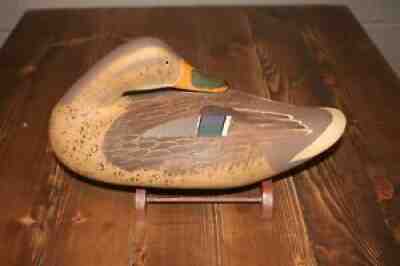
Sold on eBay Feb 13, 2022
Rare Clarence "Titbird" Bauer Mallard Resting Hen Decoy Havre de Grace Mitchell
Born in Havre de Grace, Maryland November 4th, 1924, he spent much of his childhood in and around the marshes of the Susquehanna River. That is where his interest in waterfowl began. Titbird worked for the late Madison Mitchell for over thirty two years and is well known for the miniatures he carved but he also carved a lesser amount of full size working decoys.
Sold on eBay December 10th, 2023
MINT SCARCE & SUPERB 100% ORIG c1950 MADISON MITCHELL Wood Duck Decoy CHESAPEAKE
eBay MINT, NEVER USED & SUPERB 100% ORIGINAL MADISON MITCHELL c1950 DRAKE PINTAIL GUNNING DECOY ~AWESOME SOLID CEDAR DECOY, GREAT CARVING, FORM & PAINT ~ORIG RIGGING: LEAD BALLAST WEIGHT, RING & STAPLE LINE-TIE ~HEN RIG-MATE to this DRAKE ALSO on Ebay; BOTH HAVE SAME SIZE, STYLE, FORM, CARVING, PAINT & WERE MADE THE EXACT SAME TIME & ARE FROM the SAME COLLECTION ~THIS DRAKE SHOWS INCREDIBLY & HAS NO RUBS or WEAR EXCEPT WEIGHT & LINE-TIE, NO SHOT MARKS, KNOTS, CHIPS, DENTS, CHECKS, CRACKS & PERFECTLY INTACT HEAD & NECK NAILS ~BOTH BABIED in COLLECTION SINCE THEY WERE MADE ~AWESOME AGED PATINA & HEADS & ALL RIGGING is AS TIGHT AS THE DAY BOTH DECOYS WERE MADE ~SUPERB STIPPLED, DAUBED & SWIRLED FEATHER PAINT TO BACK & WINGS & CLEAN & CONCISE TO THE BREAST, TAIL, HEAD & SPECULUMS ~BIG TYPICAL 2-LB 10-OZ PAIR of MATED DECOYS ~SUPERB MINTY CONDITION THAT ARE 3-QUARTERS of a CENTURY OLD & WOULD BE AN AWESOME PAIR TO ADD TO ANY SUPERB DECOY COLLECTION as the HEN MATE to this DRAKE is ALSO on EBAY!! MINT SCARCE & SUPERB 100% ORIG c1950 MADISON MITCHELL Wood Duck Decoy CHESAPEAKE MINT SCARCE & SUPERB 100% ORIG c1950 MADISON MITCHELL Wood Duck Decoy CHESAPEAKE Click images to enlarge Description AMERICAN CARVING LEGEND..... R. MADISON MITCHELL Birth Name: Robert Madison Mitchell (born): March 11, 1901 (died): Jan. 14, 1993 (Age 91) of Havre de Grace, Maryland (picture below): HAVRE DE GRACE & The UPPER BAY! This is WHERE MITCHELL SPENT PRACTICALLY His ENTIRE LIFE MAKING DECOYS, HUNTING, BURYING FRIENDS, STRANGERS & LOVED ONES ALIKE ........ EVENTUALLY BECOMING ONE of the MOST BELOVED FAMILY MEN and ENDEARING INDIVIDUALS to GRACE SUCH a BEAUTIFUL and HARD WORKING COMMUNITY! (picture below): HISTORIC c1980 PHOTO of MADISON MITCHELL with Many of The Men That Helped Him Over the Years, Pictured along with a Contemporary, Paul Gibson! (left to right): Harry Jobes, Paul Gibson, "MADISON MITCHELL", Clarence Bauer and Jim Pierce. _________________________________________ (Below Photos): This Mint, Scarce & Never Gunned Over, 73+ Year-Old, Outstanding c1950 Madison Mitchell, Drake Pintail Decoy Up for Auction!! Incredible Condition without a Knot, Rub, Chip, Check, Crack, Paint Smudge, Fingerprint or Shot Mark on this Solid Cedar Drake Pintail or Even the Very Rare Mint Hen Decoy! Typical Thick Tail and Bill is Carved & Sanded Blunt on the End for a Clean, Surface & Shape ....... The Entire Body was Lathe Made with an Outstanding, Undulating Form & Style ...... that Starts with a Beautifully Rounded Breast, then a Wide & Yet Thick Body that Culminates in a Beautiful, Slightly Upswept Tail!! ___________________________________________ (Below Photos): SUPERB FINELY BRUSHED ON BACK FEATHERING, SPECULUMS & WING PRIMARY FEATHERS! ________ (Below Photos): The Bottom of this Drake Pintail has a Perfect Bottom with No Defects and Perfectly Tight & Intact Line-Tie & Ballast Weight!! The Perfect Bottom on this Decoy has No Checks or Defects of Any Kind & Like the Back is still Snow White ...... Wonderfully Free of Any Knots, Chips, Dents, paint Smudges, Rubs, Fingerprints, Checks or Cracks on the Entire Decoy, Let Only those Often Seen where Rigging was Nailed On ...... Some Very Typical Incidental Paint Loss to Line-Tie & Weight From Sitting on a Shelf; And Still Outstanding!! Mitchell Used 1 Nail on Each End of the Lead Ballast Weight Until Around 1950, When He Started Using 2, Which Helps Identify this Decoy to c1950, Along with Some Small Nuances Like the Neck Shelf, etc. ________ (Below Photos): The HEAD of this MAJESTIC, ELEGANT & STUNNING "SCARCE" DRAKE PINTAIL DECOY from SEVERAL ANGLES ...... With PERFECTLY CARVED in HEAD/BILL SEPARATION & PAINTED-EYES ........... and ALL BUT 2 NAILS to ATTACH the HEAD to the BODY are PERFECTLY HIDDEN as if this DECOY was JUST MADE YESTERDAY ........ and TWO are "HARD-TO-SEE", ONLY VERY SLIGHTLY PUSH-UPS to the LEAD FILLER which is INCREDIBLE!! INCREDIBLE MINT PAINT to the ENTIRE DECOY & YOU CAN SEE EVERY BRUSH MARK ............ with VERY NEAT WHITE STREAKS up the SIDES of the HEAD & DAUBED-GRAY on the BACK of the HEAD ........... and PERFECT LOCATED YELLOW & BLACK PAINTED EYES!!! The "DRAKE PINTAIL" HEAD & NECK FLOW SO PERFECTLY into the BREAST that if IT WEREN'T for the CRISP SIDES it WOULD BE HARD-TO-SEE!! .......... it's JUST a GORGEOUSLY PAINTED & CARVED "ALERT" HEAD that is POSED with a NEAT 20-DEGREE TURN to the DECOYS LEFT!! ? ________ (Below Photos): This NEAR MINT, SCARCE & NEVER-HUNTED OVER, DRAKE PINTAIL ....... Shown with the RARER & Just as AWESOME 100% ORIGINAL CONDITION HEN RIG-MATE Also on EBAY!! LIKE MOST CARVERS & ALL FACTORIES: Since Males by Nature are All Much More Vibrantly Colored, Drakes were Made in Much Greater Numbers Since they Were Much More Visible to Wild Ducks ....... which Makes the Hen also on ebay Rarer than this Drake!! LOOK HOW SPECTACULAR they LOOK TOGETHER & COMPLEMENT EACH OTHER!! ? This Superb Pair Have Been Together Ever Since they Entered Their Collection in Saginaw, Michigan -and- Have Been in the Same Hands and Collection Ever Since!! ________ ________ This STUNNING, R. MADISON MITCHELL, DRAKE PINTAIL DECOY up for Auction: AWESOME 100% ORIGINAL, "SCARCE"; MINT CONDITION, "NEVER HUNTED OVER"; c1950 R. MADISON MITCHELL; ABSOLUTELY INCREDIBLE PATINA & PAINT; 73+ YEAR-OLD DRAKE PINTAIL; WOOD DUCK DECOY; HAVRE de GRACE, MARYLAND; SUSQUEHANNA FLATS (UPPER CHESAPEAKE BAY) This DRAKE GUNNING DECOY was CARVED LIFE-SIZED!! (This Size of His Decoys are His Most Sought After Work!!) ? OUTSTANDING ORIGINAL PAINT & CARVING on this VINTAGE GUNNING DECOY with AN INCREDIBLE, PERFECT PATINA!! EXCELLENT FORM on ONE of HIS VINTAGE & SCARCE DRAKE PINTAIL GUNNING DECOYS as this DECOY WAS MADE WHEN WOODEN DECOYS WERE STILL BEING VERY WIDELY USED FOR HUNTING ........ BUT this DECOY FOUND its WAY into a COLLECTION INSTEAD of the MIDDLE of a LARGE, OPEN-WATER BAY!! ? AWESOME STIPPLED, DAUBED, SWIRLED & STRAIGHT-LINE, BRUSH-STROKE MITCHELL PAINT -and- NICE, ALERT, HEAD & NECK that are POSED TURNING 20 DEGREES to the DECOY'S LEFT!! Vintage Hunting Decoy & His Very Best, Working Bird Style with his Nice, Long, Yet Wide at the Water Level, Body Style and Form!! ORIGINAL RIGGING is PERFECT -with- 100% ORIG. RIGGING: NAILED-ON LEAD BALLAST WEIGHT -and- COMMERCIAL STAPLE & RING, LINE-TIE!! ? ? This MINT, NEVER HUNTED OVER, DRAKE & the HEN also on Ebay LOOK & SHOW as a GREAT PAIR & HAVE an INCREDIBLE & VERY APPEALING, VERY DRY, AGED PATINA! There is OBVIOUSLY NO GUNNING WEAR & NO SHOT MARKS, KNOTS of ANY KIND; NO RUBS, NO CHECKS or CRACKS, and the ONLY RUBBING is to WEIGHT & LINE TIE!! ALTHOUGH VERY PROLIFIC, Gorgeous PINTAILS Like this PAIR are Always a HARD FIND!! ? ? __________________________________________ This is a Perfectly Symmetrically Carved & Painted Vintage & Scarce Madison Mitchell Drake Pintail Decoy! The ONLY TIME that this Decoy "EVER SAW WATER" was Was in Mitchell's Shop When Mitchell's Shop "TUNED IT" By Adjusting Where the Ballast was Nailed on so It Swam with Perfection in a Hunting Rig!!! ______ This Superb Drake Pintail and the Hen Mate also on ebay Were Made Together, and Both Measure: This DRAKE & the HEN BOTH MEASURE: 5-3/4" WIDE x 7-3/4" TALL Drake is: 18-1/2 long -and- Hen is: 16-1/4" long Both Drake & Hen Weigh a Hefty: 2-lb. 10-oz. each THAT is FANTASTIC & Makes for a PERFECT PAIR of RIG & CARVING MATES that WERE MADE at the EXACT SAME TIME!! That Makes for an Awesome pair of Very Unique Gunning Decoys that are From the Same Famous Carver & Made at the Exact Same Time!! That Makes for a Superb pair that Have Been Together in the Protection of the Same Climate & Light Controlled Collection after they Left Madison Mitchell's Shop!! ? BOTH of these DECOYS HAVE IDENTICAL WEIGHT, STYLE, FORM, CARVING, PAINT PATTERNS & BOTH MADE AT THE SAME TIME ........ ONLY DIFFERENCE is the DRAKE'S "SPECIES PERFECT" LONGER TAIL!! BOTH DECOYS are also FROM the SAME COLLECTION & OWNER! This DRAKE & the HEN ALSO on Ebay LOOK & SHOW as a GREAT PAIR TOGETHER & BOTH are FROM the SAME COLLECTOR & PURCHASER!! BOTH also have an OUTSTANDING PATINA FROM AGE & VERY CAREFUL HANDLING, OBVIOUSLY "NEVER" HUNTED OVER & VERY WELL TAKEN CARE OF WHILE in their COLLECTION!! Awesome Blended Black Eye & Gray Daubed Back of Head, Speculums, Primary & Secondary Wing Feathers ........... Along with Clean and Crisp Breast, Tail, Bill & Eye Paint that all Perfectly Flow Together to Create a Realistic Pintail Decoy! STRUCTURALLY PERFECT HEAD & NECK with ALL 5 NAILS PERFECTLY INTACT and TIGHT AS IF MADE YESTERDAY WITHOUT a SINGLE & TYPICAL NECK CHECK that YOU QUITE TYPICALLY FIND on HIS DECOYS as they are INHERENT to the CONSTRUCTION METHOD!!! ? ? To Find Perfect Pairs, Carved For the Same Rig But Unused is Always Nice When Finding & Buying Pairs of Decoys! The HEN MATE to this DRAKE is ALSO on EBAY if YOU ARE LOOKING FOR A NICE MITCHELL PINTAIL PAIR; They Were UNDOUBTEDLY CARVED OBVIOUSLY AT THE SAME TIME!! (Truly a Great pair to Own) ______________ (Below Photos): OTHER MITCHELL PINTAILS including SOLID CEDAR PINTAILS as WELL as a RARE PAIR of CORK BODIED DECOYS: __________________________ This SENSATIONAL & SCARCE, R. MADISON MITCHELL DRAKE PINTAIL up for auction: This AWESOME 100% ORIGINAL CONDITION DRAKE PINTAIL c1950 MADISON MITCHELL 73+ YEAR-OLD GUNNING DECOY with SUPERB 100% ORIG PAINT, CARVING, STYLE, PATINA & FORM!! ? ____________________________________________ (below photos): SOME OTHER OLDER MADISON MITCHELL DECOYS, ALTHOUGH FROM A VERY, OLD & VERY DATED, 45-YEAR OLD BOOK written in 1979! (For Reference Only, Very Old Values) ______________ (Below Photo): AWESOME PHOTO OF MR. MITCHELL with a DISPLAY of MANY of HIS GREAT DECOYS of DIFFERENT SPECIES!! AFTER 1960 HE WAS KNOWN TO HAVE CARVED AT LEAST A PAIR OR MORE OF EVERY SPECIES OF DUCK THAT WAS KNOWN TO USE THE ATLANTIC FLYWAY!! ________ AGAIN .......... This SENSATIONAL MADISON MITCHELL DRAKE PINTAIL up for auction: VINTAGE, SCARCE; c195O R. Madison Mitchell; "DRAKE PINTAIL"; WOOD DECOY;? ? Very Nice, Very Old Dry Paint with a Beautiful, Clean and Crisp Patina!! ? AWESOME LATHE TURNED DECOYS that WERE THEN FINISHED with KNIVES, HAND TOOLS & SANDPAPER and MADE with PERFECTION!! These Awesome Decoys were Made to Swim & Perform with Perfect Realism in Whatever Waters the Upper Bay Kicked Up!!! Plus ........ Their Large Size Made them Visible from Huge Distances, and Their Immense Weight Kept them Riding Perfect on the Water Like a Real Pintail ......... and So Well Weighted they Were Hard to Flip & Righted Themselves Immediately Even in the Roughest of Water!! HEAD & NECK are PERFECTLY TIGHT LIKE MADE YESTERDAY and IF NOT for the SHADOWS WHERE 2 NAILS WERE USED to ATTACH the HEAD ........... YOU'D NEVER KNOW WHERE they WERE LOCATED on TOP of the HEAD as the OTHER 3 NAIL'S LOCATIONS are INVISIBLE!!!! ? ? Awesome Vintage, 73+ Year Old, Hunting Decoy Form and With His Incredible Working Bird Style!! GREAT THICK, 100% ORIGINAL PAINT on this AWESOME, OLD GUNNING DECOY with GREAT PATINA!! ? SUPERB FORM & TRULY ONE OF HIS NICER, DRAKE PINTAIL DECOYS with a GREAT TURNED HEAD!! ? All ORIGINAL & You Could HUNT OVER This 73+ YEAR OLD DECOY TODAY and LOSE NO PERFORMANCE from the DAY THAT IT WAS MADE SINCE it is BASICALLY NEW & UNUSED!! This is a Perfectly Symmetrically Carved & Painted Vintage Madison Mitchell Drake Pintail! (see photos) ~18 Pictures from almost Every Direction) DON'T MISS OUT on this Truly Great Upper Chesapeake Bay Pintail without Even a Single Knot as the White Cedar Stock Used was Perfect!!? Awesome Vigilant Head Flows Perfectly into the Carved-in Flat Neck Seat with No Loss of Flow!! The Awesomely Carved Bills on these Outstanding Pintails have Crisply Carved Bill/Head Separation ........ and the Bodies Were Made with Perfectly Rounded Breasts that Begin with an Undulating Form that Rises and Widens Near the Rear and Tapers Down and Up at the Tail! ? The Dimensions & Weight are Perfect & Typical for Solid-Bodied, Solid-Cedar, Madison Mitchell Pintails!! This Drake Pintail & the Hen Mate also on ebay Clearly Show That They Came from the Climate Controlled, Direct Light-Free Collection That They Have Been Kept in Over the Many Decades and Well Over a 3/4's of a Century That They Were Being Carefully Cared For In!! ? If You Like Important Decoys from the one of the Most Famous Decoy Carvers Ever, that Are in Outstanding, 100% Original, Never Gunned-Over Condition .......THIS IS A GREAT DECOY FOR "ANY" COLLECTION!! _________________________________________ IN THE NEXT FEW WEEKS I AM PUTTING ON EBAY MORE LAWRENCE BETHEL FISH DECOYS, A PAIR OF THE ONLY KNOWN PROTOTYPES MADE OF THE VERY FIRST PRE-PRODUCTION FIBRE DECOYS EVER MADE, A NEAR MINT 1927 HEDDON GIANT VAMPIRE FISHING LURE IN RARE SHAD, A PAIR of LATE PHASE DODGE MALLARDS, A PAOR of MINT 1960 MADISON MITCHELL PINTAILS, A VERY RARE VICTORS DRAKE BUFFLEHEAD, A RALPH MALPAGE PAIR OF WOOD DUCKS, A VERY RARE c1893 100% ORIGINAL TRANSITION PERIOD MASON DRAKE BUFFLEHEAD, AN ORIGINAL PAINT SUPERB J. R. WELLS HEN BLUEBILL, A MINT c1905 HEDDON ARTISTIC MINNOW, A SCARCE RALPH MALPAGEPAIR OF GREEN-WINGED TEAL, A YELLOW WITH RED EYE BLUSH MOONLIGHT SINGLE-HOOK PIKAROON, A NIB CREEK CHUB MULLET COLOR STRIPER PIKIE IN CORRECT BOX, A PAIR of EXCELLENT MASON MALLARDS, NICE PAIRS OF MASON GLASS EYE & TACK EYE BLUEBILLS, AN AWESOME ERNIE NEUMANN SUCKER FISH DECOY, A RARE & EARLY 100% ORIGINAL 1930 WILLIAM LOHRMAN ILLINOIS RIVER CANVASBACK, A VERY NICE ERNIE NEUMANN SUCKER, A RARE 12-1/2" CHET SAWYER MINNESOTA FISH DECOY, A NEAR MINT OSCAR PETERSON PERCH FISH DECOY, A MINT PAIR OF WRAGG & BURRELL WIGEON, AN OUTRAGEOUSLY HARD TO FIND PAIR OF CHARLIE POZZINI BLUEBILLS, AN AMAZING JOHN HOLLOWAY SLEEPING TURNED HEAD DRAKE PINTAIL, A VERY BIG & BULL-NECKED EARLY FERDINAND BACH DRAKE CANVASBACK FROM HIS PERSONAL RIG AND MORE!! ? Shipping Includes Insurance! I Don't Believe in Making a Profit on Shipping, You Pay What I Pay. If it's Less Than You Paid I Refund the Difference, If More I'll Pay For It. I COMBINE SHIPPING. I am also loading over 150 Duck Decoys, 150 Fish Decoys, 70 Scarce Fishing Lures, etc. so keep checking back. __ FINALLY .......... ALL ABOUT this STUNNING MADISON MITCHELL DRAKE PINTAIL up for auction: ITEM DESCRIPTION: This 73+ Year-Old, Scarce and Amazing Drake Pintail was Carved and Painted by R. Madison Mitchell (1901-1993) of Havre de Grace, Maryland. Havre de Grace is a city in Harford County, situated at the mouth of the Susquehanna River and the head of Chesapeake Bay. It is named after the port city of Le Havre, France, which in full was once Le Havre de Grâce (French, "Haven of Grace"). During the Revolutionary War, the small hamlet known as Harmer's Town was visited several times by General Lafayette, considered a hero of the war. He commented that the area reminded him of the French seaport of Le Havre, which as mentioned previously had originally been named Le Havre de Gr ce Inspired by Lafayette's comments, the residents incorporated the town as Havre de Grace in 1785. (photo below): MR. MITCHELL APPLYING SOME EARLY PAINT DETAILS TO WHAT LOOKS TO BE A CORK DRAKE WOOD DUCK! Madison Mitchell began making decoys in 1924 when he was hired to help Sam Barnes finish out his orders for that year. He had made decoys ever since, in addition to his occupation as an undertaker. His decoys were completely hand chopped until 1931 when he had a duplicating lathe built and began turning his own bodies. A great amount of work still had to be done as the lathe, much like a band saw, simply brings the block of wood to its basic shape. It would take ten pages to describe the life and accomplishments of Mr. Mitchell, but a great reference that can give you all of the interesting details of his life and his transition from undertaker to decoy maker, is all in an article on the "International Wildfowl Carvers Association" website which has a reprinted 2007 article from Decoy Magazine written by the fascinating and knowledgeable Mr. Jim Trimble. A copy of that article follows this description and gives you a good idea of the tremendous working knowledge of the decoys from the area that Mr. Trimble has always exhibited and the importance of Decoy Magazine's contributions to collectors world-wide. (photo below): MR. MITCHELL PUTTING THE FINAL TOUCHES ON ONE OF HIS VERY HEAVY AND VERY EFFECTIVE CANADA GOOSE DECOYS!! This classic and outstanding, middle-period R. Madison Mitchell Drake Pintail up for auction is in mint and never saw water except for in his shop when they floated it to correctly locate the lead ballast weight and after it left his shop it went straight into a very discriminating Saginaw, Michigan decoy collection. After Mitchell's fame began to grow, and like this Drake Pintail and the Hen Mate also on ebay, many of Mitchell's fine and effective gunning birds were bought from or ordered from Madison Mitchell and then found their way straight into a collection. But before that and before the advent of inexpensive plastic decoys, these solid cedar decoys set the standard for what an effective and trustworthy decoy was, although many people, like the man that bought these Pintails from Mitchell, had the foresight to realize their beauty and ever increasing value and they were put straight into his collection. Madison Mitchell's decoys were so incredibly well made that some may have been lightly gunned over and just very well cared for while in use and during the off season, and went straight into collections and hardly show that they ever saw water. But when its all said and done, either gunned over or not, his decoys have always been cherished and eventually found their way onto a collector's shelf or shelves and very well taken care of whether unused or used and saw the same tender glove treatment in their retirement's "golden years". All or at least almost all of Mitchell's early or middle period decoys were much sought after by gunners to use in their rigs to lure in the wariest of wild ducks. Later, when considering Madison Mitchell's production of decoys, some went straight into a collection or took a roundabout way of getting into one by enticing a ducks within gunning range first, but either way and like this "never-used" pair up for auction, they all have been enjoyed and handled with care since they left Mr. Mitchell's shop and many lucky examples like these up for auction were never hunted over. Notwithstanding and from a geographical standpoint, with the fame and growing demand for Madison Mitchell decoys, a great many of his birds have found new homes not only in the U.S.A., but also in countries around the globe as they are very sought after and always will be and will continue to increase in value and always be in demand. I personally have sent pairs of decoys to buyer as far away as Australia and as close as a to man living one block over from me that I had never met before. Some of Madison Mitchell's decoys made their way into Michigan collections or were sent to friends there as Mitchell did spend part of his life in the mid-Michigan area of Michigan's lower peninsula, the Great Lakes State. He relocated to Pontiac, Michigan in 1918, and originally found work at a General Motors factory there so he could make a living getting work at an auto plant. But General Motors also had a great network of auto plants just to the north in Flint and Saginaw. Which of the plants he worked at other than the Pontiac plant is not documented, but he certainly lived in a hotbed of waterfowl hunting while in Michigan as he had Lake St. Clair to the east, Saginaw Bay to the north, and thousands of lakes, ponds, rivers and wetlands sprinkled in the surrounding area. He most likely brought some decoys along or sent them to Michigan acquaintances at a later date as many of his decoys made their way into some early mid Michigan collections. He also duck hunted in Michigan, mostly on Saginaw Bay, while he was in Michigan and he most certainly brought some decoys along or sent them to Michigan at a later date as many of his decoys made their way into some early Saginaw Bay area collections and many of those remain in Michigan collections in the Saginaw area, Flint area, Pontiac area, Detroit area or places in between those major southern peninsula of Michigan cities. Almost every city around where he spent time in Michigan had several auto plants ranging from stamping plants, transmission and gear plants, engine plants to final auto assembly plants and many also provided parts to Packard, GM, Ford, Studebaker, Chrysler and more. Around 2 years later, in 1920, Madison Mitchell returned to Maryland, but his decoys had already amazed and intrigued enough southeastern Michigan gunners that he did have a clientele there, but only a trickle of water in a lake compared to the demand that was awaiting him on the east coast and especially in and around the Chesapeake Bay region. Madison Mitchell's earliest output of decoys consisted of Canada Geese, Canvasbacks, Redheads and Bluebills and to a lesser degree and in a limited number pintails mallards, black ducks and a scarce baldpate or two. After 1960 Madison Mitchell carved almost every species that was known to Fly the Atlantic Flyway. (photo below): HISTORIC 1983 PHOTO of MADISON MITCHELL with One of Best Friends, the Late CHARLIE JOINER on the LEFT and the Late and also GREAT LEM WARD in FRONT ....... This was the Last Time they Were together Before Lem Ward Passed Away in 1984. (Picture taken at the Ward Brothers Work Shop) The form and detail of this Drake Pintail up for auction is pure Madison Mitchell with a perfect upswept tail, magnificently contoured body and wonderfully flowing neck, head and bill. This middle period hunting decoy has great lines and all of the character of his greatest gunning blocks. This extraordinary decoy was never used and was also very, very well taken care of over the last 73+ years, while in a fine collection of great decoys. But I am absolutely sure that if this decoy was used today, this awesome decoy would perform as well as if it was made yesterday, and as well as Mr. Mitchell's decoys were made and crafted, it would swim with the reality of a real bird on the water; even to this very day you could gun over this Drake and the Hen also on ebay!! But like all of Mitchell's work it was so well made it is in excellent 100% original structural and aesthetic condition. It retains all of the thick and perfectly applied original coat of paint with the only rub spots to the typical places, a few on the weight and line-tie, on which the decoy rested on when being set down on a shelf and not on a display stand. And per the normal, the overall condition of this decoy is outstanding and it is 100% Original on the entire decoy. The Head and Neck are Perfect and as tight as the day this decoy was made and all 3 of the nails used to attach the head to the body are perfectly hidden and in mint condition which is a huge plus. The other 2 nails have pushed up their white lead filler and paint just ever so slightly and it is hard to see them unless you are looking for them. All 5 Nails are also as tight as the day that he hammered them in and the neck is as tight to the body as if he made it yesterday and the seam is mint!!! On older decoys it is actually the exception to the norm to find upper bay decoys and Mitchell's as well, with no putty or nail pops from the stress of picking decoys up by the neck. On this Drake Pintail and the Hen Mate also on ebay the nails are so perfectly intact that if not for slight shadows on this drake you can't tell where they are and the neck has absolutely no checks, cracks of any kind which is typical of these decoys from the stress that of being picked up by the head eventually leads to. The Rare and Outstanding Hen Mate is Absolutely Mint as all 5 Nails are so perfectly intact that you can't tell where a single one is other than to just guess based on where you know where they should be. To further describe the great structural condition of this decoy is the awesome condition of the head of this Drake as it has a perfect form and shape which give it the statuesque form it has. Like most of Mitchell's decoys and many of the other carver's from the area, these decoy's heads were attached with 5 nails; 3 long finishing nails through the top of the head and 2 through the lower front of the base of the neck and into the body to give added strength to keep the head from ever swiveling (even though the 3 through the top of the head would, for the most part, would have kept this from occurring). As a result of this way of attaching the head to the body, the only natural construction defect you'll usually see on his and the decoys of other carvers that attached heads in this manner, is from the 3 nails through the top of the head, or possibly the 2 in the neck. It isn't unusual for one or more of these nails from popping up and pushing up the putty or even popping the putty out completely and possibly even a nail or two slightly pushing upward and out as a result of neck handling and/or even as the wood dried after being made or especially on birds that were gunned over as from typical gunning they would get wet, then dry, then repeating this over and over again would cause swelling and then shrinkage which caused checks, cracks, nail pops, etc. This in turn could and would often stress the neck out enough to cause a small tight check or crack in the neck that could be just on one side or all of the way through. Hence, when this occurs you might find some with some play in that area or a very minimal surface check and a head and neck as tight as the day it was made with no play whatsoever. This Drake Pintail and the Hen also on ebay both have pristine heads and necks with absolutely no neck checking or damage, and both decoys' heads and necks' remain as tight as if these decoys just left Mitchell's shop, and neither even have any surface checks at the base of the neck where the head attaches to the body and the seams are mint with perfect paint to boot. While this pair of Pintails have perfect heads and necks, even those with some typical loss of filler or putty or neck checking if anything simply adds to the aura of his decoys. Even though this pair of Pintails are perfect, sometimes checking on a Mitchell decoy was not caused by gunning or rough handling, but rather from their age as the putty or wood fully cured or years later as they aged in collections that were not temperature controlled. This is strictly cosmetic, not unusual and something most collectors consider typical, natural and even something that adds to the aura of these close to a-century-old, big and heavy, solid cedar gunning decoys. Picking any duck or goose decoy by the head is certainly very ill-advised for both older or newer, used or unused decoys in any collection. Most hunters from any area or region tried to retrieve their decoys from the water after a long day of hunting by grabbing the body and not the head when possible, so as to never stress the head or neck by handling them in that manner. But after a very long day of gunning and the additional water weight a wooden gunning may take on during a long day and season, its easy to imagine a fatigued hunter grabbing decoys by the neck and/or head and quickly getting them into the boat. This is especially true when hundreds needed to be retrieved and nasty weather is blowing the boat and waves around while you're trying to just pick em' up; as the boat or decoys keep floating away from the retrieving gunner and oarsman as the hunters are just trying to get on their way home before it gets pitch black dark. Finally, when the decoy makers, and exactly like Madison Mitchell, attached the heads to the body with the large spike finishing nails, they used a nail punch to drive the nails into a recessed hole, then filled the hole with white lead filler or putty, sanded it smooth and then painted the decoy. While the vast majority of never used or lightly gunned over decoys never show a nail pop where the nail pushed up and either just raised the white lead up a bit or kicked it out entirely, those that are more heavily used quite often will show some raised white lead, even an entire nail pop or even an exposed nail sticking up out of the pre-drilled hole. But this pair of decoys up for auction never saw any action so their necks are perfect. The superbly inserted head and neck nails are so perfectly intact on both decoys you can only tell where some are, and even if you look very closely trying you can only surmise where almost all of the nails are probably at. This is awesome and part of the reason that both decoy's heads are as tight and intact as if they just left Mitchell's shop the day before. They were made for punishment and almost never failed the challenge of the most brutal conditions expected of a rugged, well made, historic gunning decoy. (photo below): A GREAT OLD REDHEAD with a TIGHT, INTACT ORIGINAL BREAST PLUG and INTACT HEAD/NECK NAILS even CONSIDERING the HEAVY ACTION IT SAW! I REALLY ADMIRE these OLD WARRIORS!! And Even these Warriors Could Still have Been Gunned Over But were Eventually Retired when the Hunter Decided to Order a New Rig, Whether if it was Out of Necessity or Just to Gun Over New Blocks!! (photo below): In LATER YEARS, When MITCHELL was Either at His SHOP, or ATTENDING A DECOY SHOW, He Was MORE than HAPPY to IDENTIFY His Decoys with His TRADEMARK SIGNING & DATING ...... and as You CAN SEE on the BLUEBILL PICTURED Above & Below He Used his "ELECTRIC ETCHING TOOL" and CUSTOMIZED ENGRAVED SIGNATURE and DATE on this Particular Decoy, WHICH was "1948". This Drake Pintail and the Hen Mate up for auction not only show the quality of Mitchell's craftsmanship, but also the care the owner and original buyer gave this pair of decoys in what was an indoor, temperature controlled environment all of his decoys were prominently displayed in. The absence of fading to the paint also gives a good idea that this decoy was well cared for and that the collection it and the Hen Mate were in was relatively, if not totally free, of direct sunlight on the items in his collection and these Pintails were proud members of it. This decoy is in just wonderful condition, the head and all rigging are as tightly attached as the day this decoy was made. You just don't often find a Mitchell decoy with a Traceable History and a Nicer, Somewhat Older Mitchell Hunting Pintail, which isn't considered an uncommon species, especially back in the day when this species of bird was working its magic, but it is an uncommon Species for him all the Same, and an important species to have in a collection of his and all of the Susquehanna Flats carvers as well. While the seasoned collector has a variety of form, construction and paint clues that help identify a Madison Mitchell decoy, it's always nice to come across ones that are signed and/or dated, or even personalized as it adds a nice human touch if authentic. This particular Drake Pintail and the Hen also on ebay have no such Mitchell markings, so obviously it was no surprise when the late owner's son told me that his father never had the opportunity to go back East and meet Mr. Mitchell so he never had the chance to ask Mitchell to sign them, but that is the norm rather than the exception as he was a very prolific carver. Some of his decoys were even personalized a tad more with his spelled out "Havre de Grace MD" and a "Date" along with his "Signature". Many of his decoys are also signed in Ink Pen or Marker and a great many of his decoys are signed with his "electro-pen" and etched in, which was many homeowner's tool of choice in the 1950's and 1970's when people engraved their TV sets and other valuables with the hope that if they were ever stolen they might have them identified and returned. But his signature does not automatically date the decoy unless he also added the date, and in many cases this is was his, or later in life one of his friends, best guess-timate. While Mr. Mitchell was in his shop and making a sale, I am sure he would have been more than happy to engrave his signature, date, etc. And since he was very approachable, I suspect he would bring his etching pen to shows or events he attended and if an electrical outlet was close he'd be more than happy to customize anyone's decoy or decoys on the bottom. The older the decoy is, the less the odds you will find an electro-pen signature, but I have seen a couple very old birds that people must have brought to his shop, home or an event of some kind even though they had been made and gunned over many decades before he was asked to sign them. He even dated many decoys based on something he either remembered for whatever reason or made a pretty good guess based on the form, the style or quirk of one of his apprentices, the style and/or paint etc. He was so accommodating that if he didn't have his engraver with him, he was more than willing to sign with a marker, pen or whatever else was available. Madison Mitchell didn't routinely just identify or sign many, let alone all of the decoys that left his shop to be gunned over, as the new owner might have wanted only his or her own rig brand or name on the bottom or simply not signed for whatever reason. This is even more true the older the decoy is, as the further you go back in time the less the chance a decoy was signed as not to conflict with a rig mark, and also due to the fact that the older you get the less decoys were even being collected, let alone identified by some sort of signature unless it was related to identifying the owner and rig it came from in the hopes that it was returned to him or her if it floated away from a rig or the like. But from most of the stories I have been told, seen first hand, or read about, the return rate was never very good in most regions where there was concentrated gunning in the United States. In some areas, due to competition in areas where great hunting spots were limited, theft was the bigger threat unfortunately. Notwithstanding the Delaware River, Clinton River feeding Lake St. Clair and a plethora of other great, but concentrated gunning places from an area standpoint, saw many decoys thefts of which on occasion were entire rigs being stolen right out of moored sneak or other duck hunting specific boats. (photo below): NEAT Photo of MADISON MITCHELL in the MIDDLE ....... The Other TWO MEN in the PHOTO are of BILL COLLINS and his FATHER. BILL COLLINS, (One of Mitchell's Many Apprentices over the Years), was ALSO the MAN that BOUGHT MITCHELL'S SHOP IN 1980. ? This Drake Pintail up for auction was made by the great R. Madison Mitchell and has no markings, but with signatures or markings, or even without them, Mitchell's decoys are distinguishable from other carver's birds that were made to imitate or at least come close to what the many attributes that makes a Mitchell decoy a Mitchell. Even with the plethora of apprentices and helpers that helped him keep his shop running at lean times and pushing the capacity of his shop to the limit when orders were pouring in, Mitchell still had his patterns etched in his mind and those of his shop-mates and very rarely did anything or anyone deter him and his shop from turning out a true Madison Mitchell decoy with the standard look, paint, appeal, style, bill, head, tail, dimensions, rigging and appearance of any given time period during his many decades-long career. However, like the old saying goes, "If it ain't broke don't fix it", which lead to a form and style that didn't change much over the many years that he toiled at his trade. Much like even the great Mason decoy company, there were many cooks in the kitchen, but the quality and consistency of appearance was never compromised from decoy to decoy and shop worker to shop worker during a given time period ....... Madison Mitchell, himself included, and overseeing this consistency was the case. This decoy up for auction was made even with all of the aforementioned safeguards strictly and appreciatively in place. (photo below): VERY COOL PHOTO of MITCHELL in his WORK SHOP PAINTING a CANVASBACK and TALKING UP JIM PIERCE, CHARLIE JOINER and CHARLIE BRYAN!! There are absolutely no structural imperfections on this vintage Pintail decoy up for auction as a choice piece of cedar was used to construct this block. Like I previously noted, the only paint loss is from negligible rubbing to the lead ballast weight and line tie. A great attribute of this decoy is that the paint on this decoy is still bright and vivid considering its age; but you could still gun over this bull-necked cpintail today and it would perform like it came right from Mitchell's workshop and would work like a champ to draw wary birds within gunning range. And the conditions that these heavy, perfectly swimming decoys were subjected to wouldn't be a factor in whatever rough water you hunted over unless you ran into a torrent of white-caps which might get them to rolling quite a bit, but not too much unlike what a real duck looks like in messy, nasty, windy weather. But obviously you wouldn't hunt this "piece of history, antique" decoy or do anything like that with a somewhat older Mitchell decoy that has deserved its place in any collection of honest gunning decoys. Mitchell's Decoys first saw water in Mitchell's shop when he floated them to find the sweet spot to properly locate the lead ballast weight (referred to as "tuning" a decoy) in order to get the decoy to swim perfectly, sit evenly and flat on the surface and right itself immediately. This decoy has an excellent 73+ year-old patina and the original brush strokes from the thickly applied original coat of paint look extraordinary. The original yellow painted eyes with fine black pupils are still bright and jump off this Drake Pintail's dark brown head with black, eye background stripe head paint that makes it a life-like version of this fairly uncommon species of Mitchell decoy, even though he made mostly Canvasbacks, which were unlawful to to be hunted for much of the 1970's, 1980's and 1990's in the United States. This decoy is in 100% original condition and this superb R. Madison Mitchell Drake Pintail and the Hen Mate that is also on ebay both measure: 7-3/4" tall x 5-3/4" wide and weigh 2-lb. 10-oz. each of solid Eastern white cedar, which makes for a perfect Mitchell Pintail decoy. The Drake Pintail is 18-1/2" long and the Hen Rig & Carving Mate is 16-1/4" long; which is species correct as Males are longer than females because of the tail length. This is also perfect for a pair of Decoys that look, show, were from the same collector and rig-mates made at the exact same time. Even the patina is exactly the same, as is light rubbing on the weights and line ties. This is a large, high-profiled gunning bird and as far as a Pintail decoy is concerned, this decoy would certainly qualify as life-sized or even slightly bigger than an adult bird in real life. An excellent decoy from the hands of one of the most prolific and beloved carvers that called Havre de Grace home. A truly great and vintage hunting block and a not so common species for the time that it was made for gunning, but I am sure that the admirer and devotee of his work added it to their collection with great anticipation as they were prominently displayed when I bought them. This Drake Pintail is in Mint 100% Original Condition from Mitchell's shop and looks great together with the Hen Mate also on ebay as they both have the exact same form, paint and patina, and they even have the same paint rubs to their keel weights. Both decoys have heads and rigging that are as tight as the day that these decoys were made. All five nails that were used to attach the heads to the bodies on both decoys are perfectly intact and as solid to the day he made them, and all nails on both decoys are hidden well below the surface by filler or white lead putty and paint. The hen mate is equally as incredible and has all tight and hidden nails and she is as Pristine and Immaculate as a 73+ year-old gunning decoy could possibly be. This Drake and the Hen Mate also on ebay have been in the collection they came from for over 7 decades or 70+ years, and maybe even longer or from the day that they were made as they came from the same collection and originator buyer and collector. This Decoy will Make a Great addition to your decoy collection of Vintage Gunning Decoys made by one of the true East Coast Master Carvers and it has superb size, style, form, carving, paint pattern and it is in 100% original condition. Don't Miss Out on This Special Decoy. Thanks for looking. The first photo in the Beginning of this Listing is of this Great Madison Mitchell Drake Pintail up for auction. The Next Photo is of Mr. Mitchell in his shop. The Next 6 photos are of this Drake and the Hen also on ebay together so you can see how awesome and mated they look and complement each other. The Next 12 Photos are again of this Beautiful Drake Pintail by itself from many angles and distances and the Last 4 Photos are of other Mitchell Decoys showing species, date and an antiquated value estimated over 40 years ago. (I encourage you to use the zoom feature in this listing to get close-up looks at anywhere on this decoy as it can zoom in on the smallest of spots from the many different directions afford you to see the decoys entire surface.) ? __ (photo below): PICTURES of GREAT MADISON MITCHELL CANVASBACK DECOYS and RELATED CANVASBACK ITEMS; WHICH were the MOST POPULAR SPECIES of DECOYS HE EVER MADE by a WIDE MARGIN ......... as that is WHAT COLLECTORS & HUNTERS LONG BEFORE THEN REQUESTED in the GREATEST NUMBERS! The 2nd Photo is Mitchell with a Room Full of Canvasbacks and Canada Geese Decoys He Made! __________ (photo below): PHOTOS or Other SPECIES OF HIS "WORLD RENOWNED" GUNNING BIRDS; MOST are SOLID CEDAR with a HANDFUL of CORK BODIED DECOYS that HE MADE!! (photo below): VERY IMPORTANT, CONCISE & INFORMATIONAL ARTICLE WRITTEN BY MR. JIM TRIMBLE for DECOY MAGAZINE. JIM SENT ME This EMAIL of the ARTICLE & I HAVE READ IT HUNDREDS OF TIME. BUT IF YOU ARE ABLE TO GET A BACK ISSUE OF THIS PARTICULAR ISSUE OR SUBSCRIBE TO DECOY MAGAZINE IT IS MONEY EXTREMELY WELL SPENT!! R. Madison Mitchell By James L. Trimble R. Madison Mitchell The Chesapeake’s Dominant Decoy Maker Reprinted with permission from the Jan/Feb 2007 issue of Decoy Magazine. When asked the distinguishing characteristics of his decoy by a reporter many decades ago, Mitchell responded, “Ninety percent of the gunners from Columbia, Pennsylvania to Richmond, Virginia can tell you whether the decoy they are holding is a Mitchell decoy …... or not!” Mitchell, the Chesapeake’s predominant decoy maker, made that comment with a chuckle and a twinkle in his eye, a comment that might seem vain if it wasn’t also true. It was still a time when Madison Mitchell dominated wooden decoy production in his part of the world, a craft that eventually headed toward its twilight years, as did Mitchell, as wooden decoy rigs gave way to plastic. The Chesapeake Bay is the largest of the 130 estuaries located in the United States, stretching 200 miles long and up to 35 miles wide, encompassing 11,684 miles of shoreline, including the tidal tributaries of Maryland and Virginia, a distance longer than the entire west coast of the United States. Many rivers feed it, but the majority of the Chesapeake’s water is derived from the saline Atlantic Ocean to the south and the Susquehanna River to the north, which pours in fresh water at the head of the bay. A major resting and feeding habitat along the Atlantic Flyway for migratory ducks and geese, its open waters with wild sego and celery grasses are home to 29 species of waterfowl. The watermen who populated the bayside communities throughout the region harvested a great variety of seafood from its waters. The late fall arrival of ducks and geese represented another source for both sustenance and income. According to the writings in early sporting books and magazines, millions of birds arrived on the Susquehanna Flats each fall, with their numbers greatly depleted by winter’s end. It was prime gunning habitat for the market hunter of yesterday, who sold their harvest for shipping by rail to the nearby accessible markets of Philadelphia, Baltimore, Washington and Richmond. Due to this abundance of waterfowl population, this vast Chesapeake Bay region supported more decoy makers, who produced more decoys, than any other area in the world. The identities of many of the early decoy makers from many regions have been lost to time and history, however the pioneers of Upper Chesapeake Bay decoys, men such as Holly, Graham and Dye, have been identified, with fine examples of their work surviving. Robert Madison Mitchell was born in 1901 in Oakington, Maryland, near Harford County’s Swan Creek, just south of Havre de Grace, and he grew up in this waterman’s community at the top of the bay. It was a time when waterfowl conservation was non-existent and years before the U.S. Migratory Bird Treaty Act of 1918 became law. Mitchell was the son of a farmer and market hunter, who worked the land on Spesutie Island at the southern end of the Susquehanna Flats. Interviewed in George Reiger’s 1980 book, “Wings of Dawn,” Mitchell related, “We had men here, my father for example, who farmed on Spesutie Island. He got $14 a month salary and five acres of ground to do with as he pleased, as well as the fishing and hunting rights to the lower farm. If he hadn’t gunned for the market, we would have been hard pressed to make ends meet. Money from waterfowl was one of my father’s biggest sources of income.” While Mitchell was an infant, the family’s farming activities moved from Spesutie Island to the rolling hills of Mount Felix on the Heights, which overlooked Havre de Grace and the bay. His grandfather’s stroke precipitated the move, as they had to take over the family dairy and look out for his care. Mount Felix, a 7700 square foot brick manor house with unparalleled views of the bay, was built in the 1830s by Mitchell’s great grandfather canner and agriculturalist John Mitchell. This is where Mitchell spent his formative years. The 1910 Harford County census lists Robert H. Mitchell as Head of Household with his occupation as a farmer, working on “our farm.” Occupants include his wife, three daughters and 9-year-old Robert M. Mitchell. The younger Mitchell often told of life on the farm, including delivering milk by horse and buggy, all before morning classes. He learned to fish and hunt upland game at this father’s side. Although he lived in a waterfowling community, it was not a pursuit in which he would partake until he was a young man. A favorite uncle, E. Madison Mitchell, had a great impact on the younger Mitchell, so much so that he dropped his given name Robert and went by his middle name Madison, or the now proper name of R. Madison Mitchell, which he kept for life. Years later Mitchell decided to choose his favorite uncle’s profession, that of an undertaker, and he quite school at age 16 or 17, moving 30 miles south to Baltimore, where he lived in an apartment over his uncle’s funeral home. While there he “helped out,” which included “night removals” from Baltimore homes. He also attended classes at the Baltimore Business College. A year or so later, an older sister visiting Havre de Grace surprised the family with an early birth. Mitchell accompanied his sister and child on their return train trip to Michigan. While there, he took a job working at a General Motors assembly line in Pontiac for $6.00 a day, a decent wage for the time. It is quite possible that Mitchell may have run across the nearby Mason decoy factory while living there, thus noting the use of lathes and assembly line processes in producing decoys. He may also have been exposed to the wealth of Michigan’s forests, a source he turned to later in life. While Mitchell was spreading his wings elsewhere, Havre de Grace was coping with the new federal migratory laws, which forced many watermen to convert from market hunting to providing guide services for city sports, who now poured in by rail each gunning season. The small town of Havre de Grace quickly became the gunning Mecca of the East Coast. Mitchell returned home in April 1920, and according to Charles Lee Robbins 1987 book, “R. Madison Mitchell – His Life and Decoys,” Mitchell and his father hunted ducks on the Susquehanna Flats from a sinkbox that fall, something they repeated each ensuing season. Their rig was reported at 450 decoys, and they shot mostly divers, with Mitchell using a 12-gauge Winchester Pump Model 98, full-choke with a 32-inch barrel, a gun used by four generations of Mitchells. Although raised in a waterfowling community of market hunters, this was purportedly his first attempt at hunting ducks. As Mitchell is quoted in Rieger’s previously referenced book: “The market (market hunting) had stopped before I actually took up gunning.” In 1922, Mitchell received his embalmers license and opened for business shortly thereafter. Sam Barnes, a prolific decoy maker, helped paint the funeral home. Barnes was Mitchell’s mother’s cousin and a contemporary of his father, and in 1924 Mitchell started helping Barnes with his decoy production, a job completely done by hand, using a saw, a hatchet, a drawknife and spoke shave. “He was one of those old gentlemen who never stopped; he just kept on working,” Mitchell is quoted as saying in David and Joan Hagan’s 1990 book, “Upper Chesapeake Bay Decoys and Their Makers.” Purportedly when Mitchell was asked what he knew about making decoys at the time, he responded, “The same thing you did when you started.” It is interesting to note that this was the same year that a pair of Sam Barnes canvasbacks was awarded “Best in Show” at the Second Annual Exhibition of Wildfowl Decoys in New York City, based on practical (functional) use and maintenance. At the time, Barnes sold his decoys for $1.25 each. According to Madeline Shanks, Mitchell’s daughter, her father augmented his income, as did many in town, by picking up racetrack fans at the train station and taking them to the now-defunct Havre de Grace Racetrack. Champion horses of the day, including Seabiscuit, Citation and Man’O War, all raced there. The Havre de Grace destination was so popular the railroads operated special “racing trains” from New York, Philadelphia and Baltimore, using the same railroad tracks that brought in the city sports each gunning season. It is not known how long he provided this service or whether he ever used his hearse for pick-ups. Mitchell had been working on a steady basis with Barnes for about two years when Barnes died of pneumonia in 1926. Mitchell handled the funeral, and it was the first to utilize a brand new hearse he had just purchased. At the time, his business on Washington Street was handling about 20 funerals a year. Barnes left behind substantial orders for decoys - about 1400 birds in all - that needed to be filled before the next hunting season. That same year his daughter Florence, who had painted his decoys, married and left town. Recognizing the opportunity, Mitchell established his own shop, implementing power tools, including a belt sander built by a local machinist, and later a lathe to turn his decoy bodies. The shop was located behind his funeral business on Washington Street, just a few blocks from Barnes’ Washington Street home. Now on his own, Mitchell sought guidance from other area makers, particularly concerning the application of paint patterns. Capt. Billie Moore, owner of the gunning yacht Reckless and father-in-law of well-known decoy maker Bob McGaw, both Washington Street neighbors, came to Mitchell’s aid, teaching him how to mix and blend colors, applying the same feathered wing pattern used when helping his son-in-law fill decoy orders. With Moore’s help, the 1400 newly finished decoys were completed in time for gunning season. McGaw’s signature “dog bone” weight is also found on some early Mitchell decoys, which could indicate a Moore influence as well. (Locals report that McGaw was upset that his father-in-law would help this new upstart, who would eventually prove to be a formidable competitor for area decoy business.) According to the Hagen’s book, the average order was for 50 to 100 decoys and they sold for $1.50 each. For Mitchell, 1926 carried added significance, as he married local Helen Maslin, a union that lasted until her death in 1973. It should be noted that his father, Robert H. Mitchell; his cousin and mentor, Samuel T. Barnes; and the man who taught him how to paint decoys, Capt. William E. Moore; were all members of the “Ducking Police,” created by an 1872 State of Maryland statute to regulate shooting on the legal boundary limits of the Susquehanna Flats. There is no doubt that their stories about those “early days” had an impact on Mitchell. A December 5, 1926 article in the Baltimore Sun, “Ducking Days Along Susquehanna,” mentions the “hundreds of sinboxes that dot the water,” and details some of the gunning accidents that occurred there, including accidentally shooting holes in the watertight box, hunters accidentally shooting themselves and one particular case of two brothers who froze to death in their sinkbox. It would be interesting to know if Mitchell, with his new hearse, collected the bodies. The 1930 census for the City of Havre de Grace lists the 29-year-old Mitchell as living on Washington Street with his wife and two-year-old daughter. Under the Head of Household column, his given name is listed as R. Madison Mitchell and his occupation as embalmer undertaker He is not listed in the 1920 Maryland census, as he was likely residing in Pontiac, Michigan. With time, the Barnes body design was modified to clean sharp lines for easy and fast lathe production, perhaps with a Holly influence. Mitchell used lead ballast weights and replaced the traditional leather anchor straps with a small ring and staple. The first time he tried rings and staples on his father’s decoys he left the leather straps in place, commenting years later that he didn’t want “any backfire” from his father. His initial decoy production was limited to canvasbacks, blackheads (bluebills) and redheads, as he claimed they were the only ducks he could paint. With increased demand, Mitchell rebuilt and enlarged his shop in 1932. In 1934 the state of Maryland outlawed the use of a sinkbox, a lethal floating water-level platform used by Chesapeake gunners to kill diving ducks. Once eliminated, hunters no longer needed huge rigs of 400-500 decoys. That same year a severe drought in the Midwest and Canada dried up nesting potholes crucial to the survival of migrating ducks, and few came to the Chesapeake. Mitchell did not sell a decoy that year, but fortunately the ducks returned, as did the gunners and the demand for his decoys, and his business continued to grow. By the mid-1930s, most of the legendary 19th century decoy makers from the Upper Chesapeake Bay were gone, or in their twilight years with limited production. McGaw and Jim Currier were still producing decoys commercially, as were a few makers north in Cecil County, but for Mitchell, competition was limited. McGaw was the first maker in Havre de Grace to recognize the need for production decoys, and installed a used Sears & Roebuck Co. lathe to turn bodies in 1929. Reportedly it was used to turn gunstocks in World War I. In 1941, he sold his lathe to Mitchell, who sold his to Paul Gibson, who was starting his own decoy making business in Havre de Grace. Part of the transaction required Mitchell to continue turning bodies for McGaw. Currier, as well as some of the Cecil County makers, continued to chop out bodies by hand. But Mitchell outlasted them all, and eventually handled the burials for McGaw, Currier and Gibson, as he had done for his mentor Barnes. By the 1940s, increased production required additional help as well as a ready source of wood. Mitchell turned to his community for part-time workers who welcomed the opportunity to augment their income. For a while, Currier worked in his shop, refurbishing and painting cripples, some having to be dipped in lye to remove old crusted paint. Mitchell was demanding, setting high quality work standards and gaining a growing reputation for producing a superbly crafted and functional decoy. “I spent a lot of time making patterns, designing heads and designing bodies from freshly killed birds,” he is quoted in the winter 1987 issue of Wildfowl Carving and Collecting. “All of my heads were made from live ducks, but a trifle larger than the actual head…it would show up better and also had to be sufficient strength in the carved wood bill.” The first wave of workers in Mitchell’s shop is long gone, but many that came after, including Gibson, Currier, Jim Pierce, Harry Jobes, “Speed” Joiner and Tit-bird Bauer, became decoy makers in their own right, all producing a Mitchell style and inspired but with nuances of their own on their decoys. And a third generation, including Pat Vincenti, Butch Wagoner, Bill Collins and Charles and Bob Jobes, all present day makers, tutored under his watchful eye. In his book, Reiger commented on the workforce in Mitchell’s shop: “For close to half a century, Mitchell has run something like a European artist’s atelier where numerous carvers and painters have been employed turning out tens of thousands of birds using Mitchell patterns, while Mitchell himself may not actually put his hand on every decoy with his imprimatur.” George Starr’s 1974 book, “Decoys of the Atlantic Flyway,” memorializes an early trip to Mitchell’s shop. “Around 1952, my son Robin and I ended up at Mitchell’s place just after supper one evening, about two weeks before the gunning season was to start. We were welcomed and invited into the paint shop, where the last orders for the year were being finished. The paint room was about 12-feet square with floor to ceiling racks on three sides. Mitchell and about five of his jolly crew were sitting around on straight chairs or boxes. In front of each was an upturned box on which was a wooden pallet with the basic colors each person would use that night. The birds were passed around the circle – one painting the breast, another the head, etc., until the decoy returned to his place on the shelf fully painted. The painting itself had become so automatic, that everyone’s mind was free to enter into banter which made the time go swiftly.” Angus Phillips, the outdoor writer for The Washington Post, wrote a short story on Mitchell, “Decoys are Art Work for Posterity,” in the December 5, 1978 issue, 26 years after Starr’s visit. Phillips wrote, “Mitchell’s prices range from about $13 each for small ducks to about $20 for a Canada goose. A signed original will go for five times that much, and ought to. They are magnificent replicas. Before I left, I asked Mitchell if I could buy two ducks and a goose. He sighed and went to gather them up. As he handed over the ducks, a pair of blue wing teal, he told me, ‘If you can’t get $50 for these tomorrow, don’t sell them.’ Then he turned over the goose, heavy and perfect, and filled out the bill. That’ll be $47.50, he said.” Phillips wrote about Mitchell learning decoy making from his mentor Barnes a half century earlier, calling it “a simple trade and when coupled with Mitchell’s profession of mortician, it would provide him a good and full life here along the flats.” While explaining that Mitchell viewed decoy making as an occupation secondary to his mortuary business, Phillips noted that the phone rang incessantly at the cluttered workshop where Mitchell and three assistants worked 12-14 hours a day making decoys. He also noted that most of the buyers by then were decoy collectors, who had no intention of floating them on the Flats, but instead viewed them as a dying art that someday would be worth big money. “I’m a decoy maker – that’s all,” Mitchell was quoted as saying, with Phillips explaining that the veteran decoy maker was not particularly happy with the evolving collector’s demand. “Mitchell knows his decoys are worth a lot more than he sells them for,” Phillips wrote, “and that’s why orders pile up until he’s working far longer hours than a 77-year-old man ought to. He knows people buy them as decoys, then turn around and sell them as art.” Mitchell also took offense to the “plastic junk” that had taken over the trade, insisting that his heavier wooden birds were far superior and would float true in a gale, sturdy and lifelike. “A man buys a plastic decoy, he’s lucky if it lasts him two years,” Mitchell said. “Then he goes out and buys more. My decoys will last 50 years if they’re taken care of.” Phillips explained how Mitchell’s decoys were made the old-fashioned labor-intensive way - heads whittled by hand, bodies turned on a lathe. After sanding, each gets five coats of paint, and the heads are drilled and nailed to the body. “The workshop smells of pine and cedar sawdust, of paint and cigarette smoke,” he wrote, describing the scene: “Mitchell sits across a bench from Tit-bird Bauer, who’s worked for him for 30 years, both painting at an incredible pace. In the corner, a young Bobby Jobes is whittling heads. Johnny Reisinger, who worked for Mitchell for 25 years, works a whining sander downstairs, finishing bodies. Bauer and Mitchell light cigarettes, take a drag, and settle to work. It’s the only drag they get, because by the time the duck is painted, the cigarettes are burned out. Bauer paints the underbelly, upper body feathers, the tail section, then quick wing patches before handing the half-finished bird to Mitchell. The boss works with a broad brush, dabbling the ridges of feathers, a blot at the tail to signify where the two wings meet, and then the head. The pace continued for 2½ hours nonstop, until 16 birds are in the drying racks, with only eyes and bills left to paint.” According to Pierce, a long-time employee, “Mitchell was a good employer and always fair in his dealings with his employees. He was always available to answer questions and took the time and patience to guide and instruct. His decoy making calendar generally started in February after hunting season, when he began carving heads. Blocks were sawed in late spring, waiting for summer help to lathe turn and finish the bodies. Painting usually started mid-August and lasted until just before hunting season in November. He was an avid Baltimore Colts and Baltimore Orioles fan and in the shop the radio was always on when they were playing.” Pierce continued, “We were all aware that the mortician’s job was 24-7, and when the phone rang he had to go.” He also remembered that Mitchell always dressed in a khaki pants and shirt and wore a bow tie. And from time to time the shop apprentices were pressed into service to drive the hearse, act as pall bearers or assist in removals. Acceptable wood for decoy production was always a problem for Mitchell as well as the rest of the Havre de Grace decoy makers. Mitchell had watched Barnes throw away or burn knotty wood; one advantage of the lathe is that it permitted him to use it. Early on, spring rains brought fallen logs down the Susquehanna, and if usable they were retrieved and hauled to the shop, some by local gunners who bartered them for finished decoys. Another source of wood was downed telephone poles that were being replaced. And a lot of his wood, Mitchell recalled, came from “listening around” - when he heard of an old building or bridge being torn down or damaged by fire, he and his apprentices would take a truck there to see if any large timbers could be recovered. Mitchell also instituted a two for one trade-in program to secure wood, in which he accepted certain wood in predetermined sizes, lathe turned them, and kept one of the two blocks for his shop’s production. Many area decoy makers took advantage of this offering. From time to time, as stock ran low, he imported train carloads of western red cedar, usually cut from Michigan or Idaho forests, which was lighter and less expensive than the northern white cedar and white pine. He considered his pine decoys to be premium grade birds, applying a small finishing nail under the tail prior to painting them and selling them for 25 cents more per bird. Mitchell’s decoy staple and ring are usually placed behind the head, which allows the decoys to ride high in the water, not pulled down by a tight anchor. Until the early 1950s, he placed the staple parallel with the body, which often split the grain, especially the cedar bodies, until someone suggested reversing it would prevent checks. He initially attached his lead weights with a single nail fore and aft, doubling the number in the late 1940s. This attachment of the hardware is a good way to identify the age of Mitchell’s decoys. Mitchell’s earliest gunning decoys, sold by the dozen – eight drakes and four hens - had finely carved heads and paint patterns with the longest feathers running down the inside of the back, incorrect yet a signature of his work. The majority were canvasbacks and other divers, such as redheads and bluebills, but h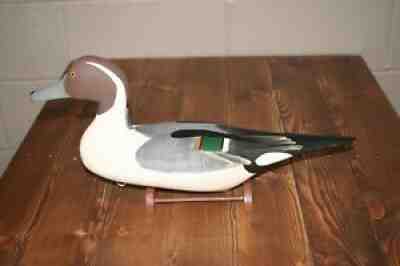
Sold on eBay Feb 10, 2022
Vintage Clarence "Titbird" Bauer Pintail Duck Decoy Havre de Grace Mitchell
Born inHavre de Grace, Maryland November 4th, 1924, he spent much of his childhood inand around the marshes of the Susquehanna River. That is where his interest inwaterfowl began. Titbird worked for the late Madison Mitchell for over thirtytwo years and is well known for the miniatures he carved but he also carved alesser amount of full size working decoys.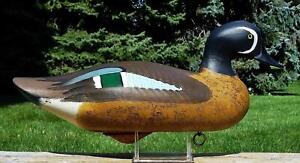
Sold on eBay October 14th, 2023
MINT RARE TEAL SUPERB 100% ORIG SIGN~DATED 1980 CAPT HARRY JOBES Wood Duck Decoy
eBay MINT & VERY RARE AMAZING "SIGNED & DATED" 1980 by the LATE CAPTAIN HARRY R. JOBES SR. DRAKE BLUE-WINGED TEAL CARVED in MADISON MITCHELL'S SHOP ~100% ORIGINAL CONDITION SUPERB GUNNING DECOY & ORIG. LEAD BALLAST WEIGHT & STAPLE & RING LINE-TIE ~CARVED & LEARNED from GREAT MADISON MITCHELL ~INCREDIBLE PAINT & OUTSTANDING CARVING ALMOST IDENTICAL to MADISON MITCHELL'S BEST BLUE-WINGED TEAL ~NOT A NICK, CHIP, PAINT SMUDGE or FINGERPRINT on this MINT DECOY with a TINY PAINT FLAKE to WEIGHT & LINE-TIE ~INCREDIBLE 43 YEAR OLD "LIKE NEW BUT MELLOWED with AGE" PATINA ~HEAD & ALL RIGGING TIGHT AS IF JUST MADE ~BRIGHT GREEN & BLUE SPECULUMS with PERFECT PAINTED EYES ~MINT BECAUSE PROTECTED IN A CASE IN AN EAST COAST COLLECTION ~THE RIG-MATE HEN TO THIS DRAKE IS ALSO ON EBAY IF YOU ARE LOOKING FOR A PERFECTLY MATCHING RIG & CARVING MATE PAIR MADE at THE EXACT SAME TIME in MITCHELL'S CARVING SHOP SIX YEARS BEFORE HARRY OPENED HIS OWN SHOP ~DON'T MISS OUT ON ONE OF HAVRE DE GRACE' MOST LOVED CARVERS! MINT RARE TEAL SUPERB 100% ORIG SIGN~DATED 1980 CAPT HARRY JOBES Wood Duck Decoy MINT RARE TEAL SUPERB 100% ORIG SIGN~DATED 1980 CAPT HARRY JOBES Wood Duck Decoy Click images to enlarge Description AMERICAN CARVING LEGEND..... Captain Harry Jobes (above picture): 18 Year Old Harry Jobes Setting Out Canvasback Decoys on the Susquehanna Flats (above picture): Captain Harry Jobes (seated) and R. Madison Mitchell (shooting) Bushwhacking on the Susquehanna Flats (above picture): Harry Jobes in His 50's Finishing a Mallard (above picture): Harry Jobes in c2018 with His Son Bob in Front of the Harry Jobes Display at the Havre de Grace Decoy Museum HARRY R. JOBES SR. Birth Name: Harry Robert Jobes BORN: Nov. 19, 1936 ..... Havre de Grace, Maryland ? DIED: May 10, 2019 ..... Aberdeen, Maryland (Captain Harry Jobes Passed Away at the Age 82) Have de Grace is a city in Harford County, Maryland. It is situated at the mouth of the Susquehanna River and the head of Chesapeake Bay. It is named after the port city of Le Havre, France, which in full was once Le Havre de Grace; (French, "Harbor of Grace"). (above picture): Harry Jobes in 1980 with One of his Largest Projects, 20 Swans he Carved (above picture): Harry Jobes Receiving One of his Many Awards for Promoting Tourism along the Chesapeake (picture below): "HARRY JOBE'S" BELOVED HAVRE DE GRACE & The UPPER BAY! This is WHERE CAPTAIN HARRY JOBES SPENT His ENTIRE LIFE MAKING DECOYS, HUNTING, CHARTER-BOAT CAPTAIN, GUIDE, WORKING at ABERDEEN PROVING GROUNDS & ALL AROUND WATERMAN ........ EVENTUALLY BECOMING ONE of the MOST BELOVED FAMILY MEN and ENDEARING INDIVIDUALS to GRACE SUCH a BEAUTIFUL and HARD WORKING COMMUNITY! (Picture Below): HISTORIC c1980 PHOTO of "HARRY JOBES" with Some of The Men That Helped MADISON MITCHELL Over the Years; (left to right): "CAPTAIN HARRY JOBES", Paul Gibson, "Madison Mitchell", Clarence Bauer and Jim Pierce. (above picture): The Above Photo is Even More Special as It was the Same Year He Carved these ~Beautiful Blue-Winged Teal "Up For Auction" ....... and Even More Significant Because they were Likely Made in Mitchell's Shop ............ Because Harry Didn't Open His Own Shop Until 1985!! And as You Can See By the Pictures Below, Harry's Earlier Output was Close to Identical to Madison Mitchell's Decoys in Many Ways ....... ESPECIALLY "AWESOME BLUE-WINGED TEAL!! ___________________________ (Picture Below): 1978 "MADISON MITCHELL" BLUE-WINGED TEAL DECOYS: (Picture Below): These 1980 "HARRY JOBES" BLUE-WINGED TEAL DECOYS (up for auction): (Picture Below): 1978 "MADISON MITCHELL" BLUE-WINGED TEAL DECOYS: (Picture Below): These 1980 "HARRY JOBES" BLUE-WINGED TEAL DECOYS (up for auction): _________________________________________ (Below Photos): This MINT 100% ORIGINAL, ALMOST HALF A CENTURY OLD" -or- 43-YEAR OLD, "SIGNED & DATED" 1980 HARRY JOBES, "DRAKE" Blue-Winged Teal Decoy Up for Auction!! Mint 100% Original Condition without a Rub, Chip, Check, Crack, Dent, Paint Smudge or Fingerprint on this Spectacular & Scarce Solid Cedar Decoy! Typical Thick Tail and Bill is Carved & Sanded Thick on the End for a Clean, Surface & Shape ....... The Entire Body was Likely Mitchell's Lathe Made with an Outstanding, Undulating Form & Style ...... it Starts with a Beautifully Rounded Breast, then a Wide & Yet Thick Body that Culminates in a Beautiful, Slightly Upswept Tail!!! (Below Photos): This SCARCE, MINT, 100% ORIGINAL, SUPERB FINELY BRUSHED ON BACK FEATHERING, SPECULUMS & WING PRIMARY FEATHERS! Very "Mason-Like", Not Only Does it Have Swirling Back Feathers & Clean Green Speculums ......... it Also Has "DOUBLE BLUE" or "Twin" Blue Wing-Feather Groups ......... and Gorgeous Long "Sweeping Wing Primaries": _ (Below Photos): The Bottom of this Drake Blue-Winged Teal has a Perfect Bottom with No Defects ....... and Perfectly Tight "Like-New" & Perfectly Intact "Ring & Staple" Line-Tie & Lead Ballast Weight!! The Perfect Bottom on this Decoy has No Checks or Defects of Any Kind & Like the Sides it is a Bright Brown-Orange ...... there is a Tiny Paint Flake to the Line-Tie & Weight From Sitting on a Shelf; But Wonderfully Free of Any Chips, Nicks, Paint Smudges, Dents, Fingerprints, Checks or Cracks ......... AS IT WAS NEVER USED & ONLY SAW WATER WHEN it was "TUNED" by FLOATING it in a TANK to LOCATE WHERE the LEAD BALLAST NEEDED to GET NAILED ON!!!! The Bottom is Also Cleanly Signed & Dated By Harry Jobes with: "Capt Harry Jobes" -and- "1980" _ (Below Photos): The HEAD of this STURDY, WELL-ROUNDED & STUNNING DRAKE BLUE-WINGED TEAL DECOY'S HEAD & NECK from SEVERAL ANGLES; With PERFECTLY CARVED in HEAD/BILL SEPARATION & PAINTED-EYES ........... and ALL NAILS to ATTACH the HEAD to the BODY are PERFECTLY HIDDEN UNDER WHITE LEAD as if this DECOY was JUST MADE YESTERDAY!!!! INCREDIBLE MINT PAINT to the ENTIRE DECOY & YOU CAN SEE EVERY BRUSH MARK ............ with VERY NEAT WHITE, PERFECTLY PAINTED "CRESCENT MOON" on the FACE ........... and PERFECTLY LOCATED YELLOW & BLACK PAINTED EYES & BLACK BILL!!! The "BLUE-WINGED TEAL" HEAD & NECK FLOW SO PERFECTLY into the BREAST that if IT WEREN'T for the SHADOWS it WOULD BE HARD-TO-SEE the SEAM .......... it's JUST a GORGEOUSLY PAINTED & CARVED "RELAXED" HEAD for a DRAKE "BLUE-WINGED TEAL" ? _ (Below Photos): This MINT & "SIGNED & DATED", DRAKE BLUE-WINGED TEAL ....... Shown with the RARER & Just as AWESOME 100% ORIGINAL CONDITION HEN RIG-MATE Also on EBAY!! LIKE MOST CARVERS & ALL FACTORIES: Since Males by Nature are All Much More Vibrantly Colored, Drakes were Made in Much Greater Numbers Since they Were Much More Visible to Wild Ducks ....... which Makes the Hen also on ebay Much Rarer than this also Rare Rig-Mate Drake!! LOOK HOW SPECTACULAR they LOOK TOGETHER & COMPLEMENT EACH OTHER!! ? This Superb Pair Have Been Together Ever Since they Entered Their Collection -and- Have Been in the Same Hands and Collection Ever Since!! _ This STUNNING, R. MADISON MITCHELL, DRAKE BLUE-WINGED TEAL DECOY up for Auction: AWESOME 100% ORIGINAL; MINT, "SIGNED and DATED"; 1980 HARRY ROBERT JOBES SR.; ABSOLUTELY INCREDIBLE PATINA & PAINT; 43+ YEAR-OLD, DRAKE BLUE-WINGED; WOOD DUCK DECOY; HAVRE de GRACE, MARYLAND; SUSQUEHANNA FLATS (UPPER CHESAPEAKE BAY) This DRAKE GUNNING DECOY was CARVED LIFE-SIZED!! (This Size of His Decoys are His Most Sought After Work!!) ? OUTSTANDING ORIGINAL PAINT and CARVING on this VINTAGE GUNNING DECOY with AN INCREDIBLE, PERFECT PATINA!! EXCELLENT FORM on ONE of SCARCE, VINTAGE "DRAKE BLUE-WINGED TEAL" GUNNING DECOYS as this DECOY WAS MADE WHEN WOODEN DECOYS WERE STILL BEING USED by DISCRIMINATING HUNTERS ........ BUT this DECOY FOUND its WAY into a COLLECTION INSTEAD of the MIDDLE of a SMALL POTHOLE, or a SLOW-STRETCH of WOOD-LINED, RIVER WATER!! ? AWESOME STIPPLED, DAUBED, SWIRLED & STRAIGHT-LINE, BRUSH-STROKE "HARRY JOBES" PAINT -and- NICE, SEMI-RELAXED POSED HEAD & NECK TURNED SLIGHTLY to ITS RIGHT!! Vintage Hunting Decoy & His Very Best, Working Bird Style with his Nice, Long, Yet Wide at the Water Level, Body Style and Form!! ORIGINAL RIGGING is PERFECT -with- 100% ORIG. RIGGING: NAILED-ON LEAD BALLAST WEIGHT -and- COMMERCIAL STAPLE & RING, LINE-TIE!! ? ? This MINT, NEVER HUNTED OVER, DRAKE & the HEN also on Ebay LOOK & SHOW as a GREAT PAIR & HAVE an INCREDIBLE & VERY APPEALING, and a MINT, YET BEAUTIFULLY AGED PATINA! There is OBVIOUSLY NO GUNNING WEAR & NO SHOT MARKS; NO RUBS, NO PAINT SMUDGES, NOT a SINGLE FINGERPRINT, NO NICKS or CHIPS, NO CHECKS, NO DENTS or CRACKS, and there are ONLY TINY RUBS to the WEIGHT & LINE TIE!! ALTHOUGH VERY PROLIFIC: Early Gorgeous Blue-Winged Teal Like this Pair are Always a Nice Find!! ? ? __________________________________________ This is a Perfectly Symmetrically Carved & Painted Vintage Captain Harry Jobes Sr. Drake Blue-Winged Teal Decoy! The ONLY TIME that this Decoy "EVER SAW WATER" was Was in Mitchell's Shop When Mitchell's Shop "TUNED IT" By Adjusting Where the Ballast was Nailed on so It Swam with Perfection in a Hunting Rig!!! This Superb Drake Blue-Winged Teal and the Hen Rig & Carving-Mate also on ebay, Both Measure: ?13-1/2" long x 5" wide x 6-1/4" tall and Each Bird Weighs Exactly: 1-lb. 11-oz. ? BOTH of these DECOYS HAVE IDENTICAL SIZE, STYLE, FORM, CARVING, PAINT PATTERN & "BOTH MADE AT THE EXACT SAME TIME"!! BOTH DECOYS are also FROM the SAME COLLECTION & OWNER! This DRAKE & the HEN also on Ebay LOOK & SHOW as a GREAT PAIR TOGETHER & BOTH are FROM the SAME COLLECTOR & PURCHASER!! BOTH also have an OUTSTANDING PATINA FROM AGE & VERY CAREFUL HANDLING, OBVIOUSLY "NEVER" HUNTED OVER & VERY WELL TAKEN CARE OF WHILE in THEIR COLLECTION!! Awesome White Face Mask Curl, Green & "Double Blue" Speculums with Swizzled Back & Secondary Feathers & Long Sweeping Primaries ........... Along with Clean and Awesomely Stippled "Brown on Red-Orange" Paint to Lower Neck, Breast, Sides & Bottom ........... Crisp & Clean Gray-Blue Head & Neck Paint that all Perfectly Flows Together to Create a Realistic Drake Blue-Winged Teal in Full Winter Plumage! STRUCTURALLY PERFECT HEAD & NECK with ALL NAILS PERFECTLY INTACT and TIGHT AS IF MADE YESTERDAY WITHOUT a SINGLE SIGN of a TYPICAL NECK CHECK that YOU QUITE TYPICALLY FIND on DECOYS as it is INHERENT to the CONSTRUCTION METHOD of the UPPER BAY CARVERS!!! ? ? To Find Perfect Pairs, Carved From the Same Rig is Always Nice When Buying Pairs of Decoys! The HEN RIG-MATE to this DRAKE is ALSO on EBAY if YOU ARE LOOKING FOR A NICE MITCHELL BLUE-WINGED TEAL PAIR; They Were UNDOUBTEDLY CARVED OBVIOUSLY AT THE EXACT SAME TIME!! (Truly a Great pair to Own) ______________ (Below Photos): OTHER BLUE-WINGED TEAL by the LATE & GREAT, CAPTAIN HARRY JOBES: __________________________ This SENSATIONAL MADISON MITCHELL DRAKE BLUE-WINGED TEAL GUNNING DECOY up for auction: This AWESOME 100% ORIGINAL CONDITION DRAKE BLUE-WINGED TEAL "SIGNED & DATED" 1980 MADISON MITCHELL 43+ YEAR-OLD GUNNING DECOY with SUPERB 100% ORIG PAINT, CARVING, STYLE, PATINA & FORM!! ? _ CAPTAIN HARRY JOBES "LEARNED FROM" -and- "CARVED WITH and FOR".....The Late Decoy "CARVING LEGEND" R. MADISON MITCHELL!! _________________________ (Below Photo): HISTORIC c1980 PHOTO of MADISON MITCHELL with Many of The Men That Helped Him Over the Years along with a Contemporary, Paul Gibson; (picture below: Left to Right): CAPTAIN HARRY JOBES, Paul Gibson, MADISON MITCHELL, Clarence "Tit-Bird" Bauer and Jim Pierce. ? (below): This Decoy up for auction was Made in 1980 by: "CAPTAIN HARRY JOBES" at the TIME AGED 44: ? Likely Made in Madison Mitchell's Shop as He Opened his Own in 1985: ? MINT, 100% ORIGINAL PAINT; FULLY RIGGED; "43 YEAR-OLD" GUNNING BIRD; "SIGNED & DATED"; 1980 CAPTAIN HARRY JOBES; "DRAKE BLUE-WINGED TEAL"; WOOD DUCK DECOY; HAVRE DE GRACE, MARYLAND; SUSQUEHANNA FLATS (UPPER CHESAPEAKE BAY) Harry Began Making Decoys at the Age of 9 and Learned Originally from Working in Charles Barnard's Shop, But Really Learned Everything he Knew from Madison Mitchell. He worked in Mitchell’s Decoy Shop for over 25 years Before Opening a Shop of his Own in 1985 ....... 5 Years After He Made this Pair of Blue-Winged Teal in Madison Mitchell's Shop!!! Excellent & Classic, Beautifully Contoured Body Style with Super Bill and Great Sweeping Tail!! ? This is a TRADITIONAL "UPPER BAY" MADISON MITCHELL STYLED "HARRY JOBES" DRAKE BLUE-WINGED TEAL!! SUPERB DEEP, STUNNINGLY GORGEOUS, ORIGINAL PAINT on this 43-YEAR OLD, GUNNING DECOY with EXCELLENT OLD & DRY PATINA!! SUPERB FORM in the STYLE HE LEARNED from MADISON MITCHELL & PASSED on to his THREE VERY TALENTED SONS!! ? AWESOME DAUBED & STIPPLED HARRY JOBES PAINT & NICELY POSED, VERY-SLIGHTLY TURNED HEAD CARVING!! Awesome Slightly Turned Head, Drake Blue-Winged Teal Hunting Decoy ........... Almost Exactly the Same Carving and Panting Detail as His Mentor Madison Mitchell's Blue-Winged Teal!! ALTHOUGH NOWHERE NEAR as PROLIFIC as MADISON MITCHELL, And AFTER HAVING MADE MANY CANVASBACKS, BLUEBILLS & REDHEADS ........... BLUE-WINGED TEAL like these INCREDIBLE EXAMPLES are "EXTREMELY HARD to FIND from this EARLY 1980 TIME PERIOD" to COMPLETE a COLLECTION of HARRY JOBES or RARE UPPER BAY DECOYS!! ? This is a PERFECTLY CARVED & PAINTED VINTAGE PAIR of HARRY JOBES TEAL ........ and ACTUALLY the BEST PAIR of HARRY'S TEAL that MOST CLOSELY RESEMBLE MADISON MITCHELL'S that I HAVE EVER SEEN ...... PERIOD!!!! ? This 43-Year Old, Pair of the Late Harry Jobes Teal Were Made in Madison Mitchell's Shop & Both Measure: ?13-1/2" long x 5" wide x 6-1/4" tall and Each Bird Weighs Exactly: 1-lb. 11-oz. ? BOTH of these DECOYS HAVE IDENTICAL SIZE, STYLE, FORM, CARVING, PAINT PATTERN & BOTH of THESE RIG-MATES were OBVIOUSLY MADE AT THE EXACT SAME TIME!! BOTH DECOYS are also FROM the SAME COLLECTION & OWNER! These Dimensions & Weight are Perfect & Typical for a Small, Marsh & River & Woodland Duck, All Cedar Duck Decoy!!! This Pair of Decoys Clearly came from Climate Controlled, Direct Light-Free Collections that they Were Lucky to Be Added To as It They Have Been Kept in Mint Condition Over the Better Part of a Half-of-Century Since they LEFT MITCHELL'S WORKSHOP in HARRY'S HANDS!! IF YOU are a FAN of GREAT GUNNING DECOYS that WOULD HAVE DONE EXACTLY what they WERE MADE TO DO if GIVEN the CHANCE ...... This is a FANTASTIC PAIR to add to YOUR COLLECTION as DECOYS with THIS EARLY JOBES STYLE & PATINA and are NOT EASY at all TO COME BY, LET ALONE CATCH A GLIMPSE OF!! If You Like Important Decoys from the one of the More Important Middle to Later Period Upper Chesapeake Bay Region Decoy Carvers, that Are in Outstanding, 100% Original Condition ........... THIS IS A GREAT DECOY FOR "ANY" COLLECTION!! _________________________________________ IN THE NEXT FEW WEEKS I AM PUTTING ON EBAY MORE LAWRENCE BETHEL FISH DECOYS, A PAIR OF THE ONLY KNOWN PROTOTYPES MADE OF THE VERY FIRST PRE-PRODUCTION FIBRE DECOYS EVER MADE, A NEAR MINT 1927 HEDDON GIANT VAMPIRE FISHING LURE IN RARE SHAD, A PAIR of LATE PHASE DODGE MALLARDS, A RARE & NEAR MINT DR. MILES PIRNIE DRAKE BALDPATE WIIGEON, A VERY RARE VICTORS DRAKE BUFFLEHEAD, A RALPH MALPAGE PAIRT OF WOOD DUCKS, A VERY RARE c1893 100% ORIGINAL TRANSITION PERIOD MASON DRAKE BUFFLEHEAD, A NEAR MINT PAIR OF MASON GLASS EYE PINTAILS, A MINT c1905 HEDDON ARTISTIC MINNOW, A SCARCE RALPH MALPAGE ATLANTIC BRANT, A YELLOW WITH RED EYE BLUSH MOONLIGHT SINGLE-HOOK PIKAROON, A NIB CREEK CHUB MULLET COLOR STRIPER PIKIE IN CORRECT BOX, A PAIR of INCREDIBLE CHALLENGE & PREMIER GRADE MASON BLUE-WINGED TEAL, A NICE PAIR OF MASON GLASS EYE BLUEBILLS, AN AWESOME ERNIE NEUMANN SUCKER FISH DECOY, A RARE c1880 ST' CLAIR FLATS DRAKE REDHEAD, A VERY NICE ERNIE NEUMANN SUCKER, A RARE 12-1/2" CHET SAWYER MINNESOTA FISH DECOY, A NEAR MINT OSCAR PETERSON PERCH FISH DECOY, A MINT PAIR OF WRAGG & BURRELL WIGEON, AN OUTRAGEOUSLY HARD TO FIND PAIR OF CHARLIE POZZINI BLUEBILLS, AN AMAZING JOHN HOLLOWAY SLEEPING TURNED HEAD DRAKE PINTAIL, A VERY BIG & BULL-NECKED EARLY FERDINAND BACH DRAKE CANVASBACK FROM HIS PERSONAL RIG AND MORE!! ? Shipping Includes Insurance! I Don't Believe in Making a Profit on Shipping, You Pay What I Pay. If it's Less Than You Paid I Refund the Difference, If More I'll Pay For It. I COMBINE SHIPPING. I am also loading over 150 Duck Decoys, 150 Fish Decoys, 70 Scarce Fishing Lures, etc. so keep checking back. ________________ This OUTSTANDING, RARE, MINT, CAPTAIN HARRY ROBERT JOBES SR., DRAKE BLUE-WINGED TEAL up for auction: ITEM DESCRIPTION: This 43+ Year Old, Wonderfully Formed, Solid Cedar, Drake Blue-Winged Teal Using Madison Mitchell's Patterns and Made in Mitchell's Shop were Expertly Carved and Painted by the Late Captain Harry Robert Jones, Sr. of Havre de Grace, Maryland. (picture below): Harry Jobes c1990, Back in the Day, A Full (10) Ten Years After He Made this Spectacular & Very Rare Blue-Winged Teal up for auction: (picture below): Harry Jobes c2018 at the Havre de Grace Decoy Museum, Roughly a Year Before he Sadly Passed Away!!! ________________ ABOUT CAPTAIN HARRY JOBES LIFE ........ An AMBASSADOR and SPOKESPERSON for the RICH CARVING & HUNTING HERITAGE his WHOLE LIFE and RIGHT UP UNTIL the DAY HE SADLY PASSED AWAY on MAY 10th, 2019 at the AGE of 82: The Region's Rich History & Harry Jobes Involvement: Havre de Grace, known as the decoy capital of the world, has spawned an entire dynasty of decoys as well as decoy carvers. Decades ago, little did gunners know that the hundreds of decoys that they chopped at their workbenches in their spare time for hunting season would one day be considered a valuable art. Fortunately, many of the earliest carver’s works have been discovered in abandoned barns and cluttered attics and have been preserved for today’s appreciative collectors. And, like all true art, the skills involved in creating these counterfeit ducks have also been passed down from earlier generations to today’s carvers. One of these earlier gunning decoy carvers and then contemporary carvers was Captain Harry Jobes, a very unique individual. You could often spot him at a decoy show, decked out in his Panama hat, suspenders and duck pants, and one of his famous hand-knitted "Captain Jobes" sweaters. Mr. Jobes was born in Wilmington, Delaware, to Donald Keith Jobes and Lorelle Evangeline "nee Beauchamp" Jobes on November 19, 1936. Even his shop, which was located behind his home in Maryland, was not the typical decoy shop. Easy to spot because of the American and Maryland flags hanging in front of his house, a visit to his shop was quite a delight. At first glance, the shop reminded you of others – the smell of pine; a coating of sawdust on benches, windows, and patterns; the lathe, band-saw, sanding machine, spoke shaves, and draw-knives; the paint table, near the wood stove, with a variety of paint cans, thinners, and brushes, drying racks holding row after row of decoys; and bodies and heads in various stages of completion on the floor and in baskets throughout the shop. (picture below): At the Time, Captain Harry Jobes was 77 when He Carved & Painted this Awesome Swan Decoy! But that’s where the similarity to other shops ended. Hanging on the wall were pin-ups of "Elvira." His 13 year old granddaughter Monica was puttying ducks while her black Lab puppy chewed the head of a finished wood duck. However, Captain Jobes looked at the puppy, laughed and said, "He’s in the doghouse now!" And, anyone who knew Harry will tell you what a dry sense of humor he had. For instance, when he would be working in the shop and the phone rang, he might answer it with, "Nobody here but the chickens!" Or, when asked if he’s made any decoys, he replied, "They’re in the incubator." Harry’s interest in carving decoys went way back to his childhood days where he was born and raised in Havre de Grace. His carving career began in Charles Nelson Barnard’s decoy shop which was located two blocks up the street from his home. Harry once said, "I was about 8 or 10. I’d run in and out of the shop, sand duck heads, then run out and play football, kick the can, and wrassle, then run back in and sand another head." In fact, Harry grew up in the midst of several other famous Havre de Grace carvers, such as Bob McGaw and Jim Currier, and could tell you many stories about most of them. Harry Jobes once said, "I also used to run in and out of McGaw’s shop ...… but he was a little on the contrary side. You didn’t touch a tool in Bob’s shop – indeed you didn’t. He didn’t want no kids in there." (pictures below): 3 Photos of Havre de Grace Carving Legend R. Madison Mitchell, the Man that Taught Harry Jobes Everything He Knew About How to Construct and Paint a Perfect Upper Bay Style Duck Decoy. This Pair of Blue-Winged Teal Carved By Harry in Mitchell's Shop So How Exact Harry was in Following His Mentor's Patterns, Paint & Thus Inherited the Aura of Mitchell's Decoys: After working in Barnard’s shop for two or three years, young Harry decided to enter one of his decoys in an art show being held at the Havre de Grace High School. He once related it by saying that he laughed, "I was in the elementary school then, and it (his decoy) looked like a chicken had painted it with his feet. But I took it up to the show, and I thought it looked pretty good to me." When he got there, he met a lady by the name of Helen Mitchell, who had several decoys made by her husband, the very famous and late R. Madison Mitchell. When he saw Mitchell’s decoys he said, "Hell, I might as well take my decoys home." But Mrs. Mitchell was very friendly and started talking to him because she knew his grandfather. She even invited him to go to work for her husband; but since Harry was already working for Mr. Barnard, he refused the offer. And, he did win a ribbon in the art contest. "… a pink ribbon or a red ribbon or something," Harry once fondly remembered. (picture below): Harry Jobes in the Mid to Late 1980's Filling Orders in His Shop: However, a year later Barnard died, and Harry went down to Mitchell’s funeral home. When Mom Mitchell answered the door, she told him to go around back to Pop’s shop. "And I worked for Mitchell for 28 years," replied Harry. "I made twenty-five cents an hour after school. I spoke shaved decoys, ran the machines and I got so I could do just about anything …....... it didn’t make any difference if it was painting or making the heads. I did anything in the shop", Harry once recalled. Sometimes there were as many as five to six woodcarvers in the shop at one time. According to Harry, you could have Bailey Moltz, Bud McKinney, Cats Wilson, Jimmy Pierce, Bob Mathews and Titbird Bauer whittling heads while Ed Sampson did all the draw knifing. Harry said he sawed them out. He once recalled, "Bailey Moltz was the best head carver on the East Coast; he’s the one who really taught me how to whittle a head. But, the painting I learned off Mitchell. He has had the biggest influence on me as a decoy maker…no question about it." (picture below): Harry with his 3 Sons Later in Life: When he was once asked what it was like working for Mitchell, he stated, "We didn’t make a lot of money, but we left a lot of memories and had a lot of fun. The memories they can’t take away from us." Harry remembered a time back in the 1950’s when Madison Mitchell had 500 canvasback decoys in his north garage that they couldn’t sell because shooting canvasbacks had been outlawed. Eventually Harry contacted a boy up in Wilmington who bought 250 at seven dollars a piece, but they still had 250 left Harry recalled. Harry added, "We took the other 250 brand new decoys, freshly painted, and sawed the heads off them and threw the bodies in the dump where the A & P Store used to be in Havre de Grace". They took them down there and burned the bodies up. Ed Sampson draw knived the heads to look like black ducks, But you Couldn’t sell decoys in those days, you couldn’t give them away. You couldn’t gun diving ducks so nobody wanted them." (picture below): Harry Jobes and his Son Bob with Family & Friends in Front of the "Harry Jobes Exhibit" at the Havre de Grace Decoy Museum": Jobes once told another story about the time he and Brother (Mitchell’s son) were working at the shop one night, jack-planing the spots on the bodies where the heads go on. Brother took the plane apart and sharpened it. But when he put it back together, the blade was sideways instead of straight; and it took off more on one side than it did on the other. "We planed off 500 bodies with the side cut unevenly." About six o’clock the next morning Eddie Mauldin and Harry Jobes were eyeing ducks when Madison Mitchell walked in, picked up one of those decoys sideways, looked at it, and saw that it and all the others had been planed off crookedly. Harry Laughed, "He was a pistol, I got the blame for it. But when I explained what had happened, Madison Mitchell's one Brother got his ear bent when he came to work." When asked what they did with the decoys, he commented, "We just nailed the heads on and let them go. They were just a looking at you sideways a little bit. They were only gunning decoys. Of course, if you could find three or four now, they’d be worth something." While working with Madison Mitchell as his mentor for 28 years, Harry also spent much of his life working on the water running research vessels for the states of Maryland and Virginia, and working for the government at Aberdeen Proving Ground piloting a patrol boat. He also operated his own charter boat business – hence the moniker "Captain" Harry Jobes. But, somehow, like all others, decoy carving became an avocation, the long hours spent at night, weekends, and holidays, that sustained his spirit; so in 1985, Harry Jobes decided to retire, build his own decoy making shop and devote all of his time and energies to carving decoys. Unlike some of his colleagues, Captain Jobes made decoys all year ‘round and created a very demanding business. It soon was no longer a part-time occupation; and even though he spent endless hours in his shop, the demand for his decoys constantly exceeded his ability to produce them. He once commented, "Decoys have been damn good to me. I’ve worked at it ....... stayed at it". His wife and business partner, Helen Jobes, a very gracious lady who endured, with good humor, visitors at their home and shop at all hours of any day, once recalled, "I used to get a break when he went to work. Now that he’s retired he works three shifts – morning, afternoon, and evening. When there’s nobody here at night. I usually get the night shift." When asked by others what she does, she used to reply "sweep floors." However, Helen took care of the perpetual paperwork of the business – recording orders, packing decoys, sending them out, etc. – work that most collectors never dream about when purchasing a Harry Jobes decoy. Indeed, the Jobes’ decoy business had become a family tradition. Just as Harry learned from Mitchell, his three sons, Bobby, Charles, and Joey, also learned from their father. All three of his sons started carving in his shop when only children. "Bobby, the oldest, used to stand up on a fish box in order to reach the vise," recalled Harry. His stepson, Jeff, who also worked in the decoy shop, was then at the time the co-publisher of Decoy Magazine, which later was turned back over to Joe Engers as the sole owner and publisher. Harry Jobes once remembered the time that Madison Mitchell called him and wanted to know if he could recommend someone to replace Ed Sampson when he retired from draw-knifing heads. "Bobby can draw-knife," replied Harry, "so Bobby went to work for Mitchell and left me holding the bag!". Bobby was Harry Jobes 2nd eldest son. All of Harry’s sons now carve decoys as a full time profession. It was quite obvious that Harry was very proud of each of them. He once quipped, "I have raised three boys, and they can do anything to a decoy that needs to be done." Bobby specializes in miniatures, Charles in half-size, and Joey in full-size decoys. Harry added, "All three are good. They’re all better than I am,". And also said, "Let’s put it this way, there’s always somebody better than you are. It doesn’t make any difference what you do." (picture below): Harry's 3 Sons Harry Robert "Bob" Jobes Jr., Charles Keith Jobes and Joseph Allen Jobes!! However, Captain Jobes was a craftsman whose talent is reflected in his decoys which are so admired and sought after today its no coincidence because he learned from the best, Madison Mitchell, and carved a great many decoys that look just like Mitchell's decoys in many ways. And as a matter of fact, without those tiny clues for the trained eye, this pair of Blue-Winged Teal likely could have been attributed to either because in 1980 and still working in Mitchell's shop, making a Mitchell decoy was second nature for harry Jobes. His popularity in the Havre de Grace area has been demonstrated by the fact that he was chosen as the Honorary Chairman of the 1988 Havre de Grace Decoy Festival. When asked how he felt about being selected for this honor, he stated. "It’s good; I guess I was surprised." Then, his dry sense of humor surfaced once again as he smiled and said, "The day before the show I’m getting two splints put on my hands so I don’t have to sign all those ducks." Although Harry Jobes made both working and ornamental decoys in that famous Havre de Grace style, all of the decoys he donated for the 1988 show and auction were working decoys. A set of 25 full-size and miniature decoys include the following species: regular and high-headed canvasbacks, redheads, blackheads, mallards, buffleheads, baldplates, cinnamon teals, ringnecks, shovelers, old squaws, pintails, goldeneyes, black ducks, wood ducks, a white wing scoter, a coot, a Canada goose, a blue goose, a snow goose, a brant, and a swan. Captain Jobes explained, "There’s a whole different ballgame between gunning and ornamentals. A working decoy you can sit it on a shelf and listen to it talk for two hours. Ornamentals can’t do that. When we made decoys years ago, we made them to go gunnin’ with, not to sit on a shelf ..... when you look at gunnin’ decoys from the 1900’s to the 60’s, the only people who made ‘em were those who lived around the river shores. Now they make gunnin’ decoys in New York City. Two thirds don’t even touch the water anymore. You wonder where they went to. You’re like Babe Ruth – you played a good game and never got paid." When questioned about carving more miniatures, he exclaimed, "When these are done, there ain’t gonna be no more of them. I can make ten full-size heads while I make one of these miniatures." So collectors who desire a Captain Jobes miniature will find it quite difficult to purchase one. Harry continued, "The year Madison Mitchell 's wife died, I made a boxcar load of these miniatures. I had ‘em in the cellar by the bushel basket full, and you don’t hardly ever see one." If a collector were fortunate enough to discover one of those old miniatures, he would indeed have found a very valuable decoy, like this pair of Early Blue-Winged Teal up for auction. Another time Captain Jobes was recognized for his outstanding decoys was in 1986 when Continental Can requested that he do a magazine advertisement for Coca Cola’s 100th birthday celebration. Many hours were spent preparing for the production of the ad. The day the production crew arrived, make-up artists worked on Harry before the photographers could film. Harry laughed, "They even brought lunch, but they forgot the Coke for the ad and had to go up to 7-11 to buy them." The final full page color ad featured Harry, working in his shop, painting a pintail drake, while his young grandson Shannon looked on. This photograph appears on the cover of the 1988 Havre de Grace Decoy Festival booklet. The later and last decoys Harry Jobes made, he sold to collectors and businesses located all over the United States and in foreign countries. He recalled at the time, "I ship them all over the place. I’ve got good friends in Holland. I ship decoys they ship tulips, I trade ‘em decoys for Tulips," he said. However, not all of the people he sold to owned shops; many were hunters and sportsmen. "I got the president of Hardees Corporation that’s got gunning marshes down in the Carolinas. I made 100 for him – 50 pair of wood ducks – and he guns them." Laughing, he said, "Yeah, it was a couple days of painting." Although born and raised on the Susquehanna Flats, Captain Jobes did very little hunting the last years of his life. He recalled before his passing, "Back Then you could look up and see thousands of cans. Now you can’t see nothin’." He remembered a time when 10-12 blinds were built on the western shore of the Chesapeake Bay where bushwhackers used to hunt. "I was one on the last ones to gun on the western flats. I’ve seen the best of this old Chesapeake." In 1970, when Harry Jobes was questioned about anything unusual that he had made, he recounted a time about ten years ago (1980) when he made 50 swan at once time. He recalled, "Most swan ever built around here at one time. It took a barrel of time to make those bodies and several cords of wood." About 30 years ago, Harry made the DuPonts four stand-up wood ducks. "They were painted in pure oil colors – took two months to dry. I ain’t gonna make no more of them things – no way!" He also once made 50 stand-up geese for Billy DuPont. (picture below): Harry Jobes with 50 Swans He Carved in 1980; That was the Exact Same Year He Carved this Pair of Blue-Winged Teal up for auction; Both Made Right in Harry's Prime!! Asked if he had any hobbies, he once replied. "I used to piddle with model trains, but I don’t have time to anymore, I guess I got my hobby right here. As Mitchell used to say. "It’s a damn expensive one." According to Captain Harry Jobes around 1986, his plans for the future were, "Just gonna make more decoys." He paused and said in that drawl of his, "I would like to take one more time and put a bushwhacking rig together and relive some of the days I had years ago. But you’ll never see that again there’s no question about it." Although those days of bushwhacking reside mostly in memory, Captain Jobes has taken his place among a select group of craftsmen who have made the Upper Chesapeake Bay region the decoy capital of the world. Much More Information on Captain Harry Jobes and Some Information About His Growing Up and Eventual Involvement in Decoy Making, Hunting & as An Ambassador for the Region: Captain Harry Jobes passed away on Friday, May 10, 2019 After a Full Life Lived and Along with Many Others, Becoming One of the Legendary Decoy Makers and Watermen of the Upper Chesapeake Bay!! Harry Jobes is a legendary talent, a master of gunning birds made in the style of the area, "The Susquehanna Flats", Chesapeake Bay decoys. His carving career began in Charles Nelson Barnard’s decoy shop which was located two blocks up the street from his home at the age of 8 or 9 by sanding duck heads. After several years Mr. Barnard died and Harry began working for the legendary Madison Mitchell. "I made twenty-five cents an hour after school .... I spoke shaved decoys .... run the machines ..... I got so I could do just about anything ..... it didn’t make any difference it it was painting or making the heads. I did anything in the shop." (Captain Harry Jobes) Captain Harry Jobes worked for the famous R. Madison Mitchell for nearly 25 years before opening his own shop in 1985. He has been featured in books, museums and in private collections. During his life he has been a commercial waterman, a hunting guide, as well as a charter boat captain. Some old images are available. "Bailey Moltz was the best head carver on the East Coast; he’s the one who really taught me how to whittle a head. But, the painting I learned off Mitchell. He has had the biggest influence on me as a decoy maker ..... no question about it" (Captain Harry Jobes) Captain Harry Jobes had three sons that all learned from him and other great carvers in the local area and then followed him into the decoy business. Each of them is a talented carver and painter, working on his own line of decoys. Captain Bob Jobes is the oldest, then Charles Jobes and Joey Jobes. "I have raised three boys, and they can do anything to a decoy that needs to be done." Bobby specializes in miniatures, Charles in half-size, and Joey in full-size decoys. "All three are good. They’re all better than I am," once commented by Harry. "Let’s put it this way, there’s always somebody better than you are. It doesn’t make any difference what you do." (Captain Harry Jobes) Harry was Married July 22, 2006, to Virginia, a long-time school friend. Harry used to make decoys all year ‘round and had a very demanding business. The demand for his decoys constantly exceeded his ability to produce them. While Harry was in Great Demand as a Decoy Maker in his Later Years, Just like the Earlier Years using Mitchell's Shop or in his Own, he was never able to keep up with the intense demand for his "very special" and rare decoys that are finally selling at the prices his decoys have always demanded. but now significantly more as he was the last of the "Mitchell Shop Decoy Makers". From 2015 and after, Captain Harry Jobes had been having medical and physical issues and has not been able to produce decoys. Thus, this ended the decoy making days of the Great Captain Harry Jobes Sr. THE HISTORY of CAPTAIN HARRY ROBERT JOBES SR. Harry R. Jobes, Sr. was born on November 19, 1936 in Harford County, Maryland. He was a third generation Havre de Grace born member of a family originally rooted in Pennsylvania. His great grandfather Joseph Allen Jobes (1846-1931) moved his family to Havre de Grace from Bucks County, PA in the 1870’s. Harry’s great grandmother was Caroline E Rowe (1849-1929). Her family goes back to 17th century Germany. Caroline’s great grandfather Dr. Johann M Rauh (1728-1792) migrated from Germany to PA. Dr. Rauh’s son’s last name became Michael Rowe (1765-1816) after he was born in America. In 1860, teenager Joseph Jobes lived on a Bucks County, PA farm with a family named Wright. He was still in school. Twenty years later in 1880, Harry’s great grandfather Joe Jobes was 35 years old. He was married to 34 year old Carrie and they were living in Havre de Grace, MD. They already had four boys and a girl. The children ranged in age from one to eleven. Harry’s grandfather Harry A Jobes (1871-1951) was nine years old. Great Grandfather Joe Jobes made his living as a bridge carpenter. A Good (2) Two Decades Later in 1900, Grandfather Harry A Jobes still lived with his parents and siblings in Havre de Grace. He was 29 and both he and his brothers Edward and George were all employed as can makers. Ten years later in 1910, Harry was married to Alice Annette Dunston (1875-1955). The couple now owned a factory and grandfather Jobes was a machinist. In 1920, Harry and Alice lived at 408 St John Street in Havre de Grace. Harry’s grandfather worked as a clerk in a clothing store and he and his wife Alice were now blessed with two children. Donald Keith Jobes (b.1911) was 8 years old and attending school and he would go on to complete the eighth grade. Donald Keith Jobes (b. 1911) had a son named Harry R. Jobes, the very Harry Jobes that made these Blue-Winjged Teal and went on to become one of the later and last of the Olg Guard of Havr de Grace's gunning decoy carvers. The Jobes family lived at 721 Otsego Street in Havre de Grace according to the 1930 census. Harry’s grandfather owned the home valued at $3,000. The family did not yet have a radio in their house. Harry Jobe's Father Donald was 18 years old, still lived with his parents, was single and unemployed. (picture below): The Incredible Plaque Located Inside the Glass Enclosed Display Featuring & Celebrating Harry Jobes and His Life: By 1940, Donald Jobes was married to Bernadine Jobes (b.1915). The couple still lived with Don’s parents in their Havre de Grace home on Otsego Sreet and Harry Robert Jobes (b.1936) now lived with his parents and paternal grandparents in Havre de Grace. Harry’s Father Donald worked as an assistant store houseman for the United States government at the Aberdeen Proving Grounds. His annual income was $1,300. He worked 44 hours a week and so did his wife. Harry’s mom was a stenographer. She earned $800 that year. Harry’s grandfather made $950 that year and he worked 48 hours a week in a department store. (picture below): Captain Harry Jobes' Lathe During the Early Stages of Forming a Decoy Body! (picture below): Captain Harry Jobes' Lathe Following a Body Pattern!! When young Harry Jobes got a little older, he started running the streets of Havre de Grace. His first exposure to the art of decoy making was before he was even 10 years old. Decoy maker Charles Nelson Barnard lived in Havre de Grace at 418 North Stokes Street and it was so close to the Jobes house that Harry could walk there from his family’s home in 5 minutes. Harry Jobes recounted how as a boy, he periodically mixed his playtime with working on decoys in Mr. Barnard’s shop. Harry also recounted how much more accommodating to young boys Mr. Barnard was when compared to another neighborhood decoy maker, Bob McGaw. Bob McGaw’s shop was almost a 15-minute walk for young Harry Jobes from his house. The pre-teen future decoy maker preferred the temperament of the Barnard shop to what the young lad found when he visited with Mr. McGaw. As a young man, Harry Jobes was just as committed to living a full life as he was when he was an adult. Harry worked part-time as he continued learning the ins and outs of decoy making from Mr. Barnard until Charles Barnard ended his decoy career. During that time, Harry was now entering Havre de Grace High School. In addition to his part-time job making decoys and his studies, Harry was both a varsity baseball and football player while at Havre de Grace High. He was a member of the baseball team that won the Harford County High School Championship in 1953 and his athletic endeavors secured him a membership in the school’s varsity club. Harry made and painted a decoy when he was in elementary school. Then, he entered it in a contest at the high school. He got a ribbon of some sort and it was during that contest that Harry met Mrs. Helen Mitchell, Madison Mitchell's wife. She was actually the member of the Mitchell family who hired Harry Jobes to work in her husband R Madison Mitchell’s decoy shop after Mr. Barnard stopped making decoys and didn’t need Harry’s help any longer. Harry worked for the Mitchells making decoys in their shop on a part-time basis for more than 25 years. When he started, Madison Mitchell paid Harry 25 cents an hour for his efforts. Harry Jobes time spent in that shop exposed him to some of the most talented decoy crafters in the world. Harry learned from them all. Bailey Moltz’s, Titbird Bauer’s and Pop Sampson’s names do not have the same level of recognition today as Harry’s or Madison Mitchell’s. Those fellows and others are the lesser-known masters of Madison’s shop. Those men taught Harry Jobes and many other young area carvers how to make decoys. Harry took what he learned and then he raised the area’s decoy marketing to a new level and eventually produced decoys on a par with Mitchell's like this pair of Blue-Winged Teal up for auction. Harry Jobes married Alice Helen Salters (1938-1991) and together they lived in Aberdeen. The couple had three sons during the years between 1959 and 1968. Mr. Jobes introduced all three of his children to the craft of decoy making. Harry’s sons, Bobby (b.1959), Charles (b.1968) and Joey (b.1965) have enjoyed long and highly productive careers making decoys. They go about their work in much the same way as their dad and the old masters that Harry knew and learned from did. Harry’s second wife Helen M Baker (1929-2004) helped with the business end of Harry’s decoy enterprise in Havre de Grace. Until 1985, Harry made his primary living as a boat captain. Thus, he is widely known as “Captain” Harry R. Jobes. During his career, Mr. Jobes skippered research vessels for the states of Maryland and Virginia as well as a patrol boat off the federal proving grounds in Aberdeen, MD. Captain Harry also ran his own charter boat for many years. He was the epitome of a waterman. (picture below): Harry Jobes was Always Eager to Help with Causes Including the Halloween Festivities at the Havre de Grace Decoy Museum, as He Greeted the Kids & Parents Right in Front of His Permanent Exhibit within the Museum: Up until 1980 Harry Jobes helped out in Madison Mitchell's shop, and as he did with other carvers like Charlie Joiner, he made his shop available to them to make their own decoys if the shop would otherwise have been idle. This pair of Blue-Winged Teal decoys up for auction were made in 1980, 5 years before Harry retired from the Aberdeen Proving Grounds job and opened up his own shop in 1985. Captain Harry began making all of his decoys full time in his own new shop. But after a good 30 years of making decoys, around 2015 Harry Jobes began to curtail his carving efforts down to a trickle. In his later and last years you could still buy his decoys and he occasionally could be found in a Panama hat at decoy related events, many of which were with one or more of his sons. For countless years, Captain Harry and his family members generously contributed their time and energies to the Havre de Grace Decoy Museum, Ducks Unlimited and other similar historical and conservation charities. (picture below): Harry Jobes, Ever the Doting Father, in His Last Years Enjoying Time with One of his Grandchildren: Captain Harry’s decoy production is quite varied and he was certainly one of Havre de Grace's greatest carvers, and as time goes on the Demand for his Work, the Appreciation for his Outstanding Decoys and the Prices Being Realized for them Continues to grow at an Amazing Level. He has made both gunning decoys and ornamental decoys. His decoys are lathe turned and they all have the traits of the traditional Havre de Grace decoy. Harry has made just about every species of waterfowl in every pose you can conceive. Harry Jobes was a member of the Havre de Grace Elks Lodge, Duck’s Unlimited and the Havre de Grace Decoy Museum. He enjoyed traveling, hunting, fishing and crabbing. Collectors can find Harry’s decoys in every state in the nation and all around the world as well as appreciation and demand for them grows exponentially year after year after year. Harry passed away on May 10, 2019 and was one of the Last Havre de Grace carvers that carved during the golden years when almost all decoys were made of wood and ducks were still rafting up across the country in large migrating groups and piling into marshes looking for refuge, rest and food while on their journey. When Harry Jobes Sr. passed, he was predeceased by his first wife Alice Helen Jobes, second wife Helen Margaret Williams Jobes, and his siblings. He is and always will be missed. Captain Harry Jobes carved decoys for most of his life. The Captain has spent all of his life on the Chesapeake Bay and Susquehanna Flats as a commercial waterman, hunting guide and charter boat captain. This close association with nature has given him first hand insight into the waterfowl world. Captain Harry’s decoys have been featured in books and museums as well as numerous private collections across the country. All of this experience and knowledge Harry passed on to his 3 sons and from the photos above you can see that they were great listeners and learners as their decoys are also excellent, true to form and will carry on the Jobes' decoy making tradition for generations to come. _ This STUNNING, R. MADISON MITCHELL, DRAKE BLUE-WINGED TEAL DECOY up for Auction: This Mint and 100% Original, "Signed & Dated" 1980 Captain Harry Jobes Drake Blue-Winged Teal decoy up for auction is aesthetically and structurally as magnificent as the day that he carved it 43 years ago. It is perfectly symmetrical from both painting and carving standpoints including the location of the painted on eyes and the carved in head/bill delineation. This decoy is in Awesome 100% Original Condition, even considering it is a 43 year old gunning bird that is mint because it went straight from Harry's work bench and into a discriminating East Coast decoy collection! Very neat bill contours perfectly like a real Blue-Winged Teal in the Wild and the head and neck carving on this great decoy is phenomenal, especially the very neat semi-alert or relaxed and turned head. The base of the neck is beautiful as it flows flawlessly from the body and into the neck seat and down the nicely rounded breast and sides. The daubed and stippled paint on this decoy is also incredible, as it really creates a life-like feathered appearance to the entire decoy, especially the daubed and swizzled back feathers and speculums, as well as long sweeping primary feather and "double blue' wing patches above the green speculums that are thinly bordered with white and black, straight-line paint! This decoy is absolutely perfect all original paint and the original rigging is perfectly intact and in superb condition. Great color on the paint job with a perfect and deftly applied "daubed" paint job in the tradition of the Havre de Grace style almost exactly like that of Madison Mitchell's decoys as he likely even carved it in Mitchell's shop and was still working part time for Mitchell as he still had other full-time job obligations. But in addition to the Havre-style daubed paint, the stippling to the paint on the back is concise and precise. This Truly Exceptional Drake Blue-Winged Teal and the Hen Rig-Mate also on ebay Both Measure a Perfect, Life-Sized 13-1/2" long x 5" wide x a very stately 6-1/4" tall and weigh a very manageable 1-lb. 11-oz. THAT IS FANTASTIC & Makes for a PERFECT BLUE-WINGED TEAL DECOY! This decoy is just in excellent condition and it clearly went straight from Mitchell's Shop and right into a light and temperature controlled collection of vintage Upper Chesapeake Bay decoys on the East Coast. A great addition to your collection of classic wood decoys and shorebirds from a man that learned from the best and now carves with the best. If you have any questions or would like any close-up pics of an area feel free to email me. Thanks for looking. The first photo in the Beginning of this Listing is of this Great Harry Jobes Drake Blue-Winged Teal up for auction. The Next 3 Photos are of Captain Harry at Different Points of Time in His Life. The Next 6 photos are of this Drake and the Hen also on ebay together so you can see how Awesome this Pair if Rig-Mates Look & Complement Each Other. The Next Photo is of Another Pair from a Book. The Last 13 Photos are again of this Beautiful Drake Blue-Winged Teal Again by Itself!! (I encourage you to use the zoom feature in this listing to get close-up looks at anywhere on this decoy as it can zoom in on the smallest of spots from the many different directions afford you to see the decoys entire surface.) ? __ (pictures below): Other Pairs of Harry Jobes Great Gunning Decoys. Some Also Show Harry's Ultra Rare Miniatures: __ Below is an ARTICLE About R. "MADISON MITCHELL", Captain "HARRY JOBES" MENTOR: BELOW are PICTURES of a VARIETY of MADISON MITCHELL'S DECOYS or OTHER ITEMS: (picture below): A PAIR of MADISON MITCHELL BLUE-WINGED TEAL with VERY CLOSE FORM & PAINT to CAPTAIN HARRY JOBES BLUE-WINGED TEAL DECOYS: (picture below): SOME MADISON MITCHELL GOOSE SPECIES and SWAN DECOYS! __________ (picture below): A FEW PHOTOS OF OTHER SPECIES OF MADISON MITCHELL GUNNING DECOYS!! (picture below): A FEW PHOTOS of MADISON MITCHELL CANVASBACK DECOYS & VARIATIONS: (picture below): MORE PHOTOS OF OTHER SPECIES OF MADISON MITCHELL GUNNING DECOYS!! (pictures below): MORE PICTURES OF OTHER GREAT MADISON MITCHELL CANVASBACK DECOYS AND RELATED REDHEAD ITEMS! (The 2nd Photo is Mitchell with a Room Full of Canvasbacks and Canada Geese Decoys He Made!) __________ (Article Below): VERY IMPORTANT, CONCISE & INFORMATIONAL ARTICLE WRITTEN BY MR. JIM TRIMBLE FOR DECOY MAGAZINE. HE SENT ME THIS EMAIL OF THE ARTICLE AS I COULDN'T FIND MY COPY AND I HAVE READ IT HUNDREDS OF TIME. BUT IF YOU ARE ABLE TO GET A BACK ISSUE OF THIS PARTICULAR ISSUE OR SUBSCRIBE TO DECOY MAGAZINE IT IS MONEY EXTREMELY WELL SPENT!! By James L. Trimble R. Madison Mitchell The Chesapeake’s Dominant Decoy Maker Reprinted with permission from the Jan/Feb 2007 issue of Decoy Magazine. When asked the distinguishing characteristics of his decoy by a reporter many decades ago, Mitchell responded, “Ninety percent of the gunners from Columbia, Pennsylvania to Richmond, Virginia can tell you whether the decoy they are holding is a Mitchell decoy…or not!” Mitchell, the Chesapeake’s predominant decoy maker, made that comment with a chuckle and a twinkle in his eye, a comment that might seem vain if it wasn’t also true. It was still a time when Madison Mitchell dominated wooden decoy production in his part of the world, a craft that eventually headed toward its twilight years, as did Mitchell, as wooden decoy rigs gave way to plastic. The Chesapeake Bay is the largest of the 130 estuaries located in the United States, stretching 200 miles long and up to 35 miles wide, encompassing 11,684 miles of shoreline, including the tidal tributaries of Maryland and Virginia, a distance longer than the entire west coast of the United States. Many rivers feed it, but the majority of the Chesapeake’s water is derived from the saline Atlantic Ocean to the south and the Susquehanna River to the north, which pours in fresh water at the head of the bay. A major resting and feeding habitat along the Atlantic Flyway for migratory ducks and geese, its open waters with wild sego and celery grasses are home to 29 species of waterfowl. The watermen who populated the bayside communities throughout the region harvested a great variety of seafood from its waters. The late fall arrival of ducks and geese represented another source for both sustenance and income. According to the writings in early sporting books and magazines, millions of birds arrived on the Susquehanna Flats each fall, with their numbers greatly depleted by winter’s end. It was prime gunning habitat for the market hunter of yesterday, who sold their harvest for shipping by rail to the nearby accessible markets of Philadelphia, Baltimore, Washington and Richmond. Due to this abundance of waterfowl population, this vast Chesapeake Bay region supported more decoy makers, who produced more decoys, than any other area in the world. The identities of many of the early decoy makers from many regions have been lost to time and history, however the pioneers of Upper Chesapeake Bay decoys, men such as Holly, Graham and Dye, have been identified, with fine examples of their work surviving. Robert Madison Mitchell was born in 1901 in Oakington, Maryland, near Harford County’s Swan Creek, just south of Havre de Grace, and he grew up in this waterman’s community at the top of the bay. It was a time when waterfowl conservation was non-existent and years before the U.S. Migratory Bird Treaty Act of 1918 became law. Mitchell was the son of a farmer and market hunter, who worked the land on Spesutie Island at the southern end of the Susquehanna Flats. Interviewed in George Reiger’s 1980 book, “Wings of Dawn,” Mitchell relates, “We had men here, my father for example, who farmed on Spesutie Island. He got $14 a month salary and five acres of ground to do with as he pleased, as well as the fishing and hunting rights to the lower farm. If he hadn’t gunned for the market, we would have been hard pressed to make ends meet. Money from waterfowl was one of my father’s biggest sources of income.” While Mitchell was an infant, the family’s farming activities moved from Spesutie Island to the rolling hills of Mount Felix on the Heights, which overlooked Havre de Grace and the bay. His grandfather’s stroke precipitated the move, as they had to take over the family dairy and look out for his care. Mount Felix, a 7700 square foot brick manor house with unparalleled views of the bay, was built in the 1830s by Mitchell’s great grandfather canner and agriculturalist John Mitchell. This is where Mitchell spent his formative years. The 1910 Harford County census lists Robert H. Mitchell as Head of Household with his occupation as a farmer, working on “our farm.” Occupants include his wife, three daughters and 9-year-old Robert M. Mitchell. The younger Mitchell often told of life on the farm, including delivering milk by horse and buggy, all before morning classes. He learned to fish and hunt upland game at this father’s side. Although he lived in a waterfowling community, it was not a pursuit in which he would partake until he was a young man. A favorite uncle, E. Madison Mitchell, had a great impact on the younger Mitchell, so much so that he dropped his given name Robert and went by his middle name Madison, or the now proper name of R. Madison Mitchell, which he kept for life. Years later Mitchell decided to choose his favorite uncle’s profession, that of an undertaker, and he quite school at age 16 or 17, moving 30 miles south to Baltimore, where he lived in an apartment over his uncle’s funeral home. While there he “helped out,” which included “night removals” from Baltimore homes. He also attended classes at the Baltimore Business College. A year or so later, an older sister visiting Havre de Grace surprised the family with an early birth. Mitchell accompanied his sister and child on their return train trip to Michigan. While there, he took a job working at a General Motors assembly line in Pontiac for $6.00 a day, a decent wage for the time. It is quite possible that Mitchell may have run across the nearby Mason decoy factory while living there, thus noting the use of lathes and assembly line processes in producing decoys. He may also have been exposed to the wealth of Michigan’s forests, a source he turned to later in life. While Mitchell was spreading his wings elsewhere, Havre de Grace was coping with the new federal migratory laws, which forced many watermen to convert from market hunting to providing guide services for city sports, who now poured in by rail each gunning season. The small town of Havre de Grace quickly became the gunning Mecca of the East Coast. Mitchell returned home in April 1920, and according to Charles Lee Robbins 1987 book, “R. Madison Mitchell – His Life and Decoys,” Mitchell and his father hunted ducks on the Susquehanna Flats from a sinkbox that fall, something they repeated each ensuing season. Their rig was reported at 450 decoys, and they shot mostly divers, with Mitchell using a 12-gauge Winchester Pump Model 98, full-choke with a 32-inch barrel, a gun used by four generations of Mitchells. Although raised in a waterfowling community of market hunters, this was purportedly his first attempt at hunting ducks. As Mitchell is quoted in Rieger’s previously referenced book: “The market (market hunting) had stopped before I actually took up gunning.” In 1922, Mitchell received his embalmers license and opened for business shortly thereafter. Sam Barnes, a prolific decoy maker, helped paint the funeral home. Barnes was Mitchell’s mother’s cousin and a contemporary of his father, and in 1924 Mitchell started helping Barnes with his decoy production, a job completely done by hand, using a saw, a hatchet, a drawknife and spoke shave. “He was one of those old gentlemen who never stopped; he just kept on working,” Mitchell is quoted as saying in David and Joan Hagan’s 1990 book, “Upper Chesapeake Bay Decoys and Their Makers.” Purportedly when Mitchell was asked what he knew about making decoys at the time, he responded, “The same thing you did when you started.” It is interesting to note that this was the same year that a pair of Sam Barnes canvasbacks was awarded “Best in Show” at the Second Annual Exhibition of Wildfowl Decoys in New York City, based on practical (functional) use and maintenance. At the time, Barnes sold his decoys for $1.25 each. According to Madeline Shanks, Mitchell’s daughter, her father augmented his income, as did many in town, by picking up racetrack fans at the train station and taking them to the now-defunct Havre de Grace Racetrack. Champion horses of the day, including Seabiscuit, Citation and Man’O War, all raced there. The Havre de Grace destination was so popular the railroads operated special “racing trains” from New York, Philadelphia and Baltimore, using the same railroad tracks that brought in the city sports each gunning season. It is not known how long he provided this service or whether he ever used his hearse for pick-ups. Mitchell had been working on a steady basis with Barnes for about two years when Barnes died of pneumonia in 1926. Mitchell handled the funeral, and it was the first to utilize a brand new hearse he had just purchased. At the time, his business on Washington Street was handling about 20 funerals a year. Barnes left behind substantial orders for decoys - about 1400 birds in all - that needed to be filled before the next hunting season. That same year his daughter Florence, who had painted his decoys, married and left town. Recognizing the opportunity, Mitchell established his own shop, implementing power tools, including a belt sander built by a local machinist, and later a lathe to turn his decoy bodies. The shop was located behind his funeral business on Washington Street, just a few blocks from Barnes’ Washington Street home. Now on his own, Mitchell sought guidance from other area makers, particularly concerning the application of paint patterns. Capt. Billie Moore, owner of the gunning yacht Reckless and father-in-law of well-known decoy maker Bob McGaw, both Washington Street neighbors, came to Mitchell’s aid, teaching him how to mix and blend colors, applying the same feathered wing pattern used when helping his son-in-law fill decoy orders. With Moore’s help, the 1400 newly finished decoys were completed in time for gunning season. McGaw’s signature “dog bone” weight is also found on some early Mitchell decoys, which could indicate a Moore influence as well. (Locals report that McGaw was upset that his father-in-law would help this new upstart, who would eventually prove to be a formidable competitor for area decoy business.) According to the Hagen’s book, the average order was for 50 to 100 decoys and they sold for $1.50 each. For Mitchell, 1926 carried added significance, as he married local Helen Maslin, a union that lasted until her death in 1973. It should be noted that his father, Robert H. Mitchell; his cousin and mentor, Samuel T. Barnes; and the man who taught him how to paint decoys, Capt. William E. Moore; were all members of the “Ducking Police,” created by an 1872 State of Maryland statute to regulate shooting on the legal boundary limits of the Susquehanna Flats. There is no doubt that their stories about those “early days” had an impact on Mitchell. A December 5, 1926 article in the Baltimore Sun, “Ducking Days Along Susquehanna,” mentions the “hundreds of sinboxes that dot the water,” and details some of the gunning accidents that occurred there, including accidentally shooting holes in the watertight box, hunters accidentally shooting themselves and one particular case of two brothers who froze to death in their sinkbox. It would be interesting to know if Mitchell, with his new hearse, collected the bodies. The 1930 census for the City of Havre de Grace lists the 29-year-old Mitchell as living on Washington Street with his wife and two-year-old daughter. Under the Head of Household column, his given name is listed as R. Madison Mitchell and his occupation as embalmer undertaker He is not listed in the 1920 Maryland census, as he was likely residing in Pontiac, Michigan. With time, the Barnes body design was modified to clean sharp lines for easy and fast lathe production, perhaps with a Holly influence. Mitchell used lead ballast weights and replaced the traditional leather anchor straps with a small ring and staple. The first time he tried rings and staples on his father’s decoys he left the leather straps in place, commenting years later that he didn’t want “any backfire” from his father. His initial decoy production was limited to canvasbacks, blackheads (bluebills) and redheads, as he claimed they were the only ducks he could paint. With increased demand, Mitchell rebuilt and enlarged his shop in 1932. In 1934 the state of Maryland outlawed the use of a sinkbox, a lethal floating water-level platform used by Chesapeake gunners to kill diving ducks. Once eliminated, hunters no longer needed huge rigs of 400-500 decoys. That same year a severe drought in the Midwest and Canada dried up nesting potholes crucial to the survival of migrating ducks, and few came to the Chesapeake. Mitchell did not sell a decoy that year, but fortunately the ducks returned, as did the gunners and the demand for his decoys, and his business continued to grow. By the mid-1930s, most of the legendary 19th century decoy makers from the Upper Chesapeake Bay were gone, or in their twilight years with limited production. McGaw and Jim Currier were still producing decoys commerci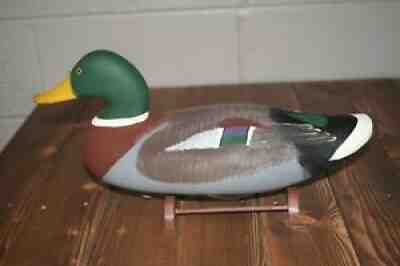
Sold on eBay Feb 12, 2022
Vintage Clarence "Titbird" Bauer Mallard Duck Decoy Havre de Grace Mitchell
Born in Havre de Grace, Maryland November 4th, 1924, he spent much of his childhood in and around the marshes of the Susquehanna River. That is where his interest in waterfowl began. Titbird worked for the late Madison Mitchell for over thirty two years and is well known for the miniatures he carved but he also carved a lesser amount of full size working decoys.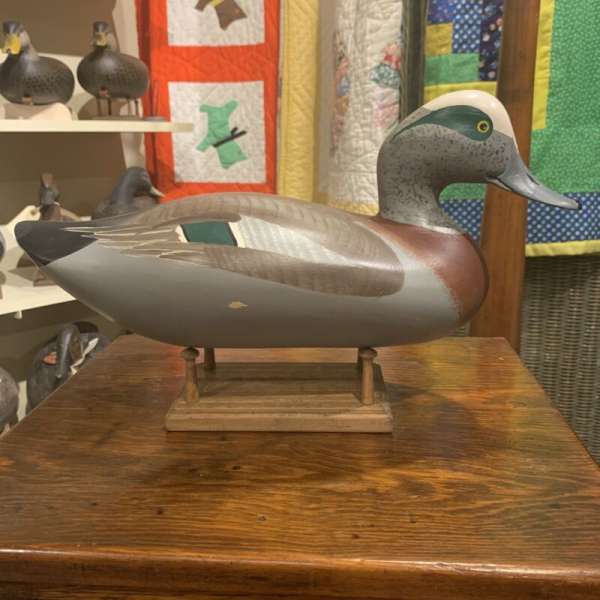
Sold on eBay October 18th, 2024
Vintage XLT R Madison Mitchell Widgeon Drake Duck Christmas Decoy S & D 1994
Vintage Excellent R Madison Mitchell Widgeon Drake Duck Christmas Decoy 1994 paint with a questionable area at tip of tail. Seems a lighter black touch up possibly at time of making as I see no repairs or rough area.14 and 5/8 inches long.Electropen signed and dated. I’m taking the date as a 1994 even though could be read as 1944. I doubt due to condition it’s 1944Please view the numerous pics for condition.I was told by an expert collector of M Mitchell that paint likely by Clarence Bauer.Weighs 2 lbs 4.8 ounces. (Condition: Pre-Owned)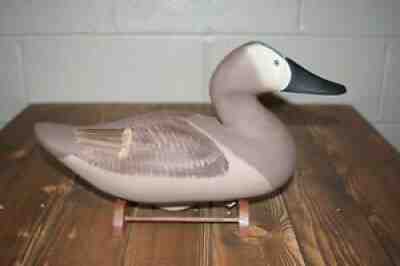
Sold on eBay Feb 13, 2022
Vintage Clarence "Titbird" Bauer Canvasback Hen Decoy Havre de Grace Mitchell
Born in Havre de Grace, Maryland November 4th, 1924, he spent much of his childhood in and around the marshes of the Susquehanna River. That is where his interest in waterfowl began. Titbird worked for the late Madison Mitchell for over thirty two years and is well known for the miniatures he carved but he also carved a lesser amount of full size working decoys.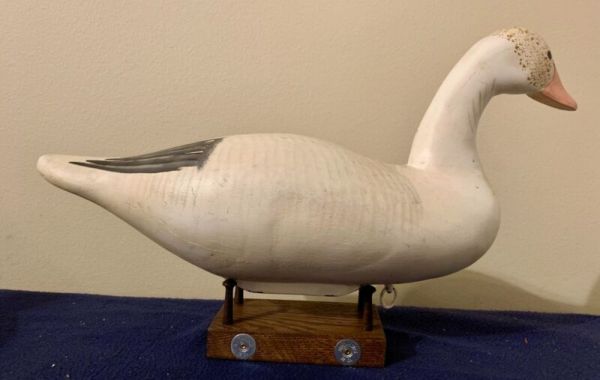
Sold on eBay October 27th, 2024
VINTAGE HUNTING DECOY**Clarence "Tit-Bird" Bauer**Harve de Grace, Maryland
Here is a full size SNOW GOOSE by Tit-Bird Bauer. Rare because he made few full size decoys. It was made on the pattern and style of his old boss "Madison Mitchell" who he worked for from 1949 until 1979. It is weighted and ready to hunt but looks like it has been on the shelf all these years. First full sized snow goose I have seen by this carver(1924 to 2006) (Condition: Pre-Owned)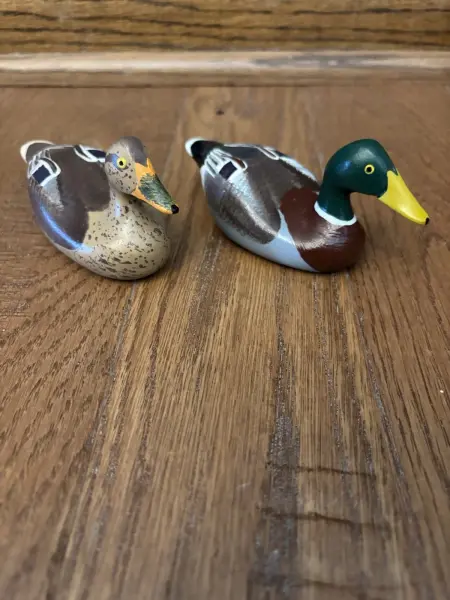
Sold on eBay April 23rd, 2025
Clarence Titbird Bauer Harve De Grace Md Miniature Vintage Decoys Signed Set
The product is a miniature vintage duck decoy made of wood by Clarence Titbird Bauer in Harve De Grace, Maryland, United States. This unique and collectible piece is crafted with great attention to detail, showcasing the rich history and artistry of vintage hunting decor. Perfect for hunting enthusiasts or collectors of vintage sporting goods, this decoy embodies the charm and nostalgia of traditional duck hunting.THESE ARE IN PERFECT CONDITION!! Male Mallard Female Mallard The story behind Clarence Titbird Bauer is interesting if your research! (Condition: Brand New)
Sold on eBay December 10th, 2023
MINT SCARCE & SUPERB 100% ORIG c1950 MADISON MITCHELL Wood Duck Decoy CHESAPEAKE
eBay MINT, NEVER USED & SUPERB 100% ORIGINAL MADISON MITCHELL c1950 "HEN" PINTAIL GUNNING DECOY ~AWESOME SOLID CEDAR DECOY, GREAT CARVING, FORM & PAINT ~ORIG RIGGING: LEAD BALLAST WEIGHT, RING & STAPLE LINE-TIE ~"DRAKE" RIG-MATE to this "HEN" ALSO on Ebay; BOTH HAVE SAME SIZE, STYLE, FORM, CARVING, PAINT & WERE MADE THE EXACT SAME TIME & ARE FROM the SAME COLLECTION ~THIS HEN SHOWS INCREDIBLY & HAS NO RUBS or WEAR EXCEPT WEIGHT & LINE-TIE, NO SHOT MARKS, KNOTS, CHIPS, DENTS, CHECKS, CRACKS & PERFECTLY INTACT HEAD & NECK NAILS ~BOTH BABIED in COLLECTION SINCE THEY WERE MADE ~AWESOME AGED PATINA & HEADS & ALL RIGGING is AS TIGHT AS THE DAY BOTH DECOYS WERE MADE ~SUPERB STIPPLED, DAUBED & SWIRLED FEATHER PAINT TO BACK & WINGS & CLEAN & CONCISE TO THE BREAST, TAIL, HEAD & SPECULUMS ~BIG TYPICAL 2-LB 10-OZ PAIR of MATED DECOYS ~SUPERB MINTY CONDITION THAT ARE 3-QUARTERS of a CENTURY OLD & WOULD BE AN AWESOME PAIR TO ADD TO ANY SUPERB DECOY COLLECTION as the HEN MATE to this DRAKE is ALSO on EBAY MINT SCARCE & SUPERB 100% ORIG c1950 MADISON MITCHELL Wood Duck Decoy CHESAPEAKE MINT SCARCE & SUPERB 100% ORIG c1950 MADISON MITCHELL Wood Duck Decoy CHESAPEAKE Click images to enlarge Description AMERICAN CARVING LEGEND..... R. MADISON MITCHELL Birth Name: Robert Madison Mitchell (born): March 11, 1901 (died): Jan. 14, 1993 (Age 91) of Havre de Grace, Maryland (picture below): HAVRE DE GRACE & The UPPER BAY! This is WHERE MITCHELL SPENT PRACTICALLY His ENTIRE LIFE MAKING DECOYS, HUNTING, BURYING FRIENDS, STRANGERS & LOVED ONES ALIKE ........ EVENTUALLY BECOMING ONE of the MOST BELOVED FAMILY MEN and ENDEARING INDIVIDUALS to GRACE SUCH a BEAUTIFUL and HARD WORKING COMMUNITY! (picture below): HISTORIC c1980 PHOTO of MADISON MITCHELL with Many of The Men That Helped Him Over the Years, Pictured along with a Contemporary, Paul Gibson! (left to right): Harry Jobes, Paul Gibson, "MADISON MITCHELL", Clarence Bauer and Jim Pierce. _________________________________________ (Below Photos): This Mint, Scarce, 73+ Year-Old & Never Gunned Over, Outstanding c1950 Madison Mitchell, Hen Pintail Decoy Up for Auction!! Incredible Condition without a Knot, Rub, Chip, Check, Crack, Paint Smudge, Fingerprint or Shot Mark on this Solid Cedar Rare Hen Pintail or Even the Scarce Mint Drake Decoy! Typical Thick Tail and Bill is Carved & Sanded Blunt on the End for a Clean, Surface & Shape ....... The Entire Body was Lathe Made with an Outstanding, Undulating Form & Style ...... that Starts with a Beautifully Rounded Breast, then a Wide & Yet Thick Body that Culminates in a Beautiful, Slightly Upswept Tail!! ___________________________________________ (Below Photos): SUPERB FINELY BRUSHED ON BACK, SIDE & ENTIRE BODY FEATHERING, SPECULUMS & WING PRIMARY FEATHERS! ________ (Below Photos): The Bottom of this Hen Pintail has a Perfect Bottom with No Defects and Perfectly Tight & Intact Line-Tie & Ballast Weight!! The Perfect Bottom on this Decoy has No Checks or Defects of Any Kind & Like the Back is still Tan-Brown with Dark Brown Feather Daubing ...... Wonderfully Free of Any Knots, Chips, Dents, paint Smudges, Rubs, Fingerprints, Checks or Cracks on the Entire Decoy, Let Only those Often Seen where Rigging was Nailed On ...... Some Very Typical Incidental Paint Loss to Line-Tie & Weight From Sitting on a Shelf; And Still Outstanding!! Mitchell Used 1 Nail on Each End of the Lead Ballast Weight Until Around 1950, When He Started Using 2, Which Helps Identify this Decoy to c1950, Along with Some Small Nuances Like the Neck Shelf, etc. ________ (Below Photos): The HEAD of this MAJESTIC, ELEGANT & STUNNING "SCARCE" HEN PINTAIL DECOY from SEVERAL ANGLES ...... With PERFECTLY CARVED in HEAD/BILL SEPARATION & PAINTED-EYES ........... and ALL 5 of the NAILS to ATTACH the HEAD to the BODY are PERFECTLY HIDDEN as if this DECOY was JUST MADE YESTERDAY ........ This HEN is so IMMACULATE that ALL 5 NAILS are SO DEEP & INTACT YOU CAN ONLY SPECULATE WHERE they are BASED on KNOWLEDGE of HIS CONSTRUCTION!! INCREDIBLE MINT PAINT to the ENTIRE DECOY & YOU CAN SEE EVERY BRUSH MARK ............ with VERY NEAT MEDIUM-DARK BROWN EYE SWATHS and DAUBED PAINT on the TOP of the HEAD & BACK of the NECK ........... and PERFECT LOCATED YELLOW & BLACK PAINTED EYES!!! The "HEN PINTAIL" HEAD & NECK FLOW SO PERFECTLY into the BREAST that if IT WEREN'T for the CRISP SIDES it WOULD BE HARD-TO-SEE!! .......... it's JUST a GORGEOUSLY PAINTED & CARVED "ALERT" HEAD "POSED STRAIGHT FORWARD" on the DECOY!! ? ________ (Below Photos): This NEAR MINT, SCARCE & NEVER-HUNTED OVER, HEN PINTAIL ....... Shown with the RARER & Just as AWESOME 100% ORIGINAL CONDITION DRAKE RIG-MATE Also on EBAY!! LIKE MOST CARVERS & ALL FACTORIES: Since Males by Nature are All Much More Vibrantly Colored, Drakes were Made in Much Greater Numbers Since they Were Much More Visible to Wild Ducks ....... which Makes this Very Rare Hen also on ebay Rarer than this Drake!! LOOK HOW SPECTACULAR they LOOK TOGETHER & COMPLEMENT EACH OTHER!! ? This Superb Pair Have Been Together Ever Since they Entered Their Collection in Saginaw, Michigan -and- Have Been in the Same Hands and Collection Ever Since!! ________ ________ This STUNNING, R. MADISON MITCHELL, "HEN" PINTAIL DECOY up for Auction: AWESOME 100% ORIGINAL, "SCARCE"; MINT CONDITION, "NEVER HUNTED OVER"; c1950 R. MADISON MITCHELL; ABSOLUTELY INCREDIBLE PATINA & PAINT; 73+ YEAR-OLD HEN PINTAIL; WOOD DUCK DECOY; HAVRE de GRACE, MARYLAND; SUSQUEHANNA FLATS (UPPER CHESAPEAKE BAY) This HEN GUNNING DECOY was CARVED LIFE-SIZED!! (This Size of His Decoys are His Most Sought After Work!!) ? OUTSTANDING ORIGINAL PAINT & CARVING on this VINTAGE GUNNING DECOY with AN INCREDIBLE, PERFECT PATINA!! EXCELLENT FORM on ONE of HIS VINTAGE & SCARCE HEN PINTAIL GUNNING DECOYS as this DECOY WAS MADE WHEN WOODEN DECOYS WERE STILL BEING VERY WIDELY USED FOR HUNTING ........ BUT this DECOY FOUND its WAY into a COLLECTION INSTEAD of the MIDDLE of a LARGE, OPEN-WATER BAY!! ? AWESOME STIPPLED, DAUBED, SWIRLED & STRAIGHT-LINE, BRUSH-STROKE MITCHELL PAINT -and- NICE, ALERT, HEAD & NECK that are STRAIGHT FORWARD FACING!! Vintage Hunting Decoy & His Very Best, Working Bird Style with his Nice, Long, Yet Wide at the Water Level, Body Style and Form!! ORIGINAL RIGGING is PERFECT -with- 100% ORIG. RIGGING: NAILED-ON LEAD BALLAST WEIGHT -and- COMMERCIAL STAPLE & RING, LINE-TIE!! ? ? This MINT, NEVER HUNTED OVER, HEN & the DRAKE also on Ebay LOOK & SHOW as a GREAT PAIR & HAVE an INCREDIBLE & VERY APPEALING, VERY DRY, AGED PATINA! There is OBVIOUSLY NO GUNNING WEAR & NO SHOT MARKS, KNOTS of ANY KIND; NO RUBS, NO CHECKS or CRACKS, and the ONLY RUBBING is to WEIGHT & LINE TIE!! ALTHOUGH VERY PROLIFIC, Gorgeous PINTAILS Like this PAIR are Always a HARD FIND!! ? ? __________________________________________ This is a Perfectly Symmetrically Carved & Painted Vintage & Scarce Madison Mitchell Hen Pintail Decoy! The ONLY TIME that this Decoy "EVER SAW WATER" was Was in Mitchell's Shop When Mitchell's Shop "TUNED IT" By Adjusting Where the Ballast was Nailed on so It Swam with Perfection in a Hunting Rig!!! ______ This Superb Hen Pintail and the Drake Mate also on ebay Were Made Together, and Both Measure: This HEN & the DRAKE BOTH MEASURE: 5-3/4" WIDE x 7-3/4" TALL Drake is: 18-1/2 long -and- Hen is: 16-1/4" long Both Hen & Drake Weigh a Hefty: 2-lb. 10-oz. each THAT is FANTASTIC & Makes for a PERFECT PAIR of RIG & CARVING MATES that WERE MADE at the EXACT SAME TIME!! That Makes for an Awesome pair of Very Unique Gunning Decoys that are From the Same Famous Carver & Made at the Exact Same Time!! That Makes for a Superb pair that Have Been Together in the Protection of the Same Climate & Light Controlled Collection after they Left Madison Mitchell's Shop!! ? BOTH of these DECOYS HAVE IDENTICAL WEIGHT, STYLE, FORM, CARVING, PAINT PATTERNS & BOTH MADE AT THE SAME TIME ........ ONLY DIFFERENCE is the HEN'S "SPECIES PERFECT" SLIGHTLY SHORTER TAIL!! BOTH DECOYS are also FROM the SAME COLLECTION & OWNER! This HEN & the DRAKE ALSO on Ebay LOOK & SHOW as a GREAT PAIR TOGETHER & BOTH are FROM the SAME COLLECTOR & PURCHASER!! BOTH also have an OUTSTANDING PATINA FROM AGE & VERY CAREFUL HANDLING, OBVIOUSLY "NEVER" HUNTED OVER & VERY WELL TAKEN CARE OF WHILE in their COLLECTION!! Awesome Blended Dark Brown Eye Stripe & Daubed on the Top of the Head & Back of the Neck, Speculums, Primary & Secondary Wing Feathers ........... Along with Clean and Crisp Breast, Tail, Bill & Eye Paint that all Perfectly Flow Together to Create a Realistic Pintail Decoy! STRUCTURALLY PERFECT HEAD & NECK with ALL 5 NAILS PERFECTLY INTACT and TIGHT AS IF MADE YESTERDAY WITHOUT a SINGLE & TYPICAL NECK CHECK that YOU QUITE TYPICALLY FIND on HIS DECOYS as they are INHERENT to the CONSTRUCTION METHOD!!! ? ? To Find Perfect Pairs, Carved For the Same Rig But Unused is Always Nice When Finding & Buying Pairs of Decoys! The DRAKE MATE to this HEN is ALSO on EBAY if YOU ARE LOOKING FOR A NICE MITCHELL PINTAIL PAIR; They Were UNDOUBTEDLY CARVED OBVIOUSLY AT THE SAME TIME!! (Truly a Great pair to Own) ______________ (Below Photos): OTHER MITCHELL PINTAILS including SOLID CEDAR PINTAILS as WELL as a RARE PAIR of CORK BODIED DECOYS: __________________________ This SENSATIONAL & SCARCE, R. MADISON MITCHELL HEN PINTAIL up for auction: This AWESOME 100% ORIGINAL CONDITION HEN PINTAIL c1950 MADISON MITCHELL 73+ YEAR-OLD GUNNING DECOY with SUPERB 100% ORIG PAINT, CARVING, STYLE, PATINA & FORM!! ? ____________________________________________ (below photos): SOME OTHER OLDER MADISON MITCHELL DECOYS, ALTHOUGH FROM A VERY, OLD & VERY DATED, 45-YEAR OLD BOOK written in 1979! (For Reference Only, Very Old Values) ______________ (Below Photo): AWESOME PHOTO OF MR. MITCHELL with a DISPLAY of MANY of HIS GREAT DECOYS of DIFFERENT SPECIES!! AFTER 1960 HE WAS KNOWN TO HAVE CARVED AT LEAST A PAIR OR MORE OF EVERY SPECIES OF DUCK THAT WAS KNOWN TO USE THE ATLANTIC FLYWAY!! ________ AGAIN .......... This SENSATIONAL MADISON MITCHELL HEN PINTAIL up for auction: VINTAGE, SCARCE; c196O R. Madison Mitchell; "HEN PINTAIL"; WOOD DECOY;? ? Very Nice, Very Old Dry Paint with a Beautiful, Clean and Crisp Patina!! ? AWESOME LATHE TURNED DECOYS that WERE THEN FINISHED with KNIVES, HAND TOOLS & SANDPAPER and MADE with PERFECTION!! These Awesome Decoys were Made to Swim & Perform with Perfect Realism in Whatever Waters the Upper Bay Kicked Up!!! Plus ........ Their Large Size Made them Visible from Huge Distances, and Their Immense Weight Kept them Riding Perfect on the Water Like a Real Pintail ......... and So Well Weighted they Were Hard to Flip & Righted Themselves Immediately Even in the Roughest of Water!! HEAD & NECK are PERFECTLY TIGHT LIKE MADE YESTERDAY and DECOYS HEAD is MINT WHERE ALL 5 NAILS WERE USED to ATTACH the HEAD ........... YOU'D NEVER KNOW WHERE ANY of the 5 WERE LOCATED on the HEAD as the NAIL'S LOCATIONS are INVISIBLE!!!! ? ? Awesome Vintage, 73+ Year Old, Hunting Decoy Form and With His Incredible Working Bird Style!! GREAT THICK, 100% ORIGINAL PAINT on this AWESOME, OLD GUNNING DECOY with GREAT PATINA!! ? SUPERB FORM & TRULY ONE OF HIS NICER, HEN PINTAIL DECOYS with a GREAT STRAIGHT FORWARD FACING NECK & HEAD!! ? All ORIGINAL & You Could HUNT OVER This 73+ YEAR OLD DECOY TODAY and LOSE NO PERFORMANCE from the DAY THAT IT WAS MADE SINCE it is BASICALLY NEW & UNUSED!! This is a Perfectly Symmetrically Carved & Painted Vintage Madison Mitchell Hen Pintail! (see photos) ~18 Pictures from almost Every Direction) DON'T MISS OUT on this Truly Great Upper Chesapeake Bay Pintail without Even a Single Knot as the White Cedar Stock Used was Perfect!!? Awesome Vigilant Head Flows Perfectly into the Carved-in Flat Neck Seat with No Loss of Flow!! The Awesomely Carved Bills on these Outstanding Pintails have Crisply Carved Bill/Head Separation ........ and the Bodies Were Made with Perfectly Rounded Breasts that Begin with an Undulating Form that Rises and Widens Near the Rear and Tapers Down and Up at the Tail! ? The Dimensions & Weight are Perfect & Typical for Solid-Bodied, Solid-Cedar, Madison Mitchell Pintails!! This Hen Pintail & the Drake Mate also on ebay Clearly Show That They Came from the Climate Controlled, Direct Light-Free Collection That They Have Been Kept in Over the Many Decades and Well Over a 3/4's of a Century That They Were Being Carefully Cared For In!! ? If You Like Important Decoys from the one of the Most Famous Decoy Carvers Ever, that Are in Outstanding, 100% Original, Never Gunned-Over Condition .......THIS IS A GREAT DECOY FOR "ANY" COLLECTION!! _________________________________________ IN THE NEXT FEW WEEKS I AM PUTTING ON EBAY MORE LAWRENCE BETHEL FISH DECOYS, A PAIR OF THE ONLY KNOWN PROTOTYPES MADE OF THE VERY FIRST PRE-PRODUCTION FIBRE DECOYS EVER MADE, A NEAR MINT 1927 HEDDON GIANT VAMPIRE FISHING LURE IN RARE SHAD, A PAIR of LATE PHASE DODGE MALLARDS, A PAOR of MINT 1960 MADISON MITCHELL PINTAILS, A VERY RARE VICTORS DRAKE BUFFLEHEAD, A RALPH MALPAGE PAIR OF WOOD DUCKS, A VERY RARE c1893 100% ORIGINAL TRANSITION PERIOD MASON DRAKE BUFFLEHEAD, AN ORIGINAL PAINT SUPERB J. R. WELLS HEN BLUEBILL, A MINT c1905 HEDDON ARTISTIC MINNOW, A SCARCE RALPH MALPAGEPAIR OF GREEN-WINGED TEAL, A YELLOW WITH RED EYE BLUSH MOONLIGHT SINGLE-HOOK PIKAROON, A NIB CREEK CHUB MULLET COLOR STRIPER PIKIE IN CORRECT BOX, A PAIR of EXCELLENT MASON MALLARDS, NICE PAIRS OF MASON GLASS EYE & TACK EYE BLUEBILLS, AN AWESOME ERNIE NEUMANN SUCKER FISH DECOY, A RARE & EARLY 100% ORIGINAL 1930 WILLIAM LOHRMAN ILLINOIS RIVER CANVASBACK, A VERY NICE ERNIE NEUMANN SUCKER, A RARE 12-1/2" CHET SAWYER MINNESOTA FISH DECOY, A NEAR MINT OSCAR PETERSON PERCH FISH DECOY, A MINT PAIR OF WRAGG & BURRELL WIGEON, AN OUTRAGEOUSLY HARD TO FIND PAIR OF CHARLIE POZZINI BLUEBILLS, AN AMAZING JOHN HOLLOWAY SLEEPING TURNED HEAD DRAKE PINTAIL, A VERY BIG & BULL-NECKED EARLY FERDINAND BACH DRAKE CANVASBACK FROM HIS PERSONAL RIG AND MORE!! ? Shipping Includes Insurance! I Don't Believe in Making a Profit on Shipping, You Pay What I Pay. If it's Less Than You Paid I Refund the Difference, If More I'll Pay For It. I COMBINE SHIPPING. I am also loading over 150 Duck Decoys, 150 Fish Decoys, 70 Scarce Fishing Lures, etc. so keep checking back. __ FINALLY .......... ALL ABOUT this STUNNING MADISON MITCHELL HEN PINTAIL up for auction: ITEM DESCRIPTION: This 73+ Year-Old, Scarce and Amazing Hen Pintail was Carved and Painted by R. Madison Mitchell (1901-1993) of Havre de Grace, Maryland. Havre de Grace is a city in Harford County, situated at the mouth of the Susquehanna River and the head of Chesapeake Bay. It is named after the port city of Le Havre, France, which in full was once Le Havre de Grâce (French, "Haven of Grace"). During the Revolutionary War, the small hamlet known as Harmer's Town was visited several times by General Lafayette, considered a hero of the war. He commented that the area reminded him of the French seaport of Le Havre, which as mentioned previously had originally been named Le Havre de Gr ce Inspired by Lafayette's comments, the residents incorporated the town as Havre de Grace in 1785. (photo below): MR. MITCHELL APPLYING SOME EARLY PAINT DETAILS TO WHAT LOOKS TO BE A CORK DRAKE WOOD DUCK! Madison Mitchell began making decoys in 1924 when he was hired to help Sam Barnes finish out his orders for that year. He had made decoys ever since, in addition to his occupation as an undertaker. His decoys were completely hand chopped until 1931 when he had a duplicating lathe built and began turning his own bodies. A great amount of work still had to be done as the lathe, much like a band saw, simply brings the block of wood to its basic shape. It would take ten pages to describe the life and accomplishments of Mr. Mitchell, but a great reference that can give you all of the interesting details of his life and his transition from undertaker to decoy maker, is all in an article on the "International Wildfowl Carvers Association" website which has a reprinted 2007 article from Decoy Magazine written by the fascinating and knowledgeable Mr. Jim Trimble. A copy of that article follows this description and gives you a good idea of the tremendous working knowledge of the decoys from the area that Mr. Trimble has always exhibited and the importance of Decoy Magazine's contributions to collectors world-wide. (photo below): MR. MITCHELL PUTTING THE FINAL TOUCHES ON ONE OF HIS VERY HEAVY AND VERY EFFECTIVE CANADA GOOSE DECOYS!! This classic and outstanding, middle-period R. Madison Mitchell Hen Pintail up for auction is in mint and never saw water except for in his shop when they floated it to correctly locate the lead ballast weight and after it left his shop it went straight into a very discriminating Saginaw, Michigan decoy collection. After Mitchell's fame began to grow, and like this Hen Pintail and the Drake Mate also on ebay, many of Mitchell's fine and effective gunning birds were bought from or ordered from Madison Mitchell and then found their way straight into a collection. But before that and before the advent of inexpensive plastic decoys, these solid cedar decoys set the standard for what an effective and trustworthy decoy was, although many people, like the man that bought these Pintails from Mitchell, had the foresight to realize their beauty and ever increasing value and they were put straight into his collection. Madison Mitchell's decoys were so incredibly well made that some may have been lightly gunned over and just very well cared for while in use and during the off season, and went straight into collections and hardly show that they ever saw water. But when its all said and done, either gunned over or not, his decoys have always been cherished and eventually found their way onto a collector's shelf or shelves and very well taken care of whether unused or used and saw the same tender glove treatment in their retirement's "golden years". All or at least almost all of Mitchell's early or middle period decoys were much sought after by gunners to use in their rigs to lure in the wariest of wild ducks. Later, when considering Madison Mitchell's production of decoys, some went straight into a collection or took a roundabout way of getting into one by enticing a ducks within gunning range first, but either way and like this "never-used" pair up for auction, they all have been enjoyed and handled with care since they left Mr. Mitchell's shop and many lucky examples like these up for auction were never hunted over. Notwithstanding and from a geographical standpoint, with the fame and growing demand for Madison Mitchell decoys, a great many of his birds have found new homes not only in the U.S.A., but also in countries around the globe as they are very sought after and always will be and will continue to increase in value and always be in demand. I personally have sent pairs of decoys to buyer as far away as Australia and as close as a to man living one block over from me that I had never met before. Some of Madison Mitchell's decoys made their way into Michigan collections or were sent to friends there as Mitchell did spend part of his life in the mid-Michigan area of Michigan's lower peninsula, the Great Lakes State. He relocated to Pontiac, Michigan in 1918, and originally found work at a General Motors factory there so he could make a living getting work at an auto plant. But General Motors also had a great network of auto plants just to the north in Flint and Saginaw. Which of the plants he worked at other than the Pontiac plant is not documented, but he certainly lived in a hotbed of waterfowl hunting while in Michigan as he had Lake St. Clair to the east, Saginaw Bay to the north, and thousands of lakes, ponds, rivers and wetlands sprinkled in the surrounding area. He most likely brought some decoys along or sent them to Michigan acquaintances at a later date as many of his decoys made their way into some early mid Michigan collections. He also duck hunted in Michigan, mostly on Saginaw Bay, while he was in Michigan and he most certainly brought some decoys along or sent them to Michigan at a later date as many of his decoys made their way into some early Saginaw Bay area collections and many of those remain in Michigan collections in the Saginaw area, Flint area, Pontiac area, Detroit area or places in between those major southern peninsula of Michigan cities. Almost every city around where he spent time in Michigan had several auto plants ranging from stamping plants, transmission and gear plants, engine plants to final auto assembly plants and many also provided parts to Packard, GM, Ford, Studebaker, Chrysler and more. Around 2 years later, in 1920, Madison Mitchell returned to Maryland, but his decoys had already amazed and intrigued enough southeastern Michigan gunners that he did have a clientele there, but only a trickle of water in a lake compared to the demand that was awaiting him on the east coast and especially in and around the Chesapeake Bay region. Madison Mitchell's earliest output of decoys consisted of Canada Geese, Canvasbacks, Redheads and Bluebills and to a lesser degree and in a limited number pintails mallards, black ducks and a scarce baldpate or two. After 1960 Madison Mitchell carved almost every species that was known to Fly the Atlantic Flyway. (photo below): HISTORIC 1983 PHOTO of MADISON MITCHELL with One of Best Friends, the Late CHARLIE JOINER on the LEFT and the Late and also GREAT LEM WARD in FRONT ....... This was the Last Time they Were together Before Lem Ward Passed Away in 1984. (Picture taken at the Ward Brothers Work Shop) The form and detail of this Hen Pintail up for auction is pure Madison Mitchell with a perfect upswept tail, magnificently contoured body and wonderfully flowing neck, head and bill. This middle period hunting decoy has great lines and all of the character of his greatest gunning blocks. This extraordinary decoy was never used and was also very, very well taken care of over the last 73+ years, while in a fine collection of great decoys. But I am absolutely sure that if this decoy was used today, this awesome decoy would perform as well as if it was made yesterday, and as well as Mr. Mitchell's decoys were made and crafted, it would swim with the reality of a real bird on the water; even to this very day you could gun over this Hen and the Drake also on ebay!! But like all of Mitchell's work it was so well made it is in excellent 100% original structural and aesthetic condition. It retains all of the thick and perfectly applied original coat of paint with the only rub spots to the typical places, a few on the weight and line-tie, on which the decoy rested on when being set down on a shelf and not on a display stand. And per the normal, the overall condition of this decoy is outstanding and it is 100% Original on the entire decoy. The Head and Neck are Perfect and as tight as the day this decoy was made and all 5 of the nails used to attach the head to the body are perfectly hidden and in mint condition which is a huge plus. All 5 Nails are also as tight as the day that he hammered them in and the neck is as tight to the body as if he made it yesterday and the seam is mint!!! On older decoys it is actually the exception to the norm to find upper bay decoys and Mitchell's as well, with no putty or nail pops from the stress of picking decoys up by the neck. On this Hen Pintail and the Drake Mate also on ebay the nails are so perfectly intact that if not for slight shadows on this drake you can't tell where they are and the neck has absolutely no checks, cracks of any kind which is typical of these decoys from the stress that of being picked up by the head eventually leads to. The Rare and Outstanding Drake Mate is Absolutely Mint as all 2 Nails are so perfectly intact that you can't tell where they are unless you look hard at the top of the head the shadows give them away. To further describe the great structural condition of this decoy is the awesome condition of the head of this Hen as it has a perfect form and shape which give it the statuesque form it has. Like most of Mitchell's decoys and many of the other carver's from the area, these decoy's heads were attached with 5 nails; 3 long finishing nails through the top of the head and 2 through the lower front of the base of the neck and into the body to give added strength to keep the head from ever swiveling (even though the 3 through the top of the head would, for the most part, would have kept this from occurring). As a result of this way of attaching the head to the body, the only natural construction defect you'll usually see on his and the decoys of other carvers that attached heads in this manner, is from the 3 nails through the top of the head, or possibly the 2 in the neck. It isn't unusual for one or more of these nails from popping up and pushing up the putty or even popping the putty out completely and possibly even a nail or two slightly pushing upward and out as a result of neck handling and/or even as the wood dried after being made or especially on birds that were gunned over as from typical gunning they would get wet, then dry, then repeating this over and over again would cause swelling and then shrinkage which caused checks, cracks, nail pops, etc. This in turn could and would often stress the neck out enough to cause a small tight check or crack in the neck that could be just on one side or all of the way through. Hence, when this occurs you might find some with some play in that area or a very minimal surface check and a head and neck as tight as the day it was made with no play whatsoever. This Hen Pintail and the Drake also on ebay both have pristine heads and necks with absolutely no neck checking or damage, and both decoys' heads and necks' remain as tight as if these decoys just left Mitchell's shop, and neither even have any surface checks at the base of the neck where the head attaches to the body and the seams are mint with perfect paint to boot. While this pair of Pintails have perfect heads and necks, even those with some typical loss of filler or putty or neck checking if anything simply adds to the aura of his decoys. Even though this pair of Pintails are perfect, sometimes checking on a Mitchell decoy was not caused by gunning or rough handling, but rather from their age as the putty or wood fully cured or years later as they aged in collections that were not temperature controlled. This is strictly cosmetic, not unusual and something most collectors consider typical, natural and even something that adds to the aura of these close to a-century-old, big and heavy, solid cedar gunning decoys. Picking any duck or goose decoy by the head is certainly very ill-advised for both older or newer, used or unused decoys in any collection. Most hunters from any area or region tried to retrieve their decoys from the water after a long day of hunting by grabbing the body and not the head when possible, so as to never stress the head or neck by handling them in that manner. But after a very long day of gunning and the additional water weight a wooden gunning may take on during a long day and season, its easy to imagine a fatigued hunter grabbing decoys by the neck and/or head and quickly getting them into the boat. This is especially true when hundreds needed to be retrieved and nasty weather is blowing the boat and waves around while you're trying to just pick em' up; as the boat or decoys keep floating away from the retrieving gunner and oarsman as the hunters are just trying to get on their way home before it gets pitch black dark. Finally, when the decoy makers, and exactly like Madison Mitchell, attached the heads to the body with the large spike finishing nails, they used a nail punch to drive the nails into a recessed hole, then filled the hole with white lead filler or putty, sanded it smooth and then painted the decoy. While the vast majority of never used or lightly gunned over decoys never show a nail pop where the nail pushed up and either just raised the white lead up a bit or kicked it out entirely, those that are more heavily used quite often will show some raised white lead, even an entire nail pop or even an exposed nail sticking up out of the pre-drilled hole. But this pair of decoys up for auction never saw any action so their necks are perfect. The superbly inserted head and neck nails are so perfectly intact on both decoys you can only tell where some are, and even if you look very closely trying you can only surmise where almost all of the nails are probably at. This is awesome and part of the reason that both decoy's heads are as tight and intact as if they just left Mitchell's shop the day before. They were made for punishment and almost never failed the challenge of the most brutal conditions expected of a rugged, well made, historic gunning decoy. (photo below): A GREAT OLD REDHEAD with a TIGHT, INTACT ORIGINAL BREAST PLUG and INTACT HEAD/NECK NAILS even CONSIDERING the HEAVY ACTION IT SAW! I REALLY ADMIRE these OLD WARRIORS!! And Even these Warriors Could Still have Been Gunned Over But were Eventually Retired when the Hunter Decided to Order a New Rig, Whether if it was Out of Necessity or Just to Gun Over New Blocks!! (photo below): In LATER YEARS, When MITCHELL was Either at His SHOP, or ATTENDING A DECOY SHOW, He Was MORE than HAPPY to IDENTIFY His Decoys with His TRADEMARK SIGNING & DATING ...... and as You CAN SEE on the BLUEBILL PICTURED Above & Below He Used his "ELECTRIC ETCHING TOOL" and CUSTOMIZED ENGRAVED SIGNATURE and DATE on this Particular Decoy, WHICH was "1948". This Hen Pintail and the Drake Mate up for auction not only show the quality of Mitchell's craftsmanship, but also the care the owner and original buyer gave this pair of decoys in what was an indoor, temperature controlled environment all of his decoys were prominently displayed in. The absence of fading to the paint also gives a good idea that this decoy was well cared for and that the collection it and the Drake Mate were in was relatively, if not totally free, of direct sunlight on the items in his collection and these Pintails were proud members of it. This decoy is in just wonderful condition, the head and all rigging are as tightly attached as the day this decoy was made. You just don't often find a Mitchell decoy with a Traceable History and a Nicer, Somewhat Older Mitchell Hunting Pintail, which isn't considered an uncommon species, especially back in the day when this species of bird was working its magic, but it is an uncommon Species for him all the Same, and an important species to have in a collection of his and all of the Susquehanna Flats carvers as well. While the seasoned collector has a variety of form, construction and paint clues that help identify a Madison Mitchell decoy, it's always nice to come across ones that are signed and/or dated, or even personalized as it adds a nice human touch if authentic. This particular Hen Pintail and the Drake also on ebay have no such Mitchell markings, so obviously it was no surprise when the late owner's son told me that his father never had the opportunity to go back East and meet Mr. Mitchell so he never had the chance to ask Mitchell to sign them, but that is the norm rather than the exception as he was a very prolific carver. Some of his decoys were even personalized a tad more with his spelled out "Havre de Grace MD" and a "Date" along with his "Signature". Many of his decoys are also signed in Ink Pen or Marker and a great many of his decoys are signed with his "electro-pen" and etched in, which was many homeowner's tool of choice in the 1950's and 1970's when people engraved their TV sets and other valuables with the hope that if they were ever stolen they might have them identified and returned. But his signature does not automatically date the decoy unless he also added the date, and in many cases this is was his, or later in life one of his friends, best guess-timate. While Mr. Mitchell was in his shop and making a sale, I am sure he would have been more than happy to engrave his signature, date, etc. And since he was very approachable, I suspect he would bring his etching pen to shows or events he attended and if an electrical outlet was close he'd be more than happy to customize anyone's decoy or decoys on the bottom. The older the decoy is, the less the odds you will find an electro-pen signature, but I have seen a couple very old birds that people must have brought to his shop, home or an event of some kind even though they had been made and gunned over many decades before he was asked to sign them. He even dated many decoys based on something he either remembered for whatever reason or made a pretty good guess based on the form, the style or quirk of one of his apprentices, the style and/or paint etc. He was so accommodating that if he didn't have his engraver with him, he was more than willing to sign with a marker, pen or whatever else was available. Madison Mitchell didn't routinely just identify or sign many, let alone all of the decoys that left his shop to be gunned over, as the new owner might have wanted only his or her own rig brand or name on the bottom or simply not signed for whatever reason. This is even more true the older the decoy is, as the further you go back in time the less the chance a decoy was signed as not to conflict with a rig mark, and also due to the fact that the older you get the less decoys were even being collected, let alone identified by some sort of signature unless it was related to identifying the owner and rig it came from in the hopes that it was returned to him or her if it floated away from a rig or the like. But from most of the stories I have been told, seen first hand, or read about, the return rate was never very good in most regions where there was concentrated gunning in the United States. In some areas, due to competition in areas where great hunting spots were limited, theft was the bigger threat unfortunately. Notwithstanding the Delaware River, Clinton River feeding Lake St. Clair and a plethora of other great, but concentrated gunning places from an area standpoint, saw many decoys thefts of which on occasion were entire rigs being stolen right out of moored sneak or other duck hunting specific boats. (photo below): NEAT Photo of MADISON MITCHELL in the MIDDLE ....... The Other TWO MEN in the PHOTO are of BILL COLLINS and his FATHER. BILL COLLINS, (One of Mitchell's Many Apprentices over the Years), was ALSO the MAN that BOUGHT MITCHELL'S SHOP IN 1980. ? This Hen Pintail up for auction was made by the great R. Madison Mitchell and has no markings, but with signatures or markings, or even without them, Mitchell's decoys are distinguishable from other carver's birds that were made to imitate or at least come close to what the many attributes that makes a Mitchell decoy a Mitchell. Even with the plethora of apprentices and helpers that helped him keep his shop running at lean times and pushing the capacity of his shop to the limit when orders were pouring in, Mitchell still had his patterns etched in his mind and those of his shop-mates and very rarely did anything or anyone deter him and his shop from turning out a true Madison Mitchell decoy with the standard look, paint, appeal, style, bill, head, tail, dimensions, rigging and appearance of any given time period during his many decades-long career. However, like the old saying goes, "If it ain't broke don't fix it", which lead to a form and style that didn't change much over the many years that he toiled at his trade. Much like even the great Mason decoy company, there were many cooks in the kitchen, but the quality and consistency of appearance was never compromised from decoy to decoy and shop worker to shop worker during a given time period ....... Madison Mitchell, himself included, and overseeing this consistency was the case. This decoy up for auction was made even with all of the aforementioned safeguards strictly and appreciatively in place. (photo below): VERY COOL PHOTO of MITCHELL in his WORK SHOP PAINTING a CANVASBACK and TALKING UP JIM PIERCE, CHARLIE JOINER and CHARLIE BRYAN!! There are absolutely no structural imperfections on this vintage Pintail decoy up for auction as a choice piece of cedar was used to construct this block. Like I previously noted, the only paint loss is from negligible rubbing to the lead ballast weight and line tie. A great attribute of this decoy is that the paint on this decoy is still bright and vivid considering its age; but you could still gun over this bull-necked pintail today and it would perform like it came right from Mitchell's workshop and would work like a champ to draw wary birds within gunning range. And the conditions that these heavy, perfectly swimming decoys were subjected to wouldn't be a factor in whatever rough water you hunted over unless you ran into a torrent of white-caps which might get them to rolling quite a bit, but not too much unlike what a real duck looks like in messy, nasty, windy weather. But obviously you wouldn't hunt this "piece of history, antique" decoy or do anything like that with a somewhat older Mitchell decoy that has deserved its place in any collection of honest gunning decoys. Mitchell's Decoys first saw water in Mitchell's shop when he floated them to find the sweet spot to properly locate the lead ballast weight (referred to as "tuning" a decoy) in order to get the decoy to swim perfectly, sit evenly and flat on the surface and right itself immediately. This decoy has an excellent 73+ year-old patina and the original brush strokes from the thickly applied original coat of paint look extraordinary. The original yellow painted eyes with fine black pupils are still bright and jump off this Hen Pintail's medium brown head with dark brown, eye background stripe head paint that makes it a life-like version of this fairly uncommon species of Mitchell decoy, even though he made mostly Canvasbacks, which were unlawful to to be hunted for much of the 1970's, 1980's and 1990's in the United States. This decoy is in 100% original condition and this superb R. Madison Mitchell Hen Pintail and the Drake Mate that is also on ebay both measure: 7-3/4" tall x 5-3/4" wide and weigh 2-lb. 10-oz. each of solid Eastern white cedar, which makes for a perfect Mitchell Pintail decoy. The Drake Pintail is 18-1/2" long and this Hen Rig & Carving Mate is 16-1/4" long; which is species correct as Males are longer than females because of the tail length. This is also perfect for a pair of Decoys that look, show, were from the same collector and rig-mates made at the exact same time. Even the patina is exactly the same, as is light rubbing on the weights and line ties. This is a large, high-profiled gunning bird and as far as a Pintail decoy is concerned, this decoy would certainly qualify as life-sized or even slightly bigger than an adult bird in real life. An excellent decoy from the hands of one of the most prolific and beloved carvers that called Havre de Grace home. A truly great and vintage hunting block and a not so common species for the time that it was made for gunning, but I am sure that the admirer and devotee of his work added it to their collection with great anticipation as they were prominently displayed when I bought them. This Hen Pintail is in Mint 100% Original Condition from Mitchell's shop and looks great together with the Drake Mate also on ebay as they both have the exact same form, paint and patina, and they even have the same paint rubs to their keel weights. Both decoys have heads and rigging that are as tight as the day that these decoys were made. All five nails that were used to attach the heads to the bodies on both decoys are perfectly intact and as solid to the day he made them, and all nails on both decoys are hidden well below the surface by filler or white lead putty and paint. The drake mate is equally as incredible and has all tight and hidden nails and he is as Pristine and Immaculate as a 73+ year-old gunning decoy could possibly be. This Hen and the Drake Mate also on ebay have been in the collection they came from for over 7 decades or 70+ years, and maybe even longer or from the day that they were made as they came from the same collection and originator buyer and collector. This Decoy will Make a Great addition to your decoy collection of Vintage Gunning Decoys made by one of the true East Coast Master Carvers and it has superb size, style, form, carving, paint pattern and it is in 100% original condition. Don't Miss Out on This Special Decoy. Thanks for looking. The first photo in the Beginning of this Listing is of this Great Madison Mitchell Hen Pintail up for auction. The Next Photo is of Mr. Mitchell in his shop. The Next 6 photos are of this Hen and the Drake also on ebay together so you can see how awesome and mated they look and complement each other. The Next 12 Photos are again of this Beautiful Hen Pintail by itself from many angles and distances and the Last 4 Photos are of other Mitchell Decoys showing species, date and an antiquated value estimated over 40 years ago. (I encourage you to use the zoom feature in this listing to get close-up looks at anywhere on this decoy as it can zoom in on the smallest of spots from the many different directions afford you to see the decoys entire surface.) ? __ (photo below): PICTURES of GREAT MADISON MITCHELL CANVASBACK DECOYS and RELATED CANVASBACK ITEMS; WHICH were the MOST POPULAR SPECIES of DECOYS HE EVER MADE by a WIDE MARGIN ......... as that is WHAT COLLECTORS & HUNTERS LONG BEFORE THEN REQUESTED in the GREATEST NUMBERS! The 2nd Photo is Mitchell with a Room Full of Canvasbacks and Canada Geese Decoys He Made! __________ (photo below): PHOTOS or Other SPECIES OF HIS "WORLD RENOWNED" GUNNING BIRDS; MOST are SOLID CEDAR with a HANDFUL of CORK BODIED DECOYS that HE MADE!! (photo below): VERY IMPORTANT, CONCISE & INFORMATIONAL ARTICLE WRITTEN BY MR. JIM TRIMBLE for DECOY MAGAZINE. JIM SENT ME This EMAIL of the ARTICLE & I HAVE READ IT HUNDREDS OF TIME. BUT IF YOU ARE ABLE TO GET A BACK ISSUE OF THIS PARTICULAR ISSUE OR SUBSCRIBE TO DECOY MAGAZINE IT IS MONEY EXTREMELY WELL SPENT!! R. Madison Mitchell By James L. Trimble R. Madison Mitchell The Chesapeake’s Dominant Decoy Maker Reprinted with permission from the Jan/Feb 2007 issue of Decoy Magazine. When asked the distinguishing characteristics of his decoy by a reporter many decades ago, Mitchell responded, “Ninety percent of the gunners from Columbia, Pennsylvania to Richmond, Virginia can tell you whether the decoy they are holding is a Mitchell decoy …... or not!” Mitchell, the Chesapeake’s predominant decoy maker, made that comment with a chuckle and a twinkle in his eye, a comment that might seem vain if it wasn’t also true. It was still a time when Madison Mitchell dominated wooden decoy production in his part of the world, a craft that eventually headed toward its twilight years, as did Mitchell, as wooden decoy rigs gave way to plastic. The Chesapeake Bay is the largest of the 130 estuaries located in the United States, stretching 200 miles long and up to 35 miles wide, encompassing 11,684 miles of shoreline, including the tidal tributaries of Maryland and Virginia, a distance longer than the entire west coast of the United States. Many rivers feed it, but the majority of the Chesapeake’s water is derived from the saline Atlantic Ocean to the south and the Susquehanna River to the north, which pours in fresh water at the head of the bay. A major resting and feeding habitat along the Atlantic Flyway for migratory ducks and geese, its open waters with wild sego and celery grasses are home to 29 species of waterfowl. The watermen who populated the bayside communities throughout the region harvested a great variety of seafood from its waters. The late fall arrival of ducks and geese represented another source for both sustenance and income. According to the writings in early sporting books and magazines, millions of birds arrived on the Susquehanna Flats each fall, with their numbers greatly depleted by winter’s end. It was prime gunning habitat for the market hunter of yesterday, who sold their harvest for shipping by rail to the nearby accessible markets of Philadelphia, Baltimore, Washington and Richmond. Due to this abundance of waterfowl population, this vast Chesapeake Bay region supported more decoy makers, who produced more decoys, than any other area in the world. The identities of many of the early decoy makers from many regions have been lost to time and history, however the pioneers of Upper Chesapeake Bay decoys, men such as Holly, Graham and Dye, have been identified, with fine examples of their work surviving. Robert Madison Mitchell was born in 1901 in Oakington, Maryland, near Harford County’s Swan Creek, just south of Havre de Grace, and he grew up in this waterman’s community at the top of the bay. It was a time when waterfowl conservation was non-existent and years before the U.S. Migratory Bird Treaty Act of 1918 became law. Mitchell was the son of a farmer and market hunter, who worked the land on Spesutie Island at the southern end of the Susquehanna Flats. Interviewed in George Reiger’s 1980 book, “Wings of Dawn,” Mitchell related, “We had men here, my father for example, who farmed on Spesutie Island. He got $14 a month salary and five acres of ground to do with as he pleased, as well as the fishing and hunting rights to the lower farm. If he hadn’t gunned for the market, we would have been hard pressed to make ends meet. Money from waterfowl was one of my father’s biggest sources of income.” While Mitchell was an infant, the family’s farming activities moved from Spesutie Island to the rolling hills of Mount Felix on the Heights, which overlooked Havre de Grace and the bay. His grandfather’s stroke precipitated the move, as they had to take over the family dairy and look out for his care. Mount Felix, a 7700 square foot brick manor house with unparalleled views of the bay, was built in the 1830s by Mitchell’s great grandfather canner and agriculturalist John Mitchell. This is where Mitchell spent his formative years. The 1910 Harford County census lists Robert H. Mitchell as Head of Household with his occupation as a farmer, working on “our farm.” Occupants include his wife, three daughters and 9-year-old Robert M. Mitchell. The younger Mitchell often told of life on the farm, including delivering milk by horse and buggy, all before morning classes. He learned to fish and hunt upland game at this father’s side. Although he lived in a waterfowling community, it was not a pursuit in which he would partake until he was a young man. A favorite uncle, E. Madison Mitchell, had a great impact on the younger Mitchell, so much so that he dropped his given name Robert and went by his middle name Madison, or the now proper name of R. Madison Mitchell, which he kept for life. Years later Mitchell decided to choose his favorite uncle’s profession, that of an undertaker, and he quite school at age 16 or 17, moving 30 miles south to Baltimore, where he lived in an apartment over his uncle’s funeral home. While there he “helped out,” which included “night removals” from Baltimore homes. He also attended classes at the Baltimore Business College. A year or so later, an older sister visiting Havre de Grace surprised the family with an early birth. Mitchell accompanied his sister and child on their return train trip to Michigan. While there, he took a job working at a General Motors assembly line in Pontiac for $6.00 a day, a decent wage for the time. It is quite possible that Mitchell may have run across the nearby Mason decoy factory while living there, thus noting the use of lathes and assembly line processes in producing decoys. He may also have been exposed to the wealth of Michigan’s forests, a source he turned to later in life. While Mitchell was spreading his wings elsewhere, Havre de Grace was coping with the new federal migratory laws, which forced many watermen to convert from market hunting to providing guide services for city sports, who now poured in by rail each gunning season. The small town of Havre de Grace quickly became the gunning Mecca of the East Coast. Mitchell returned home in April 1920, and according to Charles Lee Robbins 1987 book, “R. Madison Mitchell – His Life and Decoys,” Mitchell and his father hunted ducks on the Susquehanna Flats from a sinkbox that fall, something they repeated each ensuing season. Their rig was reported at 450 decoys, and they shot mostly divers, with Mitchell using a 12-gauge Winchester Pump Model 98, full-choke with a 32-inch barrel, a gun used by four generations of Mitchells. Although raised in a waterfowling community of market hunters, this was purportedly his first attempt at hunting ducks. As Mitchell is quoted in Rieger’s previously referenced book: “The market (market hunting) had stopped before I actually took up gunning.” In 1922, Mitchell received his embalmers license and opened for business shortly thereafter. Sam Barnes, a prolific decoy maker, helped paint the funeral home. Barnes was Mitchell’s mother’s cousin and a contemporary of his father, and in 1924 Mitchell started helping Barnes with his decoy production, a job completely done by hand, using a saw, a hatchet, a drawknife and spoke shave. “He was one of those old gentlemen who never stopped; he just kept on working,” Mitchell is quoted as saying in David and Joan Hagan’s 1990 book, “Upper Chesapeake Bay Decoys and Their Makers.” Purportedly when Mitchell was asked what he knew about making decoys at the time, he responded, “The same thing you did when you started.” It is interesting to note that this was the same year that a pair of Sam Barnes canvasbacks was awarded “Best in Show” at the Second Annual Exhibition of Wildfowl Decoys in New York City, based on practical (functional) use and maintenance. At the time, Barnes sold his decoys for $1.25 each. According to Madeline Shanks, Mitchell’s daughter, her father augmented his income, as did many in town, by picking up racetrack fans at the train station and taking them to the now-defunct Havre de Grace Racetrack. Champion horses of the day, including Seabiscuit, Citation and Man’O War, all raced there. The Havre de Grace destination was so popular the railroads operated special “racing trains” from New York, Philadelphia and Baltimore, using the same railroad tracks that brought in the city sports each gunning season. It is not known how long he provided this service or whether he ever used his hearse for pick-ups. Mitchell had been working on a steady basis with Barnes for about two years when Barnes died of pneumonia in 1926. Mitchell handled the funeral, and it was the first to utilize a brand new hearse he had just purchased. At the time, his business on Washington Street was handling about 20 funerals a year. Barnes left behind substantial orders for decoys - about 1400 birds in all - that needed to be filled before the next hunting season. That same year his daughter Florence, who had painted his decoys, married and left town. Recognizing the opportunity, Mitchell established his own shop, implementing power tools, including a belt sander built by a local machinist, and later a lathe to turn his decoy bodies. The shop was located behind his funeral business on Washington Street, just a few blocks from Barnes’ Washington Street home. Now on his own, Mitchell sought guidance from other area makers, particularly concerning the application of paint patterns. Capt. Billie Moore, owner of the gunning yacht Reckless and father-in-law of well-known decoy maker Bob McGaw, both Washington Street neighbors, came to Mitchell’s aid, teaching him how to mix and blend colors, applying the same feathered wing pattern used when helping his son-in-law fill decoy orders. With Moore’s help, the 1400 newly finished decoys were completed in time for gunning season. McGaw’s signature “dog bone” weight is also found on some early Mitchell decoys, which could indicate a Moore influence as well. (Locals report that McGaw was upset that his father-in-law would help this new upstart, who would eventually prove to be a formidable competitor for area decoy business.) According to the Hagen’s book, the average order was for 50 to 100 decoys and they sold for $1.50 each. For Mitchell, 1926 carried added significance, as he married local Helen Maslin, a union that lasted until her death in 1973. It should be noted that his father, Robert H. Mitchell; his cousin and mentor, Samuel T. Barnes; and the man who taught him how to paint decoys, Capt. William E. Moore; were all members of the “Ducking Police,” created by an 1872 State of Maryland statute to regulate shooting on the legal boundary limits of the Susquehanna Flats. There is no doubt that their stories about those “early days” had an impact on Mitchell. A December 5, 1926 article in the Baltimore Sun, “Ducking Days Along Susquehanna,” mentions the “hundreds of sinboxes that dot the water,” and details some of the gunning accidents that occurred there, including accidentally shooting holes in the watertight box, hunters accidentally shooting themselves and one particular case of two brothers who froze to death in their sinkbox. It would be interesting to know if Mitchell, with his new hearse, collected the bodies. The 1930 census for the City of Havre de Grace lists the 29-year-old Mitchell as living on Washington Street with his wife and two-year-old daughter. Under the Head of Household column, his given name is listed as R. Madison Mitchell and his occupation as embalmer undertaker He is not listed in the 1920 Maryland census, as he was likely residing in Pontiac, Michigan. With time, the Barnes body design was modified to clean sharp lines for easy and fast lathe production, perhaps with a Holly influence. Mitchell used lead ballast weights and replaced the traditional leather anchor straps with a small ring and staple. The first time he tried rings and staples on his father’s decoys he left the leather straps in place, commenting years later that he didn’t want “any backfire” from his father. His initial decoy production was limited to canvasbacks, blackheads (bluebills) and redheads, as he claimed they were the only ducks he could paint. With increased demand, Mitchell rebuilt and enlarged his shop in 1932. In 1934 the state of Maryland outlawed the use of a sinkbox, a lethal floating water-level platform used by Chesapeake gunners to kill diving ducks. Once eliminated, hunters no longer needed huge rigs of 400-500 decoys. That same year a severe drought in the Midwest and Canada dried up nesting potholes crucial to the survival of migrating ducks, and few came to the Chesapeake. Mitchell did not sell a decoy that year, but fortunately the ducks returned, as did the gunners and the demand for his decoys, and his business continued to grow. By the mid-1930s, most of the legendary 19th century decoy makers from the Upper Chesapeake Bay were gone, or in their twilight years with limited production. McGaw and Jim Currier were still producing decoys commercially, as were a few makers north in Cecil County, but for Mitchell, competition was limited. McGaw was the first maker in Havre de Grace to recognize the need for production decoys, and installed a used Sears & Roebuck Co. lathe to turn bodies in 1929. Reportedly it was used to turn gunstocks in World War I. In 1941, he sold his lathe to Mitchell, who sold his to Paul Gibson, who was starting his own decoy making business in Havre de Grace. Part of the transaction required Mitchell to continue turning bodies for McGaw. Currier, as well as some of the Cecil County makers, continued to chop out bodies by hand. But Mitchell outlasted them all, and eventually handled the burials for McGaw, Currier and Gibson, as he had done for his mentor Barnes. By the 1940s, increased production required additional help as well as a ready source of wood. Mitchell turned to his community for part-time workers who welcomed the opportunity to augment their income. For a while, Currier worked in his shop, refurbishing and painting cripples, some having to be dipped in lye to remove old crusted paint. Mitchell was demanding, setting high quality work standards and gaining a growing reputation for producing a superbly crafted and functional decoy. “I spent a lot of time making patterns, designing heads and designing bodies from freshly killed birds,” he is quoted in the winter 1987 issue of Wildfowl Carving and Collecting. “All of my heads were made from live ducks, but a trifle larger than the actual head…it would show up better and also had to be sufficient strength in the carved wood bill.” The first wave of workers in Mitchell’s shop is long gone, but many that came after, including Gibson, Currier, Jim Pierce, Harry Jobes, “Speed” Joiner and Tit-bird Bauer, became decoy makers in their own right, all producing a Mitchell style and inspired but with nuances of their own on their decoys. And a third generation, including Pat Vincenti, Butch Wagoner, Bill Collins and Charles and Bob Jobes, all present day makers, tutored under his watchful eye. In his book, Reiger commented on the workforce in Mitchell’s shop: “For close to half a century, Mitchell has run something like a European artist’s atelier where numerous carvers and painters have been employed turning out tens of thousands of birds using Mitchell patterns, while Mitchell himself may not actually put his hand on every decoy with his imprimatur.” George Starr’s 1974 book, “Decoys of the Atlantic Flyway,” memorializes an early trip to Mitchell’s shop. “Around 1952, my son Robin and I ended up at Mitchell’s place just after supper one evening, about two weeks before the gunning season was to start. We were welcomed and invited into the paint shop, where the last orders for the year were being finished. The paint room was about 12-feet square with floor to ceiling racks on three sides. Mitchell and about five of his jolly crew were sitting around on straight chairs or boxes. In front of each was an upturned box on which was a wooden pallet with the basic colors each person would use that night. The birds were passed around the circle – one painting the breast, another the head, etc., until the decoy returned to his place on the shelf fully painted. The painting itself had become so automatic, that everyone’s mind was free to enter into banter which made the time go swiftly.” Angus Phillips, the outdoor writer for The Washington Post, wrote a short story on Mitchell, “Decoys are Art Work for Posterity,” in the December 5, 1978 issue, 26 years after Starr’s visit. Phillips wrote, “Mitchell’s prices range from about $13 each for small ducks to about $20 for a Canada goose. A signed original will go for five times that much, and ought to. They are magnificent replicas. Before I left, I asked Mitchell if I could buy two ducks and a goose. He sighed and went to gather them up. As he handed over the ducks, a pair of blue wing teal, he told me, ‘If you can’t get $50 for these tomorrow, don’t sell them.’ Then he turned over the goose, heavy and perfect, and filled out the bill. That’ll be $47.50, he said.” Phillips wrote about Mitchell learning decoy making from his mentor Barnes a half century earlier, calling it “a simple trade and when coupled with Mitchell’s profession of mortician, it would provide him a good and full life here along the flats.” While explaining that Mitchell viewed decoy making as an occupation secondary to his mortuary business, Phillips noted that the phone rang incessantly at the cluttered workshop where Mitchell and three assistants worked 12-14 hours a day making decoys. He also noted that most of the buyers by then were decoy collectors, who had no intention of floating them on the Flats, but instead viewed them as a dying art that someday would be worth big money. “I’m a decoy maker – that’s all,” Mitchell was quoted as saying, with Phillips explaining that the veteran decoy maker was not particularly happy with the evolving collector’s demand. “Mitchell knows his decoys are worth a lot more than he sells them for,” Phillips wrote, “and that’s why orders pile up until he’s working far longer hours than a 77-year-old man ought to. He knows people buy them as decoys, then turn around and sell them as art.” Mitchell also took offense to the “plastic junk” that had taken over the trade, insisting that his heavier wooden birds were far superior and would float true in a gale, sturdy and lifelike. “A man buys a plastic decoy, he’s lucky if it lasts him two years,” Mitchell said. “Then he goes out and buys more. My decoys will last 50 years if they’re taken care of.” Phillips explained how Mitchell’s decoys were made the old-fashioned labor-intensive way - heads whittled by hand, bodies turned on a lathe. After sanding, each gets five coats of paint, and the heads are drilled and nailed to the body. “The workshop smells of pine and cedar sawdust, of paint and cigarette smoke,” he wrote, describing the scene: “Mitchell sits across a bench from Tit-bird Bauer, who’s worked for him for 30 years, both painting at an incredible pace. In the corner, a young Bobby Jobes is whittling heads. Johnny Reisinger, who worked for Mitchell for 25 years, works a whining sander downstairs, finishing bodies. Bauer and Mitchell light cigarettes, take a drag, and settle to work. It’s the only drag they get, because by the time the duck is painted, the cigarettes are burned out. Bauer paints the underbelly, upper body feathers, the tail section, then quick wing patches before handing the half-finished bird to Mitchell. The boss works with a broad brush, dabbling the ridges of feathers, a blot at the tail to signify where the two wings meet, and then the head. The pace continued for 2½ hours nonstop, until 16 birds are in the drying racks, with only eyes and bills left to paint.” According to Pierce, a long-time employee, “Mitchell was a good employer and always fair in his dealings with his employees. He was always available to answer questions and took the time and patience to guide and instruct. His decoy making calendar generally started in February after hunting season, when he began carving heads. Blocks were sawed in late spring, waiting for summer help to lathe turn and finish the bodies. Painting usually started mid-August and lasted until just before hunting season in November. He was an avid Baltimore Colts and Baltimore Orioles fan and in the shop the radio was always on when they were playing.” Pierce continued, “We were all aware that the mortician’s job was 24-7, and when the phone rang he had to go.” He also remembered that Mitchell always dressed in a khaki pants and shirt and wore a bow tie. And from time to time the shop apprentices were pressed into service to drive the hearse, act as pall bearers or assist in removals. Acceptable wood for decoy production was always a problem for Mitchell as well as the rest of the Havre de Grace decoy makers. Mitchell had watched Barnes throw away or burn knotty wood; one advantage of the lathe is that it permitted him to use it. Early on, spring rains brought fallen logs down the Susquehanna, and if usable they were retrieved and hauled to the shop, some by local gunners who bartered them for finished decoys. Another source of wood was downed telephone poles that were being replaced. And a lot of his wood, Mitchell recalled, came from “listening around” - when he heard of an old building or bridge being torn down or damaged by fire, he and his apprentices would take a truck there to see if any large timbers could be recovered. Mitchell also instituted a two for one trade-in program to secure wood, in which he accepted certain wood in predetermined sizes, lathe turned them, and kept one of the two blocks for his shop’s production. Many area decoy makers took advantage of this offering. From time to time, as stock ran low, he imported train carloads of western red cedar, usually cut from Michigan or Idaho forests, which was lighter and less expensive than the northern white cedar and white pine. He considered his pine decoys to be premium grade birds, applying a small finishing nail under the tail prior to painting them and selling them for 25 cents more per bird. Mitchell’s decoy staple and ring are usually placed behind the head, which allows the decoys to ride high in the water, not pulled down by a tight anchor. Until the early 1950s, he placed the staple parallel with the body, which often split the grain, especially the cedar bodies, until someone suggested reversing it would prevent checks. He initially attached his lead weights with a single nail fore and aft, doubling the number in the late 1940s. This attachment of the hardware is a good way to identify the age of Mitchell’s decoys. Mitchell’s earliest gunning decoys, sold by the dozen – eight drakes and four hens - had finely carved heads and paint patterns with the longest feathers running down the inside of the back, incorrect yet a signature of his work. The majority were canvasbacks and other divers, such as redheads and bluebills, but he also made a limited number of puddle ducks,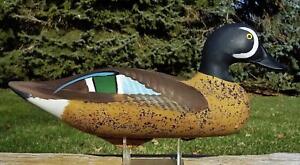
Sold on eBay December 23rd, 2023
MINT RARE TEAL ~SUPERB 100% ORIG SIGN~DATED 1992 CPT HARRY JOBES Wood Duck Decoy
eBay MINT & VERY RARE 32 YEAR OLD, AMAZING "SIGNED, DATED, SPECIES & GENDER" 1992 by the LATE CAPTAIN HARRY R. JOBES SR. DRAKE BLUE-WINGED TEAL CARVED in MADISON MITCHELL'S STYLE ~100% ORIG. CONDITION SUPERB GUNNING DECOY & ORIG. LEAD BALLAST WEIGHT & STAPLE & RING LINE-TIE ~CARVED & LEARNED from GREAT MADISON MITCHELL ~SUPERB PAINT & AWESOME CARVING ALMOST IDENTICAL to MADISON MITCHELL'S BEST TEAL ~NOT A NICK, CHIP, DENT, PAINT SMUDGE or FINGERPRINT on a MINT DECOY & a TINY PAINT FLAKE to the LINE-TIE ~INCREDIBLE 32 YEAR OLD "LIKE NEW BUT MELLOWED with AGE" PATINA ~HEAD & ALL RIGGING TIGHT AS IF JUST MADE ~BRIGHT GREEN SPECULUMS & WHITE EYE PATCH with PERFECT PAINTED EYES ~MINT BECAUSE PROTECTED IN A CASE IN A EAST COAST COLLECTION ~RIG-MATE HEN TO THIS DRAKE IS ALSO ON EBAY IF YOU ARE LOOKING FOR PERFECTLY MATCHING RIG & CARVING MATE PAIR MADE AT EXACT SAME TIME in JOBE'S CARVING SHOP 7 YEARS AFTER HARRY OPENED HIS SHOP in 1985 ~DON'T MISS OUT ON ONE OF HAVRE DE GRACE' MOST LOVED CARVERS MINT RARE TEAL ~SUPERB 100% ORIG SIGN~DATED 1992 CPT HARRY JOBES Wood Duck Decoy MINT RARE TEAL ~SUPERB 100% ORIG SIGN~DATED 1992 CPT HARRY JOBES Wood Duck Decoy Click images to enlarge Description AMERICAN CARVING LEGEND..... Captain Harry Jobes (above picture): 18 Year Old Harry Jobes Setting Out Canvasback Decoys on the Susquehanna Flats (above picture): Captain Harry Jobes (seated) and R. Madison Mitchell (shooting) Bushwhacking on the Susquehanna Flats (above picture): Harry Jobes in His 50's Finishing a Mallard (above picture): The Large Plaque Inside the Harry Jobes Tribute Section! (above picture): The Late Captain Harry Jobes c2018 with His Son Bob in Front of the Glass Enclosed Harry Jobes Display at the Havre de Grace Decoy Museum! CAPTAIN HARRY R. JOBES SR. Birth Name: Harry Robert Jobes BORN: Nov. 19, 1936 ..... Havre de Grace, Maryland ? DIED: May 10, 2019 ..... Aberdeen, Maryland (Captain Harry Jobes Passed Away at the Age 82) Have de Grace is a city in Harford County, Maryland. It is situated at the mouth of the Susquehanna River and the head of Chesapeake Bay. It is named after the port city of Le Havre, France, which in full was once Le Havre de Grace; (French, "Harbor of Grace"). (above picture): Harry Jobes in 1980 with One of his Largest Projects, 20 Swans he Carved (above picture): Harry Jobes Receiving One of his Many Awards for Promoting Tourism along the Chesapeake (picture below): "HARRY JOBE'S" BELOVED HAVRE DE GRACE & The UPPER BAY! This is WHERE CAPTAIN HARRY JOBES SPENT His ENTIRE LIFE MAKING DECOYS, HUNTING, CHARTER-BOAT CAPTAIN, GUIDE, WORKING at ABERDEEN PROVING GROUNDS & ALL AROUND WATERMAN ........ EVENTUALLY BECOMING ONE of the MOST BELOVED FAMILY MEN and ENDEARING INDIVIDUALS to GRACE SUCH a BEAUTIFUL and HARD WORKING COMMUNITY! (Picture Below): HISTORIC c1980 PHOTO of "HARRY JOBES" with Some of The Men That HELPED MADISON MITCHELL Over the Years; (left to right): "CAPTAIN HARRY JOBES", Paul Gibson, "Madison Mitchell", Clarence Bauer and Jim Pierce. (above picture): The Above Photo is Very Interesting as It was Taken ~12 Years Before He made these Superb ..... Blue-Winged Teal "Up For Auction" in 1992 ....... More Significant Because they were Made 7 Years after Harry Opened his Own Shop ............ Because Harry Didn't Open His Own Shop Until 1985!! ______________ And as You Can See By the Pictures Below, Harry's Earlier Output was in Many Ways Close to Identical to Madison Mitchell's Decoys in Many Ways ....... ESPECIALLY his "AMAZING BLUE-WINGED TEAL!! ______________ (Picture Below): A PAIR of 1978 "MADISON MITCHELL" BLUE-WINGED TEAL: (Picture Below): These 1992 "HARRY JOBES" BLUE-WINGED TEAL DECOYS (up for auction): (Picture Below): Another PAIR of 1978 "MADISON MITCHELL" BLUE-WINGED TEAL DECOYS: (Picture Below): These 1992 "HARRY JOBES" BLUE-WINGED TEAL DECOYS (up for auction): _________________________________________ (Below Photos): This MINT, SCARCE & 100% ORIGINAL, ALMOST A THIRD of a CENTURY OLD" -AND- 32-YEAR OLD, "SIGNED & DATED" 1992 HARRY JOBES, "DRAKE" BLUE-WINGED Decoy Up for Auction!! Mint "Like New" Pristine; 100% Original Condition without a Rub, Chip, Check, Crack, Dent, Paint Smudge or Fingerprint on this Spectacular & Scarce Solid Cedar Decoy! Typical Thick Tail and Bill is Carved & Sanded Thick on the End for a Clean, Surface & Shape ....... The Entire Body was Made in Harry's New Shop with an Outstanding, Undulating Mitchell Form & Style ........ it Starts with a Beautifully Rounded Breast, then a Wide & Yet Thick Noby that Culminates in a Gorgeous, Upswept Tail!! (Below Photos): This SCARCE, MINT, "LIKE-NEW", 100% ORIGINAL, SUPERB FINELY BRUSHED ON BACK FEATHERING, SPECULUMS & WING PRIMARY FEATHERS! Very "Mason-Like", Not Only Does it Have Swirling Back Feathers & Clean Green Speculums ......... it Also Has "DOUBLE BLUE" or "Twin" Blue Wing-Feather Groups ......... and Gorgeous Long "Sweeping Wing Primaries": _ (Below Photos): The Bottom of this Drake Blue-Winged Teal has a Perfect Bottom in Mint Condition ....... and Perfectly Tight "Like-New" & Perfectly Intact "Ring & Round Staple" Line-Tie & Staple-Nailed, Lead Ballast Weight!! The Perfect Bottom on this Decoy is Sensational, Mint & Like the Sides it is a Bright, Brown-Orange ....... AS the WEIGHT is LIKE NEW ... a COUPLE TYPICAL TINY PAINT FLAKES on the LINE-TIE RING; And WONDERFULLY FREE of ANY CHIPS, DENTS, PAINT FLAKES, FINGERPRINTS, CHECKS or DEFECTS on ANY KIND, ......... AS IT WAS NEVER USED & ONLY SAW WATER WHEN it was "TUNED" by FLOATING it in a TANK to LOCATE WHERE the LEAD BALLAST NEEDED to BE LOCATED!!! The Bottom is Also Cleanly Signed & Dated By Harry Jobes with: "Blue-Wing Teal Drake" -and- "Capt Harry Jobes" -and- "Maker 1992" This Decoy is So Mint, "Like-New" & Unused .......... The RING on the LINE-TIE is STILL STUCK into the ORIGINAL PAINT on the BOTTOM STAPLE!!!!! _ (Below Photos): The HEAD of this STURDY, WELL-ROUNDED & STUNNING DRAKE BLUE-WINGED TEAL DECOY'S HEAD & NECK from SEVERAL ANGLES; With PERFECTLY CARVED in HEAD/BILL SEPARATION & PAINTED-EYES ....... and ALL NAILS to ATTACH the HEAD to the BODY are PERFECTLY HIDDEN UNDER WHITE LEAD & PAINT and MINT CONDITION!!!! INCREDIBLE MINT PAINT to the ENTIRE DECOY & YOU CAN SEE EVERY BRUSH MARK ............ with VERY NEAT WHITE, PERFECTLY PAINTED "CRESCENT MOON" on the FACE ........... and PERFECTLY LOCATED YELLOW & BLACK PAINTED EYES & BLACK BILL ......... with BLACK BILL and SUPERB "SLATE BLUE-GRAY" HEAD!!! The "BLUE-WINGED TEAL" HEAD & NECK FLOW SO PERFECTLY into the BREAST that IT'S HARD-TO-SEE WHERE the SEAM IS .......... it's JUST a GORGEOUSLY PAINTED & CARVED "SEMI-ALERT" HEAD for a DRAKE "BLUE-WING" ? _ (Below Photos): This MINT, "SIGNED & DATED", DRAKE BLUE-WINGED TEAL ....... Shown with the RARER & Just as AWESOME 100% ORIGINAL CONDITION HEN RIG-MATE Also on EBAY!! LIKE MOST CARVERS & ALL FACTORIES: Since Males by Nature are All Much More Vibrantly Colored, Drakes were Made in Much Greater Numbers Since they are Much More Visible to Wild Ducks ....... which Makes the Hen also on ebay Much Rarer than this also Rare Rig-Mate Drake!! LOOK HOW SPECTACULAR they LOOK TOGETHER & COMPLEMENT EACH OTHER!! ? This Superb Pair Have Been Together Ever Since they Entered Their Collection -and- Have Been in the Same Hands and Collection Ever Since!! ] _ This STUNNING, CAPTAIN HARRY R. JOBES, DRAKE BLUE-WINGED TEAL DECOY up for Auction: SUPERB 100% ORIGINAL; MINT & LIKE-NEW, "SIGNED & DATED with SPECIES & GENDER"; 1992 CAPTAIN HARRY ROBERT JOBES SR.; INCREDIBLE PATINA & PAINT; 32 YEAR-OLD, DRAKE BLUE-WINGED TEAL; SOLID-CEDAR; WOOD DUCK DECOY; HAVRE de GRACE, MARYLAND; SUSQUEHANNA FLATS (UPPER CHESAPEAKE BAY) This DRAKE GUNNING DECOY was CARVED LIFE-SIZED!! (This Size of His Decoys are His Most Sought After Work!!) ? OUTSTANDING ORIGINAL PAINT and CARVING on this VINTAGE GUNNING DECOY with AN INCREDIBLE, PERFECT PATINA!! EXCELLENT FORM on a SCARCE, VINTAGE "DRAKE BLUE-WINGED TEAL" GUNNING DECOY as SOME WOODEN DECOYS WERE STILL BEING USED by DISCRIMINATING HUNTERS ........ BUT this DECOY FOUND its WAY into a COLLECTION INSTEAD of the MIDDLE of a SMALL POTHOLE, or a SLOW-STRETCH of WOOD-LINED, RIVER WATER!! ? AWESOME STIPPLED, DAUBED, SWIRLED & STRAIGHT-LINE, BRUSH-STROKE "HARRY JOBES" PAINT -and- NICE, SEMI-ALERT, POSED HEAD & NECK TURNED TO to its RIGHT ABOUT 20 DEGREES!! Vintage Hunting Decoy & His Very Best, Working Bird Style with his Nice, Long, Yet Stout at the Water Level, Body Style and Form!! Harry Jobe's Had a Very Prestigious Clientele, that including Gunner's National-Wide ...... Harry Made Decoys for Hunting for Various Members of the Famed "DuPont Family", the "President of Hardee's" Fast Food Restaurants, "Coca-Cola's 100th Anniversary" & Many More including Hunters as Far as "Holland and Elsewhere Around the World"!! ORIGINAL RIGGING is PERFECT -with- 100% ORIG. RIGGING: STAPLE-NAIL Attached LEAD BALLAST WEIGHT -and- COMMERCIAL STAPLE & RING, LINE-TIE!! ? ? This MINT, NEVER HUNTED OVER, DRAKE & the HEN also on Ebay LOOK & SHOW as a GREAT PAIR & HAVE an INCREDIBLE & VERY APPEALING, and a MINT, YET BEAUTIFULLY AGED PATINA! There is OBVIOUSLY NO GUNNING WEAR & NO SHOT MARKS; NO RUBS, NO PAINT SMUDGES, NOT a SINGLE FINGERPRINT, NO NICKS or CHIPS, NO CHECKS, NO DENTS or CRACKS, and there are ONLY TINY RUBS to the RING on the LINE TIE!! ALTHOUGH PROLIFIC: Early Gorgeous "Blue-Winged Teal" Like this Pair are Always a Nice Find!! ? ? __________________________________________ This is a Perfectly Symmetrically Carved & Painted Vintage Captain Harry Jobes Sr. "Drake Blue-Winged Teal" Decoy! The ONLY TIME that this Decoy "EVER SAW WATER" was in Harry's Shop When Harry "TUNED IT" By Adjusting Where the Ballast was Attached so It Swam Perfect in a Hunting Rig!!! ?This Superb Drake Blue-Winged Teal and the Hen Rig & Carving-Mate also on ebay, Both Measure: ?13-1/4" long x 4-3/4 wide x 6-1/4" tall and Each Decoy Weighs EXACTLY: 1-lb. 10-oz. ? BOTH of these DECOYS HAVE the SAME SIZE, STYLE, FORM, CARVING, PAINT PATTERN -and- "BOTH MADE AT THE EXACT SAME TIME"!! BOTH DECOYS are also FROM the SAME COLLECTION & OWNER! This DRAKE & the HEN also on Ebay LOOK & SHOW as a GREAT PAIR TOGETHER & BOTH are FROM the SAME COLLECTOR & PURCHASER!! BOTH also have an OUTSTANDING PATINA FROM AGE & VERY CAREFUL HANDLING, OBVIOUSLY "NEVER" HUNTED OVER & EXTREMELY WELL TAKEN CARE of WHILE in THEIR COLLECTION!! Awesome White Face Mask "Crescent Moon", Green & "Double Blue" Speculums with Daub-Paint Stippled & Swizzled Back & Secondary Feathers & Long Sweeping Primaries ........... Along with Clean and Awesomely Stippled "Dark Brown on Red-Orange" Paint to Lower Neck, Breast, Sides & Bottom ........... Crisp & Clean Slate Gray-Blue Head & Neck Paint that all Perfectly Flows Together to Create a Realistic Drake Blue-Winged Teal in Full Winter Plumage! STRUCTURALLY PERFECT HEAD & NECK with ALL NAILS PERFECTLY INTACT and TIGHT AS IF MADE YESTERDAY WITHOUT a SINGLE SIGN of a TYPICAL NECK CHECK that YOU QUITE TYPICALLY FIND on DECOYS as it is INHERENT to the CONSTRUCTION METHOD of the UPPER BAY CARVERS!!! ? ? To Find Perfect Pairs, Carved From the Same Rig ........ Made at the Same Time is Always Nice When Buying Pairs of Decoys! The HEN RIG-MATE to this DRAKE is ALSO on EBAY if YOU are LOOKING for a SUPERB "HARRY JOBES" BLUE-WINGED TEAL PAIR; WRITTEN in BLACK PERMANENT MARKER on the BOTTOMS ..... is the SIGNATURE, MAKER DATE, SPECIES & GENDER Which Were OBVIOUSLY DONE at The EXACT SAME TIME!! (Truly a Great pair to Own) ______________ (Below Photos): A COUPLE OTHER PAIRS of "BLUE-WINGED TEAL" by the LATE & GREAT, CAPTAIN HARRY JOBES: __________________________ This OUTSTANDING "CAPTAIN HARRY JOBES" "DRAKE BLUE-WINGED TEAL" GUNNING DECOY up for auction: This AWESOME 100% ORIGINAL CONDITION "DRAKE BLUE-WINGED TEAL"; "SIGNED & DATED" with the "SPECIES WRITTEN" 1992 HARRY R. JOBES 32+ YEAR-OLD GUNNING DECOY with SUPERB 100% ORIG PAINT, CARVING, STYLE, PATINA & FORM!! ? _ CAPTAIN HARRY JOBES "LEARNED FROM" -and- "CARVED WITH and FOR" ....... The LATE DECOY "CARVING LEGEND" R. MADISON MITCHELL!! _________________________ (Below Photo): HISTORIC c1980 PHOTO of "MADISON MITCHELL" with Many of The Men That Helped Him Over the Years along with a Contemporary, Paul Gibson; (picture below: Left to Right): CAPTAIN HARRY JOBES, Paul Gibson, "MADISON MITCHELL", Clarence Bauer & Jim Pierce. ? (below): This Decoy for auction was Made in 1992 by: "HARRY JOBES" when was "52" Years Old ? Made in His Own Shop After he Left Mitchell's Shop & Opened his Own in 1985: ? PRISTINE, 100% ORIGINAL PAINT; FULLY-RIGGED; "32 YEAR-OLD" GUNNING BIRD; HAND-WRITTEN; "SIGNATURE, DATE, SPECIES & GENDER"; 1992 CAPTAIN HARRY JOBES; "DRAKE BLUE-WINGED TEAL"; WOOD DUCK DECOY; HAVRE DE GRACE, MARYLAND; SUSQUEHANNA FLATS (UPPER CHESAPEAKE BAY) Harry Began Making Decoys at the Age of 9 & Learned Originally Working in "CHARLES BARNARD'S Shop ....... But in Reality He Learned Everything he Knew from the GREAT "MADISON MITCHELL Harry Jobes Worked in Mitchell’s Decoy Shop for over 28 years Before Opening a Shop of his Own in 1985 ....... 7 Years After He Left Mitchell's Shop He Made these Blue-Winged Teal!!! Excellent & Classic, Beautifully Contoured Body Style with Superb Bill and Great Sweeping Tail!! ? This is a TRADITIONAL "UPPER BAY" MADISON MITCHELL STYLED "HARRY JOBES" DRAKE BLUE-WINGED TEAL .......... A BEAUTIFUL, VERY SMALL-SIZED, PUDDLE or DABBLING DUCK!! SUPERB DEEP, STUNNINGLY GORGEOUS, ORIGINAL PAINT on this 32-YEAR OLD, GUNNING DECOY with EXCELLENT OLD & DRY PATINA!! SUPERB FORM in the STYLE HE LEARNED from MADISON MITCHELL & PASSED on to his THREE TALENTED SONS that they EACH GAVE their OWN LOOK, STYLE & FORM TO!! ? AWESOME DAUBED & STIPPLED HARRY JOBES PAINT & NICELY POSED, TURNED HEAD CARVING!! Awesome Turned Head, Drake Blue-Winged Teal Hunting Decoy ........... Almost Exactly the Same Carving and Panting Detail as His Mentor Madison Mitchell's Blue-Winged Teal!! ALTHOUGH NOWHERE NEAR as PROLIFIC as MADISON MITCHELL, And AFTER HAVING MADE MANY CANVASBACKS, BLUEBILLS & REDHEADS BLUE WINGED TEAL like these INCREDIBLE EXAMPLES are "EXTREMELY HARD to FIND from this 1990 TIME PERIOD" ........ GREAT SPECIMENS to COMPLETE a COLLECTION of HARRY JOBES or RARE UPPER BAY DECOYS!! ? This is a PERFECTLY CARVED & PAINTED VINTAGE DRAKE BLUE-WINGED TEAL & HEN RIG-MATE also on ebay WERE MADE TOGETHER ........ and ACTUALLY ONE of the the NICEST PAIR of HARRY'S BLUE-WINGED TEAL that CLOSELY RESEMBLE MADISON MITCHELL'S that YOU'LL SEE ANYTIME SOON!! ? This Decoy's Dimensions & Weight are Perfect & Typical for a Small-Sized, Marsh, River & Flooded Woodland Duck ......... and its Solid Cedar!!! This Pair of Decoys Clearly Came from their East Coast, Climate Controlled, Direct Light-Free Collection that they Were Lucky to Be Added To as It They Have Been Kept in Mint, "Like-New" Condition Over the Better Part of Over 3 Decades Since they LEFT HARRY JOBE'S WORKSHOP & HARRY'S HANDS!! IF YOU are a FAN of GREAT GUNNING DECOYS that WERE MADE to GUN DUCKS OVER & SWIM PERFECTLY ...... This is a FANTASTIC PAIR to add to YOUR COLLECTION as DECOYS from the EARLY DAYS of HARRY JOBE'S OWN SHOP have a UNIQUE STYLE, FORM & PAINT and are NOT EASY at all TO COME BY!! If You Like Important Decoys from the one of the More Important Middle to Later Period Upper Chesapeake Bay Region Decoy Carvers, that Are in Outstanding, 100% Original Condition ........... THIS IS A GREAT DECOY FOR "ANY" COLLECTION!! _________________________________________ IN THE NEXT FEW WEEKS I AM PUTTING ON EBAY MORE LAWRENCE BETHEL FISH DECOYS, A PEARL BETHEL SUCKER, A PAIR OF THE ONLY KNOWN PROTOTYPES MADE OF THE VERY FIRST PRE-PRODUCTION FIBRE DECOYS EVER MADE, A NEAR MINT 1927 HEDDON GIANT VAMPIRE FISHING LURE IN RARE SHAD, A PAIR of LATE PHASE DODGE MALLARDS, A PAOR of MINT 1960 MADISON MITCHELL PINTAILS, A VERY RARE VICTORS DRAKE BUFFLEHEAD, A RALPH MALPAGE PAIR OF WOOD DUCKS, A VERY RARE c1893 100% ORIGINAL TRANSITION PERIOD MASON DRAKE BUFFLEHEAD, AN ORIGINAL PAINT SUPERB J. R. WELLS HEN BLUEBILL, A MINT c1905 HEDDON ARTISTIC MINNOW, A SCARCE RALPH MALPAGEPAIR OF GREEN-WINGED TEAL, A YELLOW WITH RED EYE BLUSH MOONLIGHT SINGLE-HOOK PIKAROON, A NIB CREEK CHUB MULLET COLOR STRIPER PIKIE IN CORRECT BOX, A PAIR of EXCELLENT MASON MALLARDS, NICE PAIRS OF MASON GLASS EYE & TACK EYE BLUEBILLS, AN AWESOME ERNIE NEUMANN SUCKER FISH DECOY, A RARE & EARLY 100% ORIGINAL 1930 WILLIAM LOHRMAN ILLINOIS RIVER CANVASBACK, A VERY NICE ERNIE NEUMANN SUCKER, A RARE 12-1/2" CHET SAWYER MINNESOTA FISH DECOY, A NEAR MINT OSCAR PETERSON PERCH FISH DECOY, A MINT PAIR OF WRAGG & BURRELL WIGEON, AN OUTRAGEOUSLY HARD TO FIND PAIR OF CHARLIE POZZINI BLUEBILLS, AN AMAZING JOHN HOLLOWAY SLEEPING TURNED HEAD DRAKE PINTAIL, A VERY BIG & BULL-NECKED EARLY FERDINAND BACH DRAKE CANVASBACK FROM HIS PERSONAL RIG AND MORE!! ? Shipping Includes Insurance! I Don't Believe in Making a Profit on Shipping, You Pay What I Pay. If it's Less Than You Paid I Refund the Difference, If More I'll Pay For It. I COMBINE SHIPPING. I am also loading over 150 Duck Decoys, 150 Fish Decoys, 70 Scarce Fishing Lures, etc. so keep checking back. __ This OUTSTANDING, RARE, MINT, CAPTAIN HARRY ROBERT JOBES SR., "DRAKE BLUE-WINGED TEAL" up for auction: ITEM DESCRIPTION: This 32+ Year Old, Mint Condition, Signed and Dated, Signed Species, Signed Gender, Wonderfully Formed, Solid Cedar, Drake Blue-Winged Teal was Superbly Carved and Painted by the Late Captain Harry Robert Jobes, Sr. of Havre de Grace, Maryland. He rough carved this awesome decoy on a lathe in his own shop in 1992, similar to the one he mastered after helping Madison Mitchell keep up with orders in Mitchell's shop for 28 years. But Harry didn't just master the art of carving and constructed a decoy by Havre de Grace's beloved Mitchell, Harry also mastered painting the various species as well and this Teal is a perfect example of what he learned. (picture below): Harry Jobes c1990, Back in the Day, Just 2 Years Before He Made this Spectacular & Rare Blue-Winged Teal Decoy up for auction: (picture below): Harry Jobes c2018 at the Havre de Grace Decoy Museum, Roughly a Year Before He Sadly Passed Away at the Age of 82 on May 10, 2019: ________________ ABOUT CAPTAIN HARRY JOBES LIFE ........ An AMBASSADOR and SPOKESPERSON for the RICH CARVING & HUNTING HERITAGE his WHOLE LIFE and RIGHT UP UNTIL the DAY HE SADLY PASSED AWAY! The Region's Rich History & Harry Jobes Involvement: Havre de Grace, known as the decoy capital of the world, has spawned an entire dynasty of decoys as well as decoy carvers. Decades ago, little did gunners know that the hundreds of decoys that they chopped at their workbenches in their spare time for hunting season would one day be considered a valuable art. Fortunately, many of the earliest carver’s works have been discovered in abandoned barns and cluttered attics and have been preserved for today’s appreciative collectors. And, like all true art, the skills involved in creating these counterfeit ducks have also been passed down from earlier generations to today’s carvers. One of these earlier gunning decoy carvers and then later collector carvers was Captain Harry Jobes, a very unique individual. You could often spot him at a decoy show, decked out in his Panama hat, suspenders and duck pants, as well as one of his famous hand-knitted "Captain Jobes" sweaters. Mr. Jobes was born in Wilmington, Delaware, to Donald Keith Jobes and Lorelle Evangeline "nee Beauchamp" Jobes on November 19, 1936. Even his shop, which was located behind his home in Maryland, was not the typical decoy shop. Easy to spot because of the American and Maryland flags hanging in front of his house, a visit to his shop was quite a delight. At first glance, the shop reminded you of others – the smell of pine; a coating of sawdust on benches, windows, and patterns; the lathe, band-saw, sanding machine, spoke shaves, and draw-knives; the paint table, near the wood stove, with a variety of paint cans, thinners, and brushes, drying racks holding row after row of decoys; and bodies and heads in various stages of completion on the floor and in baskets throughout the shop. (picture below): At this Time, Captain Harry Jobes was 77 when He Carved & Painted this Awesome Swan Decoy! But that’s where the similarity to other shops ended. Hanging on the wall were pin-ups of "Elvira." His 13 year-old, granddaughter Monica was puttying ducks while her black Lab puppy chewed the head of a finished wood duck. However, Captain Harry Jobes looked at the puppy, laughed and said, "He’s in the doghouse now!" And, anyone who knew Harry will tell you what a dry sense of humor he had. For instance, when he would be working in the shop and the phone rang, he might answer it with, "Nobody here but the chickens!" Or, when asked if he’s made any decoys, he replied, "They’re in the incubator." Harry’s interest in carving decoys went way back to his childhood days where he was born and raised in Havre de Grace. His carving career began in Charles Nelson Barnard’s decoy shop which was located two blocks up the street from his home. Harry once said, "I was about 8 or 10. I’d run in and out of the shop, sand duck heads, then run out and play football, kick the can, and wrassle, then run back in and sand another head." In fact, Harry grew up in the midst of several other famous Havre de Grace carvers, such as Bob McGaw and Jim Currier, and could tell you many stories about most of them. Harry Jobes once said, "I also used to run in and out of McGaw’s shop ...… but he was a little on the contrary side. You didn’t touch a tool in Bob’s shop – indeed you didn’t. He didn’t want no kids in there." (pictures below): 3 Photos of Havre de Grace Carving Legend R. Madison Mitchell, the Man that Taught Harry Jobes Most Everything He Knew About How to Construct and Paint a Perfect Upper Bay Style Duck Decoy. This Pair of Blue-Winged Teal Carved By Harry in His Shop Show How Exact Harry was in Following His Mentor Madison Mitchell's Patterns, Paint & Thus Inherited the Aura of a Mitchell Decoy: (picture below): A Young Madison Mitchell Dressed for what Appears to be a Funeral, as He was the Towns Main Undertaker & Funeral Arranger: (picture below): An Older Madison Mitchell in His Shop Sharing a Laugh with a Fellow Carver or Visitor: (picture below): A Middle to Slightly Older Madison Mitchell with a Drake Redhead & a Few Bluebills from a Successful Hunt: After working in Charles Barnard’s shop for two or three years, young Harry Jobes decided to enter one of his decoys in an art show being held at the Havre de Grace High School. He once related it by saying that he laughed, "I was in the elementary school then, and it (his decoy) looked like a chicken had painted it with his feet. But I took it up to the show, and I thought it looked pretty good to me." When Harry Jobes got to the show, he met a lady by the name of Helen Mitchell, who had several decoys made by her husband Madison, the very famous and late R. Madison Mitchell. When he saw Mitchell’s decoys Harry said, "Hell, I might as well take my decoys home." But Mrs. Mitchell was very friendly and started talking to him because she knew his grandfather. She even invited him to go to work for her husband; but since Harry was already working for Mr. Charles Barnard, he refused the offer. And, he did win a ribbon in the art contest. "A pink ribbon or a red ribbon or something," Harry once fondly remembered. (picture below): Harry Jobes in the Mid to Late 1980's Filling Orders in His Shop, which He Opened in 1985: However, a year after the school's decoy show, Charles Barnard died, and Harry went down to Mitchell’s funeral home. When Mom Mitchell answered the door, she told him to go around back to Pop’s shop. "And I worked for Mitchell for 28 years," replied Harry. "I made twenty-five cents an hour after school. I spoke shaved decoys, ran the machines and I got so good I could do just about anything …....... it didn’t make any difference if it was painting or making the heads. I did anything in the shop", Harry once recalled. Sometimes there were as many as five to six woodcarvers in the shop at one time. According to Harry, you could have Bailey Moltz, Bud McKinney, Cats Wilson, Jimmy Pierce, Bob Mathews and Titbird Bauer whittling heads while Ed Sampson did all the draw knifing. Harry said he sawed them out. He once recalled, "Bailey Moltz was the best head carver on the East Coast; he’s the one who really taught me how to whittle a head. But, the painting I learned off Mitchell. He has had the biggest influence on me as a decoy maker…no question about it." (picture below): Harry with his 3 Sons Somewhat Later in Life: When he was once asked what it was like working for Mitchell, he stated, "We didn’t make a lot of money, but we left a lot of memories and had a lot of fun. The memories they can’t take away from us." Harry remembered a time back in the 1950’s when Madison Mitchell had 500 canvasback decoys in his north garage that they couldn’t sell because shooting canvasbacks had been outlawed. Eventually Harry contacted a boy up in Wilmington who bought 250 at seven dollars a piece, but they still had 250 left Harry recalled. Harry added, "We took the other 250 brand new decoys, freshly painted, and sawed the heads off them and threw the bodies in the dump where the A & P Store used to be in Havre de Grace". They took them down there and burned the bodies up. Ed Sampson draw-knifed the heads to look like black ducks, But you Couldn’t sell decoys in those days, you couldn’t give them away. You couldn’t gun diving ducks so nobody wanted them." (picture below): Harry Jobes and his Son Bob with Family & Friends in Front of the "Harry Jobes Exhibit" at the Havre de Grace Decoy Museum": Jobes once told another story about the time he and Brother (Mitchell’s son) were working at the shop one night, jack-planing the spots on the bodies where the heads go on. Brother took the plane apart and sharpened it. But when he put it back together, the blade was sideways instead of straight; and it took off more on one side than it did on the other. "We planed off 500 bodies with the side cut unevenly." About six o’clock the next morning Eddie Mauldin and Harry Jobes were eyeing ducks when Madison Mitchell walked in, picked up one of those decoys sideways, looked at it, and saw that it and all the others had been planed off crookedly. Harry Laughed, "He was a pistol, I got the blame for it. But when I explained what had happened, Madison Mitchell's one Brother got his ear bent when he came to work." When asked what they did with the decoys, he commented, "We just nailed the heads on and let them go. They were just a looking at you sideways a little bit. They were only gunning decoys. Of course, if you could find three or four now, they’d be worth something." While working with Madison Mitchell as his mentor for 28 years, Harry also spent much of his life working on the water running research vessels for the states of Maryland and Virginia, and working for the government at Aberdeen Proving Ground piloting a patrol boat. He also operated his own charter boat business – hence the moniker "Captain" Harry Jobes. But, somehow, like all others, decoy carving became an avocation, the long hours spent at night, weekends, and holidays, that sustained his spirit; so in 1985, Harry Jobes decided to retire, build his own decoy making shop and devote all of his time and energies to carving decoys. Unlike some of his colleagues, Captain Jobes made decoys all year around and created a very demanding business. It soon was no longer a part-time occupation; and even though he spent endless hours in his shop, the demand for his decoys constantly exceeded his ability to produce them. He once commented, "Decoys have been damn good to me. I’ve worked at it ....... stayed at it". His wife and business partner, Helen Jobes, a very gracious lady who endured, with good humor, visitors at their home and shop at all hours of any day, once recalled, "I used to get a break when he went to work. Now that he’s retired he works three shifts – morning, afternoon, and evening. When there’s nobody here at night. I usually get the night shift." When asked by others what she does, she used to reply "sweep floors." However, Helen took care of the perpetual paperwork of the business – recording orders, packing decoys, sending them out, etc. – work that most collectors never dream about when purchasing a Harry Jobes decoy. Indeed, the Jobes’ decoy business had become a family tradition. Just as Harry learned from Mitchell, his three sons, Bobby, Charles, and Joey, also learned from their father. All three of his sons started carving in his shop when only children. "Bobby, the oldest, used to stand up on a fish box in order to reach the vise," recalled Harry". His stepson, Jeff, who also worked in the decoy shop, was then at the time the co-publisher of Decoy Magazine, which later was turned back over to Joe Engers as the sole owner and publisher. Harry Jobes once remembered the time that Madison Mitchell called him and wanted to know if he could recommend someone to replace Ed Sampson when he retired from draw-knifing heads. "Bobby can draw-knife," replied Harry, "So Bobby went to work for Mitchell and left me holding the bag!". Bobby was Harry Jobes 2nd eldest son. All of Harry’s sons now carve decoys as a full time profession. It was quite obvious that Harry was very proud of each of them. He once quipped, "I have raised three boys, and they can do anything to a decoy that needs to be done." Bobby specializes in miniatures, Charles in half-size, and Joey in full-size decoys. Harry added, "All three are good. They’re all better than I am,". And also said, "Let’s put it this way, there’s always somebody better than you are. It doesn’t make any difference what you do." (picture below): A Very Dated Pic of Harry's 3 Sons: Harry Robert "Bob" Jobes Jr., Charles Keith Jobes and Joseph Allen Jobes!! However, Captain Jobes was a craftsman whose talent is reflected in his decoys which are so admired and sought after today its no coincidence because he learned from the best, Madison Mitchell, and carved a great many decoys that look just like Mitchell's decoys in many ways. And as a matter of fact, without those tiny clues for the trained eye, this pair of Blue-Winged Teal likely could have been attributed to either because in 1980 and still working in Mitchell's shop, and after 1985 in his own shop, making a Mitchell decoy was second nature for Harry Jobes. His popularity in the Havre de Grace area has been demonstrated by the fact that he was chosen as the Honorary Chairman of the 1988 Havre de Grace Decoy Festival. When asked how he felt about being selected for this honor, he stated. "It’s good; I guess I was surprised." Then, his dry sense of humor surfaced once again as he smiled and said, "The day before the show I’m getting two splints put on my hands so I don’t have to sign all those ducks." Although Harry Jobes made both working and ornamental decoys in that famous Havre de Grace style, all of the decoys he donated for the 1988 show and auction were working decoys. A set of 25 full-size and miniature decoys include the following species: regular and high-headed canvasbacks, redheads, blackheads bluebills), mallards, buffleheads, baldplates, cinnamon teal, ringnecks, shovelers, old squaws, pintails, goldeneyes, black ducks, wood ducks, a white wing scoter, a coot, a Canada goose, a blue goose, a snow goose, a brant, and a swan. Captain Jobes explained, "There’s a whole different ballgame between gunning and ornamentals. A working decoy you can sit it on a shelf and listen to it talk for two hours. Ornamentals can’t do that. When we made decoys years ago, we made them to go gunnin’ with, not to sit on a shelf ..... when you look at gunnin’ decoys from the 1900’s to the 1960’s, the only people who made ‘em were those who lived around the river shores. Now they make gunnin’ decoys in New York City. Two thirds don’t even touch the water anymore. You wonder where they went to. You’re like Babe Ruth – you played a good game and never got paid". When questioned about carving more miniatures, he exclaimed, "When these are done, there ain’t gonna be no more of them. I can make ten full-size heads while I make one of these miniatures." So collectors who desire a Captain Jobes miniature will find it quite difficult to purchase one. Harry continued, "The year Madison Mitchell 's wife died, I made a boxcar load of these miniatures. I had ‘em in the cellar by the bushel basket full, and you don’t hardly ever see one." If a collector were fortunate enough to discover one of those old miniatures, he would indeed have found a very valuable decoy, like this pair of Early to Middle Period Blue-Winged Teal decoys up for auction. Another time Captain Jobes was recognized for his outstanding decoys was in 1986 when Continental Can requested that he do a magazine advertisement for Coca Cola’s 100th birthday celebration. Many hours were spent preparing for the production of the ad. The day the production crew arrived, make-up artists worked on Harry before the photographers could film. Harry laughed, "They even brought lunch, but they forgot the Coke for the ad and had to go up to 7-11 to buy them." The final full page color ad featured Harry, working in his shop, painting a pintail drake, while his young grandson Shannon looked on. This photograph appears on the cover of the 1988 Havre de Grace Decoy Festival booklet. The later and last decoys Harry Jobes made, he sold to collectors and businesses located all over the United States and in foreign countries. He recalled at the time, "I ship them all over the place. I’ve got good friends in Holland. I ship decoys, they ship tulips, I trade ‘em decoys for Tulips," he said. However, not all of the people he sold to owned shops; many were hunters and sportsmen. "I got the president of Hardee's Corporation that’s got gunning marshes down in the Carolinas. I made 100 for him – 50 pair of wood ducks – and he guns them." Laughing, he said, "Yeah, it was a couple days of painting." Although born and raised on the Susquehanna Flats, Captain Jobes did very little hunting the last years of his life. He recalled before his passing, "Back Then you could look up and see thousands of cans. Now you can’t see nothin’." He remembered a time when 10-12 blinds were built on the western shore of the Chesapeake Bay where bushwhackers used to hunt. "I was one on the last ones to gun on the western flats. I’ve seen the best of this old Chesapeake." In 1970, when Harry Jobes was questioned about anything unusual that he had made, he recounted a time about ten years ago (1980) when he made 50 swans at one time. He recalled, "Most swan ever built around here at one time. It took a barrel of time to make those bodies and several cords of wood." About 30 years ago, Harry made the DuPonts four stand-up wood ducks. "They were painted in pure oil colors – took two months to dry. I ain’t gonna make no more of them things – no way!" He also once made 50 stand-up geese for Billy DuPont. (picture below): Harry Jobes with 50 Swans He Carved in 1980 while Still Working at Mitchell's Shop; That was 12 Years Before He Carved this Pair of Blue-Winged Teal up for auction; Both Made Right in Harry's Prime!! Asked if he had any hobbies, he once replied. "I used to piddle with model trains, but I don’t have time to anymore, I guess I got my hobby right here. As Mitchell used to say. "It’s a damn expensive one." According to Captain Harry Jobes, around 1986, his plans for the future were, "Just gonna make more decoys." He paused and said in that drawl of his, "I would like to take one more time and put a bushwhacking rig together and relive some of the days I had years ago. But you’ll never see that again there’s no question about it." Although those days of bushwhacking reside mostly in memory, Captain Jobes has taken his place among a select group of craftsmen who have made the Upper Chesapeake Bay region the decoy capital of the world. Much More Information on Captain Harry Jobes and Some Information About His Growing Up and Eventual Involvement in Decoy Making, Hunting & as An Ambassador for the Region: Captain Harry Jobes passed away on Friday, May 10, 2019 After a Full Life Lived and Along with Many Others, Becoming One of the Legendary Decoy Makers and Watermen of the Upper Chesapeake Bay!! Harry Jobes is a legendary talent, a master of gunning birds made in the style of the Madison Mitchell and the area, "The Susquehanna Flats", Chesapeake Bay decoys. His carving career began in Charles Nelson Barnard’s decoy shop which was located two blocks up the street from his home at the age of 8 or 9 by sanding duck heads. After several years Mr. Barnard died and Harry began working for the legendary Madison Mitchell. "I made twenty-five cents an hour after school .... I spoke shaved decoys .... run the machines ..... I got so I could do just about anything ..... it didn’t make any difference it it was painting or making the heads. I did anything in the shop." (Captain Harry Jobes) Captain Harry Jobes worked for the famous R. Madison Mitchell for nearly 28 years before opening his own shop in 1985. He has been featured in books, museums and in private collections. During his life he has been a commercial waterman, a hunting guide, as well as a charter boat captain. Some old images are available. "Bailey Moltz was the best head carver on the East Coast; he’s the one who really taught me how to whittle a head. But, the painting I learned off Mitchell. He has had the biggest influence on me as a decoy maker ..... no question about it" (Captain Harry Jobes) Captain Harry Jobes had three sons that all learned from him and other great carvers in the local area and then followed him into the decoy business. Each of them is a talented carver and painter, working on his own line of decoys. Captain Bob Jobes is the oldest, then Charles Jobes and Joey Jobes. "I have raised three boys, and they can do anything to a decoy that needs to be done." Bobby specializes in miniatures, Charles in half-size, and Joey in full-size decoys. "All three are good. They’re all better than I am," once commented by Harry. "Let’s put it this way, there’s always somebody better than you are. It doesn’t make any difference what you do." (Captain Harry Jobes) Harry was Married July 22, 2006, to Virginia, a long-time school friend. Harry used to make decoys all year around and had a very demanding business. The demand for his decoys constantly exceeded his ability to produce them. While Harry was in Great Demand as a Decoy Maker in his Later Years, Just like the Earlier Years using Mitchell's Shop or in his Own, he was never able to keep up with the intense demand for his "very special" and rare decoys that are finally selling at the prices his decoys have always demanded. but now significantly more as he was the last of the "Mitchell Shop Decoy Makers". From 2015 and after, Captain Harry Jobes had been having medical and physical issues and has not been able to produce decoys. Thus, this ended the decoy making days of the Great Captain Harry Jobes Sr. (below): THE HISTORY of CAPTAIN HARRY ROBERT JOBES SR. Harry R. Jobes, Sr. was born on November 19, 1936 in Harford County, Maryland. He was a third generation Havre de Grace born member of a family originally rooted in Pennsylvania. His great grandfather Joseph Allen Jobes (1846-1931) moved his family to Havre de Grace from Bucks County, PA in the 1870’s. Harry’s great grandmother was Caroline E Rowe (1849-1929). Her family goes back to 17th century Germany. Caroline’s great grandfather Dr. Johann M Rauh (1728-1792) migrated from Germany to Pennsylvania. Dr. Rauh’s son’s last name became Michael Rowe (1765-1816) after he was born in America. In 1860, teenager Joseph Jobes lived on a Bucks County, Pennsylvania farm with a family named Wright. He was still in school. Twenty years later in 1880, Harry’s great grandfather Joe Jobes was 35 years old. He was married to 34 year old Carrie and they were living in Havre de Grace, MD. They already had four boys and a girl. The children ranged in age from one to eleven. Harry’s grandfather Harry A Jobes (1871-1951) was nine years old. Great Grandfather Joe Jobes made his living as a bridge carpenter. A Good (2) Two Decades Later in 1900, Harry's Grandfather Harry A. Jobes still lived with his parents and siblings in Havre de Grace. He was 29 and both he and his brothers Edward and George were all employed as can makers. Ten years later in 1910, Harry was married to Alice Annette Dunston (1875-1955). The couple now owned a factory and grandfather Jobes' was a machinist. In 1920, Harry and Alice lived at 408 St John Street in Havre de Grace. Harry’s grandfather worked as a clerk in a clothing store and he and his wife Alice were now blessed with two children. Donald Keith Jobes (b.1911) was 8 years old and attending school and he would go on to complete the eighth grade. Donald Keith Jobes (b. 1911) had a son named Harry R. Jobes, the very Harry Jobes that made these Blue-Winged Teal and went on to become one of the later and last of the Old Guard of Havre de Grace's gunning decoy carvers. The Jobes family lived at 721 Otsego Street in Havre de Grace according to the 1930 census. Harry’s grandfather owned the home valued at $3,000. The family did not yet have a radio in their house. Harry Jobe's Father Donald was 18 years old, still lived with his parents, was single and unemployed. (picture below): The Incredible Plaque Located Inside the Glass Enclosed Display Featuring & Celebrating Harry Jobes and His Life: By 1940, Donald Jobes was married to Bernadine Jobes (b.1915). The couple still lived with Don’s parents in their Havre de Grace home on Otsego Street and Harry Robert Jobes (b.1936) now lived with his parents and paternal grandparents in Havre de Grace. Harry’s Father Donald worked as an assistant store houseman for the United States government at the Aberdeen Proving Grounds. His annual income was $1,300. He worked 44 hours a week and so did his wife. Harry’s mom was a stenographer. She earned $800 that year. Harry’s grandfather made $950 that year and he worked 48 hours a week in a department store. (picture below): Captain Harry Jobes' Lathe During the Early Stages of Forming a Decoy Body! (picture below): Captain Harry Jobes' Lathe Following a Body Pattern!! When young Harry Jobes got a little older, he started running the streets of Havre de Grace. His first exposure to the art of decoy making was before he was even 8 to 10 years old. Decoy maker Charles Nelson Barnard lived in Havre de Grace at 418 North Stokes Street and it was so close to the Jobes house that Harry could walk there from his family’s home in 5 minutes. Harry Jobes recounted how as a boy, he periodically mixed his playtime with working on decoys in Mr. Barnard’s shop. Harry also recounted how much more accommodating to young boys Mr. Barnard was when compared to another neighborhood decoy maker, Bob McGaw. Bob McGaw’s shop was almost a 15-minute walk for young Harry Jobes from his house. The pre-teen future decoy maker preferred the temperament of the Barnard shop to what the young lad found when he visited with Mr. McGaw. As a young man, Harry Jobes was just as committed to living a full life as he was when he was an adult. Harry worked part-time as he continued learning the ins and outs of decoy making from Mr. Barnard until Charles Barnard ended his decoy career. During that time, Harry was now entering Havre de Grace High School. In addition to his part-time job making decoys and his studies, Harry was both a varsity baseball and football player while at Havre de Grace High. He was a member of the baseball team that won the Harford County High School Championship in 1953 and his athletic endeavors secured him a membership in the school’s varsity club. Harry made and painted a decoy when he was in elementary school. Then, he entered it in a contest at the high school. He got a ribbon of some sort and it was during that contest that Harry met Mrs. Helen Mitchell, Madison Mitchell's wife. She was actually the member of the Mitchell family who hired Harry Jobes to work in her husband R Madison Mitchell’s decoy shop after Mr. Barnard stopped making decoys and didn’t need Harry’s help any longer. Harry worked for the Mitchells making decoys in their shop on a part-time basis for more than 28 years. When he started, Madison Mitchell paid Harry 25 cents an hour for his efforts. Harry Jobes time spent in that shop exposed him to some of the most talented decoy crafters in the world. Harry learned from them all. Bailey Moltz’s, Titbird Bauer’s and Pop Sampson’s names do not have the same level of recognition today as Harry’s or Madison Mitchell’s. Those fellows and others are the lesser-known masters of Madison’s shop. Those men taught Harry Jobes and many other young area carvers how to make decoys. Harry took what he learned and then he raised the area’s decoy marketing to a new level and eventually produced decoys on a par with Mitchell's like this pair of Blue-Winged Teal up for auction. Captain Harry R. Jobes (1936-2019), married Alice Helen Salters (1938-1991) and together they lived in Aberdeen. The couple had three sons during the years between 1959 and 1968. Mr. Jobes introduced all three of his children to the craft of decoy making. Harry’s sons, Bobby (b. 1959), Charles (b. 1968) and Joey (b. 1965) have enjoyed long and highly productive careers making decoys. They go about their work in much the same way as their dad and the old masters that Harry knew and learned from did. Harry’s second wife Helen M Baker (1929-2004) helped with the business end of Harry’s decoy enterprise in Havre de Grace. Until 1985, Harry made his primary living as a boat captain. Thus, he is widely known as “Captain” Harry R. Jobes. During his career, Mr. Jobes skippered research vessels for the states of Maryland and Virginia as well as a patrol boat off the federal proving grounds in Aberdeen, Maryland. Captain Harry also ran his own charter boat for many years. He was the epitome of a waterman. (picture below): Harry Jobes was Always Eager to Help with Causes Including the Halloween Festivities at the Havre de Grace Decoy Museum, as He Greeted the Kids & Parents Right in Front of His Permanent Exhibit within the Museum: Up until 1985, when he made his own decoy making shop, Harry Jobes helped out in Madison Mitchell's shop, and as he did with other carvers like Charlie Joiner, Madison Mitchell made his shop available to them to make their own decoys if the shop would otherwise have been idle. This pair of Blue-Winged Teal decoys up for auction were made in 1992, 7 years after Harry retired from the Aberdeen Proving Grounds job and opened up his own shop in 1985. Captain Harry began making all of his decoys full time in his own new shop. But after a good 30 years of making decoys, around 2015 Harry Jobes began to curtail his carving efforts down to a trickle. In his later and last years you could still buy his decoys and he occasionally could be found in a Panama hat at decoy related events, many of which were with one or more of his sons. For countless years, Captain Harry and his family members generously contributed their time and energies to the Havre de Grace Decoy Museum, Ducks Unlimited and other similar historical and conservation charities. (picture below): Harry Jobes, Ever the Doting Father, in His Last Years He Enjoyed Time with His Grandchildren: Captain Harry’s decoy production is quite varied and he was certainly one of Havre de Grace's greatest carvers, and as time goes on the Demand for his Work, the Appreciation for his Outstanding Decoys and the Prices Being Realized for them Continues to grow at an Amazing Level. He has made both gunning decoys and ornamental decoys. His decoys are lathe turned and they all have the traits of the traditional Havre de Grace decoy. Harry has made just about every species of waterfowl in every pose you can conceive. Harry Jobes was a member of the Havre de Grace Elks Lodge, Duck’s Unlimited and the Havre de Grace Decoy Museum. He enjoyed traveling, hunting, fishing and crabbing. Collectors can find Harry’s decoys in every state in the nation and all around the world as well as appreciation and demand for them grows exponentially year after year after year. Harry passed away on May 10, 2019, and was one of the Last Havre de Grace carvers that carved during the golden years when almost all decoys were made of wood specifically for hunters, and ducks were still rafting up across the country in large migrating groups and piling into marshes looking for refuge, rest and food while on their journey. When Harry Jobes Sr. passed, he was predeceased by his first wife Alice Helen Jobes, second wife Helen Margaret Williams Jobes, and his siblings. He is and always will be missed. Captain Harry Jobes carved decoys for most of his life. The Captain has spent all of his life on the Chesapeake Bay and Susquehanna Flats as a commercial waterman, hunting guide and charter boat captain. This close association with nature has given him first hand insight into the waterfowl world. Captain Harry’s decoys have been featured in books and museums as well as many private collections across the country. All of this experience and knowledge Harry passed on to his 3 sons and from the photos above you can see that they were great listeners and learners as their decoys are also excellent, true to form and will carry on the Jobes' decoy making tradition for generations to come. But each son has his own style, form and paint which is a tribute to each of the son's own artistic abilities and their search for a making a decoy that was distinctively their own style, form and paint giving each son's decoys their own unique look and feel. _ This STUNNING, R. MADISON MITCHELL, DRAKE "BLUE-WINGED TEAL" DECOY up for Auction: This Mint and 100% Original, "Signed & Dated", Plus "Species & Gender" is written on the bottom and this 1992 Captain Harry Jobes Drake Blue-Winged Teal decoy up for auction is aesthetically and structurally as magnificent as the day that he carved it 32 years ago. It is perfectly symmetrical from both painting and carving standpoints including the location of the painted on eyes and the carved in head/bill delineation. This decoy is in Awesome 100% Original Condition, even considering it is a 32-year old gunning bird that is mint because it went straight from Harry's work bench and into a discriminating East Coast decoy collection! Very neat bill contours perfectly like a real Blue-Winged Teal in the Wild and the head and neck carving on this great decoy is phenomenal, especially the very neat semi-alert and turned head. The base of the neck is beautiful as it flows flawlessly from the body and into the neck seat and down the nicely rounded breast and sides. The daubed and stippled paint on this decoy is also incredible, as it really creates a life-like feathered appearance to the entire decoy, especially the daubed and swizzled back feathers and speculums, as well as long sweeping primary feathers and white "cresecent moon" face & eye patch along with the green speculums that are thinly bordered with black and then a thicker white border, with both speculum border paint being perfect, straight-line paint! This decoy is absolutely perfect with all 100% original paint and the original rigging is perfectly intact and in superb condition. Great color on the paint job with a perfect and deftly applied "daubed" paint job in the tradition of the Havre de Grace style almost exactly like that of Madison Mitchell's decoys as he likely carved this decoy with Mitchell's decoy patterns and form but in his own shop, but since he retired he no longer had other full-time job obligations to attend to. But in addition to the Havre-style daubed paint, the stippling to the paint on the back is concise and precise. This Truly Exceptional Drake Blue-Winged Teal and the Hen Rig-Mate also on ebay Both Measure a Perfect, Life-Sized 13-1/4" long x 4-3/4" wide x a very stately 6-1/4" tall and weigh an Exactly the Same 1-lb. 10-oz. THAT IS FANTASTIC & Makes for a PERFECT, VERY SMALL-SIZED PUDDLE or DABBLING DUCK DECOY! This decoy is just in OUTSTANDING condition and it clearly went straight from Harry Jobes's Shop and right into a light and temperature controlled collection of vintage Upper Chesapeake Bay decoys on the East Coast. A great addition to your collection of classic wood decoys and shorebirds from a man that learned from the best and now carves with the best. If you have any questions or would like any close-up pics of an area feel free to email me. Thanks for looking. The first photo in the Beginning of this Listing is of this Great Harry Jobes Drake Blue-Winged Teal up for auction. The Next 4 Photos are of Captain Harry at Different Points of Time in His Life and a Photo of 2 other pairs of his Blue-Winged Teal. The Next 6 photos are of this Drake and the Hen also on ebay together so you can see how Awesome this Pair of Rig-Mates Look & Complement Each Other. The Last 13 Photos are again of this Beautiful Drake Blue-Winged Teal Again by Itself!! (I encourage you to use the zoom feature in this listing to get close-up looks at anywhere on this decoy as it can zoom in on the smallest of spots from the many different directions afford you to see the decoys entire surface.) ? __ (pictures below): Other Pairs of Harry Jobes Great Gunning Decoys. Some Also Show Harry's Ultra Rare Miniatures: Below is an ARTICLE About R. "MADISON MITCHELL", Captain "HARRY JOBES" MENTOR: BELOW are PICTURES of a VARIETY of MADISON MITCHELL'S DECOYS or OTHER ITEMS: (picture below): A PAIR of MADISON MITCHELL BLUE-WINGED TEAL with VERY CLOSE FORM & PAINT to CAPTAIN HARRY JOBES BLUE-WINGED TEAL DECOYS: (picture below): SOME MADISON MITCHELL GOOSE SPECIES and SWAN DECOYS! __________ (picture below): A FEW PHOTOS OF OTHER SPECIES OF MADISON MITCHELL GUNNING DECOYS!! (picture below): A FEW PHOTOS of MADISON MITCHELL CANVASBACK DECOYS & VARIATIONS: (picture below): MORE PHOTOS OF OTHER SPECIES OF MADISON MITCHELL GUNNING DECOYS!! (pictures below): MORE PICTURES OF OTHER GREAT MADISON MITCHELL CANVASBACK DECOYS AND RELATED REDHEAD ITEMS! (The 2nd Photo is Mitchell with a Room Full of Canvasbacks and Canada Geese Decoys He Made!) __________ (Article Below): VERY IMPORTANT, CONCISE & INFORMATIONAL ARTICLE WRITTEN BY MR. JIM TRIMBLE FOR DECOY MAGAZINE. HE SENT ME THIS EMAIL OF THE ARTICLE AS I COULDN'T FIND MY COPY AND I HAVE READ IT HUNDREDS OF TIME. BUT IF YOU ARE ABLE TO GET A BACK ISSUE OF THIS PARTICULAR ISSUE OR SUBSCRIBE TO DECOY MAGAZINE IT IS MONEY EXTREMELY WELL SPENT!! By James L. Trimble R. Madison Mitchell The Chesapeake’s Dominant Decoy Maker Reprinted with permission from the Jan/Feb 2007 issue of Decoy Magazine. When asked the distinguishing characteristics of his decoy by a reporter many decades ago, Mitchell responded, “Ninety percent of the gunners from Columbia, Pennsylvania to Richmond, Virginia can tell you whether the decoy they are holding is a Mitchell decoy…or not!” Mitchell, the Chesapeake’s predominant decoy maker, made that comment with a chuckle and a twinkle in his eye, a comment that might seem vain if it wasn’t also true. It was still a time when Madison Mitchell dominated wooden decoy production in his part of the world, a craft that eventually headed toward its twilight years, as did Mitchell, as wooden decoy rigs gave way to plastic. The Chesapeake Bay is the largest of the 130 estuaries located in the United States, stretching 200 miles long and up to 35 miles wide, encompassing 11,684 miles of shoreline, including the tidal tributaries of Maryland and Virginia, a distance longer than the entire west coast of the United States. Many rivers feed it, but the majority of the Chesapeake’s water is derived from the saline Atlantic Ocean to the south and the Susquehanna River to the north, which pours in fresh water at the head of the bay. A major resting and feeding habitat along the Atlantic Flyway for migratory ducks and geese, its open waters with wild sego and celery grasses are home to 29 species of waterfowl. The watermen who populated the bayside communities throughout the region harvested a great variety of seafood from its waters. The late fall arrival of ducks and geese represented another source for both sustenance and income. According to the writings in early sporting books and magazines, millions of birds arrived on the Susquehanna Flats each fall, with their numbers greatly depleted by winter’s end. It was prime gunning habitat for the market hunter of yesterday, who sold their harvest for shipping by rail to the nearby accessible markets of Philadelphia, Baltimore, Washington and Richmond. Due to this abundance of waterfowl population, this vast Chesapeake Bay region supported more decoy makers, who produced more decoys, than any other area in the world. The identities of many of the early decoy makers from many regions have been lost to time and history, however the pioneers of Upper Chesapeake Bay decoys, men such as Holly, Graham and Dye, have been identified, with fine examples of their work surviving. Robert Madison Mitchell was born in 1901 in Oakington, Maryland, near Harford County’s Swan Creek, just south of Havre de Grace, and he grew up in this waterman’s community at the top of the bay. It was a time when waterfowl conservation was non-existent and years before the U.S. Migratory Bird Treaty Act of 1918 became law. Mitchell was the son of a farmer and market hunter, who worked the land on Spesutie Island at the southern end of the Susquehanna Flats. Interviewed in George Reiger’s 1980 book, “Wings of Dawn,” Mitchell relates, “We had men here, my father for example, who farmed on Spesutie Island. He got $14 a month salary and five acres of ground to do with as he pleased, as well as the fishing and hunting rights to the lower farm. If he hadn’t gunned for the market, we would have been hard pressed to make ends meet. Money from waterfowl was one of my father’s biggest sources of income.” While Mitchell was an infant, the family’s farming activities moved from Spesutie Island to the rolling hills of Mount Felix on the Heights, which overlooked Havre de Grace and the bay. His grandfather’s stroke precipitated the move, as they had to take over the family dairy and look out for his care. Mount Felix, a 7700 square foot brick manor house with unparalleled views of the bay, was built in the 1830s by Mitchell’s great grandfather canner and agriculturalist John Mitchell. This is where Mitchell spent his formative years. The 1910 Harford County census lists Robert H. Mitchell as Head of Household with his occupation as a farmer, working on “our farm.” Occupants include his wife, three daughters and 9-year-old Robert M. Mitchell. The younger Mitchell often told of life on the farm, including delivering milk by horse and buggy, all before morning classes. He learned to fish and hunt upland game at this father’s side. Although he lived in a waterfowling community, it was not a pursuit in which he would partake until he was a young man. A favorite uncle, E. Madison Mitchell, had a great impact on the younger Mitchell, so much so that he dropped his given name Robert and went by his middle name Madison, or the now proper name of R. Madison Mitchell, which he kept for life. Years later Mitchell decided to choose his favorite uncle’s profession, that of an undertaker, and he quite school at age 16 or 17, moving 30 miles south to Baltimore, where he lived in an apartment over his uncle’s funeral home. While there he “helped out,” which included “night removals” from Baltimore homes. He also attended classes at the Baltimore Business College. A year or so later, an older sister visiting Havre de Grace surprised the family with an early birth. Mitchell accompanied his sister and child on their return train trip to Michigan. While there, he took a job working at a General Motors assembly line in Pontiac for $6.00 a day, a decent wage for the time. It is quite possible that Mitchell may have run across the nearby Mason decoy factory while living there, thus noting the use of lathes and assembly line processes in producing decoys. He may also have been exposed to the wealth of Michigan’s forests, a source he turned to later in life. While Mitchell was spreading his wings elsewhere, Havre de Grace was coping with the new federal migratory laws, which forced many watermen to convert from market hunting to providing guide services for city sports, who now poured in by rail each gunning season. The small town of Havre de Grace quickly became the gunning Mecca of the East Coast. Mitchell returned home in April 1920, and according to Charles Lee Robbins 1987 book, “R. Madison Mitchell – His Life and Decoys,” Mitchell and his father hunted ducks on the Susquehanna Flats from a sinkbox that fall, something they repeated each ensuing season. Their rig was reported at 450 decoys, and they shot mostly divers, with Mitchell using a 12-gauge Winchester Pump Model 98, full-choke with a 32-inch barrel, a gun used by four generations of Mitchells. Although raised in a waterfowling community of market hunters, this was purportedly his first attempt at hunting ducks. As Mitchell is quoted in Rieger’s previously referenced book: “The market (market hunting) had stopped before I actually took up gunning.” In 1922, Mitchell received his embalmers license and opened for business shortly thereafter. Sam Barnes, a prolific decoy maker, helped paint the funeral home. Barnes was Mitchell’s mother’s cousin and a contemporary of his father, and in 1924 Mitchell started helping Barnes with his decoy production, a job completely done by hand, using a saw, a hatchet, a drawknife and spoke shave. “He was one of those old gentlemen who never stopped; he just kept on working,” Mitchell is quoted as saying in David and Joan Hagan’s 1990 book, “Upper Chesapeake Bay Decoys and Their Makers.” Purportedly when Mitchell was asked what he knew about making decoys at the time, he responded, “The same thing you did when you started.” It is interesting to note that this was the same year that a pair of Sam Barnes canvasbacks was awarded “Best in Show” at the Second Annual Exhibition of Wildfowl Decoys in New York City, based on practical (functional) use and maintenance. At the time, Barnes sold his decoys for $1.25 each. According to Madeline Shanks, Mitchell’s daughter, her father augmented his income, as did many in town, by picking up racetrack fans at the train station and taking them to the now-defunct Havre de Grace Racetrack. Champion horses of the day, including Seabiscuit, Citation and Man’O War, all raced there. The Havre de Grace destination was so popular the railroads operated special “racing trains” from New York, Philadelphia and Baltimore, using the same railroad tracks that brought in the city sports each gunning season. It is not known how long he provided this service or whether he ever used his hearse for pick-ups. Mitchell had been working on a steady basis with Barnes for about two years when Barnes died of pneumonia in 1926. Mitchell handled the funeral, and it was the first to utilize a brand new hearse he had just purchased. At the time, his business on Washington Street was handling about 20 funerals a year. Barnes left behind substantial orders for decoys - about 1400 birds in all - that needed to be filled before the next hunting season. That same year his daughter Florence, who had painted his decoys, married and left town. Recognizing the opportunity, Mitchell established his own shop, implementing power tools, including a belt sander built by a local machinist, and later a lathe to turn his decoy bodies. The shop was located behind his funeral business on Washington Street, just a few blocks from Barnes’ Washington Street home. Now on his own, Mitchell sought guidance from other area makers, particularly concerning the application of paint patterns. Capt. Billie Moore, owner of the gunning yacht Reckless and father-in-law of well-known decoy maker Bob McGaw, both Washington Street neighbors, came to Mitchell’s aid, teaching him how to mix and blend colors, applying the same feathered wing pattern used when helping his son-in-law fill decoy orders. With Moore’s help, the 1400 newly finished decoys were completed in time for gunning season. McGaw’s signature “dog bone” weight is also found on some early Mitchell decoys, which could indicate a Moore influence as well. (Locals report that McGaw was upset that his father-in-law would help this new upstart, who would eventually prove to be a formidable competitor for area decoy business.) According to the Hagen’s book, the average order was for 50 to 100 decoys and they sold for $1.50 each. For Mitchell, 1926 carried added significance, as he married local Helen Maslin, a union that lasted until her death in 1973. It should be noted that his father, Robert H. Mitchell; his cousin a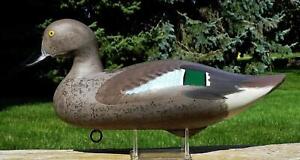
Sold on eBay October 14th, 2023
MINT RARE TEAL SUPERB 100% ORIG SIGN~DATED 1980 CAPT HARRY JOBES Wood Duck Decoy
eBay MINT & VERY RARE AMAZING "SIGNED & DATED" 1980 by the LATE CAPTAIN HARRY R. JOBES SR. "HEN" BLUE-WINGED TEAL CARVED in MADISON MITCHELL'S SHOP ~100% ORIGINAL CONDITION SUPERB GUNNING DECOY & ORIG. LEAD BALLAST WEIGHT & STAPLE & RING LINE-TIE ~CARVED & LEARNED from GREAT MADISON MITCHELL ~INCREDIBLE PAINT & OUTSTANDING CARVING ALMOST IDENTICAL to MADISON MITCHELL'S BEST BLUE-WINGED TEAL ~NOT A NICK, CHIP, PAINT SMUDGE or FINGERPRINT on this MINT DECOY with a TINY PAINT FLAKE to WEIGHT & LINE-TIE ~INCREDIBLE 43 YEAR OLD "LIKE NEW BUT MELLOWED with AGE" PATINA ~HEAD & ALL RIGGING TIGHT AS IF JUST MADE ~BRIGHT GREEN & BLUE SPECULUMS with PERFECT PAINTED EYES ~MINT BECAUSE PROTECTED IN A CASE IN AN EAST COAST COLLECTION ~THE RIG-MATE DRAKE TO THIS HEN IS ALSO ON EBAY IF YOU ARE LOOKING FOR A PERFECTLY MATCHING RIG & CARVING MATE PAIR MADE at THE EXACT SAME TIME in MITCHELL'S CARVING SHOP SIX YEARS BEFORE HARRY OPENED HIS OWN SHOP ~DON'T MISS OUT ON ONE OF HAVRE DE GRACE' MOST LOVED CARVERS! MINT RARE TEAL SUPERB 100% ORIG SIGN~DATED 1980 CAPT HARRY JOBES Wood Duck Decoy MINT RARE TEAL SUPERB 100% ORIG SIGN~DATED 1980 CAPT HARRY JOBES Wood Duck Decoy Click images to enlarge Description AMERICAN CARVING LEGEND..... Captain Harry Jobes (above picture): 18 Year Old Harry Jobes Setting Out Canvasback Decoys on the Susquehanna Flats (above picture): Captain Harry Jobes (seated) and R. Madison Mitchell (shooting) Bushwhacking on the Susquehanna Flats (above picture): Harry Jobes in His 50's Finishing a Mallard (above picture): Harry Jobes in c2018 with His Son Bob in Front of the Harry Jobes Display at the Havre de Grace Decoy Museum HARRY R. JOBES SR. Birth Name: Harry Robert Jobes BORN: Nov. 19, 1936 ..... Havre de Grace, Maryland ? DIED: May 10, 2019 ..... Aberdeen, Maryland (Captain Harry Jobes Passed Away at the Age 82) Have de Grace is a city in Harford County, Maryland. It is situated at the mouth of the Susquehanna River and the head of Chesapeake Bay. It is named after the port city of Le Havre, France, which in full was once Le Havre de Grace; (French, "Harbor of Grace"). (above picture): Harry Jobes in 1980 with One of his Largest Projects, 20 Swans he Carved (above picture): Harry Jobes Receiving One of his Many Awards for Promoting Tourism along the Chesapeake (picture below): "HARRY JOBE'S" BELOVED HAVRE DE GRACE & The UPPER BAY! This is WHERE CAPTAIN HARRY JOBES SPENT His ENTIRE LIFE MAKING DECOYS, HUNTING, CHARTER-BOAT CAPTAIN, GUIDE, WORKING at ABERDEEN PROVING GROUNDS & ALL AROUND WATERMAN ........ EVENTUALLY BECOMING ONE of the MOST BELOVED FAMILY MEN and ENDEARING INDIVIDUALS to GRACE SUCH a BEAUTIFUL and HARD WORKING COMMUNITY! (Picture Below): HISTORIC c1980 PHOTO of "HARRY JOBES" with Some of The Men That Helped MADISON MITCHELL Over the Years; (left to right): "CAPTAIN HARRY JOBES", Paul Gibson, "Madison Mitchell", Clarence Bauer and Jim Pierce. (above picture): The Above Photo is Even More Special as It was the Same Year He Carved these ~Beautiful Blue-Winged Teal "Up For Auction" ....... and Even More Significant Because they were Likely Made in Mitchell's Shop ............ Because Harry Didn't Open His Own Shop Until 1985!! And as You Can See By the Pictures Below, Harry's Earlier Output was Close to Identical to Madison Mitchell's Decoys in Many Ways ....... ESPECIALLY "AWESOME BLUE-WINGED TEAL!! ___________________________ (Picture Below): 1978 "MADISON MITCHELL" BLUE-WINGED TEAL DECOYS: (Picture Below): These 1980 "HARRY JOBES" BLUE-WINGED TEAL DECOYS (up for auction): (Picture Below): 1978 "MADISON MITCHELL" BLUE-WINGED TEAL DECOYS: (Picture Below): These 1980 "HARRY JOBES" BLUE-WINGED TEAL DECOYS (up for auction): _________________________________________ (Below Photos): This MINT 100% ORIGINAL, ALMOST HALF A CENTURY OLD" -or- 43-YEAR OLD, "SIGNED & DATED" 1980 HARRY JOBES, "HEN" Blue-Winged Teal Decoy Up for Auction!!! Mint 100% Original Condition without a Rub, Chip, Check, Crack, Dent, Paint Smudge or Fingerprint on this Spectacular & Scarce Solid Cedar Decoy! Typical Thick Tail and Bill is Carved & Sanded Thick on the End for a Clean, Surface & Shape ....... The Entire Body was Likely Mitchell's Lathe Made with an Outstanding, Undulating Form & Style ...... it Starts with a Beautifully Rounded Breast, then a Wide & Yet Thick Body that Culminates in a Beautiful, Slightly Upswept Tail!!! (Below Photos): This SCARCE, MINT, 100% ORIGINAL, SUPERB FINELY BRUSHED ON BACK FEATHERING, SPECULUMS & WING PRIMARY FEATHERS! Very "Mason-Like", Not Only Does it Have Swirling Back Feathers & Clean Green Speculums ......... it Also Has Gorgeous "Swizzling" Blue Wing-Feather Speculum Wing Patches ......... and Gorgeous Long "Sweeping Wing Primaries: _ (Below Photos): The Bottom of this Hen Blue-Winged Teal has a Perfect Bottom with No Defects ....... and Perfectly Tight "Like-New" & Perfectly Intact "Ring & Staple" Line-Tie & Lead Ballast Weight!! The Perfect Bottom on this Decoy has No Checks or Defects of Any Kind & Like the Sides it is a Perfect Gray-Tan with Gray-Dark Beige Feather Stippling ...... there is a Tiny Paint Flake to the Line-Tie & Weight From Sitting on a Shelf; But Wonderfully Free of Any Chips, Nicks, Paint Smudges, Dents, Fingerprints, Checks or Cracks ......... AS IT WAS NEVER USED & ONLY SAW WATER WHEN it was "TUNED" by FLOATING it in a TANK to LOCATE WHERE the LEAD BALLAST NEEDED to GET NAILED ON!!!! The Bottom is Also Cleanly Signed & Dated By Harry Jobes with: "Capt Harry Jobes" -and- "1980" _ (Below Photos): The HEAD of this STURDY, WELL-ROUNDED & STUNNING HEN BLUE-WINGED TEAL DECOY'S HEAD & NECK from SEVERAL ANGLES; With PERFECTLY CARVED in HEAD/BILL SEPARATION & PAINTED-EYES ........... and ALL NAILS to ATTACH the HEAD to the BODY are PERFECTLY HIDDEN UNDER WHITE LEAD as if this DECOY was JUST MADE YESTERDAY!!!! INCREDIBLE MINT PAINT to the ENTIRE DECOY & YOU CAN SEE EVERY BRUSH MARK ............ with VERY NEAT GRAY-TAN EYE SWOOSHES & CAP with PERFECT GRAY-DARK BEIGE, FEATHER STIPPLING ........... and PERFECTLY LOCATED YELLOW & BLACK PAINTED EYES & BLACK BILL!!! The "BLUE-WINGED TEAL" HEAD & NECK FLOW SO PERFECTLY into the BREAST that if IT WEREN'T for the SHADOWS it WOULD BE HARD-TO-SEE the SEAM .......... it's JUST a GORGEOUSLY PAINTED & CARVED "RELAXED" HEAD for a HEN "BLUE-WINGED TEAL" ? _ (Below Photos): This MINT & "SIGNED & DATED", VERY RARE, HEN BLUE-WINGED TEAL ....... Shown with the JUST as AWESOME 100% ORIGINAL CONDITION DRAKE RIG-MATE Also on EBAY!! LIKE MOST CARVERS & ALL FACTORIES: Since Males by Nature are All Much More Vibrantly Colored, Drakes were Made in Much Greater Numbers Since they Were Much More Visible to Wild Ducks ....... which Makes this Hen Much Rarer than the also Rare Drake Rig-Mate also on ebay!! LOOK HOW SPECTACULAR they LOOK TOGETHER & COMPLEMENT EACH OTHER!! ? This Superb Pair Have Been Together Ever Since they Entered Their Collection -and- Have Been in the Same Hands and Collection Ever Since!! _ This STUNNING, R. MADISON MITCHELL, HEN BLUE-WINGED TEAL DECOY up for Auction: AWESOME 100% ORIGINAL; MINT, "SIGNED and DATED"; 1980 HARRY ROBERT JOBES SR.; ABSOLUTELY INCREDIBLE PATINA & PAINT; 43+ YEAR-OLD, HEN BLUE-WINGED; WOOD DUCK DECOY; HAVRE de GRACE, MARYLAND; SUSQUEHANNA FLATS (UPPER CHESAPEAKE BAY) This HEN GUNNING DECOY was CARVED LIFE-SIZED!! (This Size of His Decoys are His Most Sought After Work!!) ? OUTSTANDING ORIGINAL PAINT and CARVING on this VINTAGE GUNNING DECOY with AN INCREDIBLE, PERFECT PATINA!! EXCELLENT FORM on ONE of SCARCE, VINTAGE "HEN BLUE-WINGED TEAL" GUNNING DECOYS as this DECOY WAS MADE WHEN WOODEN DECOYS WERE STILL BEING USED by DISCRIMINATING HUNTERS ........ BUT this DECOY FOUND its WAY into a COLLECTION INSTEAD of the MIDDLE of a SMALL POTHOLE, or a SLOW-STRETCH of WOOD-LINED, RIVER WATER!! ? AWESOME STIPPLED, DAUBED, SWIRLED & STRAIGHT-LINE, BRUSH-STROKE "HARRY JOBES" PAINT -and- NICE, SEMI-RELAXED POSED HEAD & NECK TURNED SLIGHTLY to ITS LEFT!! Vintage Hunting Decoy & His Very Best, Working Bird Style with his Nice, Long, Yet Wide at the Water Level, Body Style and Form!! ORIGINAL RIGGING is PERFECT -with- 100% ORIG. RIGGING: NAILED-ON LEAD BALLAST WEIGHT -and- COMMERCIAL STAPLE & RING, LINE-TIE!! ? ? This MINT, NEVER HUNTED OVER, HEN & the DRAKE also on Ebay LOOK & SHOW as a GREAT PAIR & HAVE an INCREDIBLE & VERY APPEALING, and a MINT, YET BEAUTIFULLY AGED PATINA! There is OBVIOUSLY NO GUNNING WEAR & NO SHOT MARKS; NO RUBS, NO PAINT SMUDGES, NOT a SINGLE FINGERPRINT, NO NICKS or CHIPS, NO CHECKS, NO DENTS or CRACKS, and there are ONLY TINY RUBS to the WEIGHT & LINE TIE!! ALTHOUGH VERY PROLIFIC: Early Gorgeous Blue-Winged Teal Like this Pair are Always a Nice Find!! ? ? __________________________________________ This is a Perfectly Symmetrically Carved & Painted Vintage Captain Harry Jobes Sr. Hen Blue-Winged Teal Decoy! The ONLY TIME that this Decoy "EVER SAW WATER" was Was in Mitchell's Shop When Mitchell's Shop "TUNED IT" By Adjusting Where the Ballast was Nailed on so It Swam with Perfection in a Hunting Rig!!! This Superb Hen Blue-Winged Teal and the Drake Rig & Carving-Mate also on ebay, Both Measure: ?13-1/2" long x 5" wide x 6-1/4" tall and Each Bird Weighs Exactly: 1-lb. 11-oz. ? BOTH of these DECOYS HAVE IDENTICAL SIZE, STYLE, FORM, CARVING, PAINT PATTERN & "BOTH MADE AT THE EXACT SAME TIME"!! BOTH DECOYS are also FROM the SAME COLLECTION & OWNER! This HEN & the DRAKE also on Ebay LOOK & SHOW as a GREAT PAIR TOGETHER & BOTH are FROM the SAME COLLECTOR & PURCHASER!! BOTH also have an OUTSTANDING PATINA FROM AGE & VERY CAREFUL HANDLING, OBVIOUSLY "NEVER" HUNTED OVER & VERY WELL TAKEN CARE OF WHILE in THEIR COLLECTION!! Superb Gray-Tan Base with Gray-Dark Beige Feather Stippling to Head, Breast, Lower Sides & Bottom with Green & "Swizzled" Blue Speculums ........... Along with Clean and Awesomely Swizzled Gray-Dark Beige Paint to the Back, Sides & Tail with Long Darker Gray-Brown Primary Feathers .............. that all Perfectly Flow Together to Create a Realistic Hen Blue-Winged Teal in Full Winter Plumage! STRUCTURALLY PERFECT HEAD & NECK with ALL NAILS PERFECTLY INTACT and TIGHT AS IF MADE YESTERDAY WITHOUT a SINGLE SIGN of a TYPICAL NECK CHECK that YOU QUITE TYPICALLY FIND on DECOYS as it is INHERENT to the CONSTRUCTION METHOD of the UPPER BAY CARVERS!!! ? ? To Find Perfect Pairs, Carved From the Same Rig is Always Nice When Buying Pairs of Decoys! The DRAKE RIG-MATE to this HEN is ALSO on EBAY if YOU ARE LOOKING FOR A NICE MITCHELL BLUE-WINGED TEAL PAIR; They Were UNDOUBTEDLY CARVED OBVIOUSLY AT THE EXACT SAME TIME!! (Truly a Great pair to Own) ______________ (Below Photos): OTHER BLUE-WINGED TEAL by the LATE & GREAT, CAPTAIN HARRY JOBES: __________________________ This SENSATIONAL MADISON MITCHELL HEN BLUE-WINGED TEAL GUNNING DECOY up for auction: This AWESOME 100% ORIGINAL CONDITION HEN BLUE-WINGED TEAL "SIGNED & DATED" 1980 MADISON MITCHELL 43+ YEAR-OLD GUNNING DECOY with SUPERB 100% ORIG PAINT, CARVING, STYLE, PATINA & FORM!! ? _ CAPTAIN HARRY JOBES "LEARNED FROM" -and- "CARVED WITH and FOR".....The Late Decoy "CARVING LEGEND" R. MADISON MITCHELL!! _________________________ (Below Photo): HISTORIC c1980 PHOTO of MADISON MITCHELL with Many of The Men That Helped Him Over the Years along with a Contemporary, Paul Gibson; (picture below: Left to Right): CAPTAIN HARRY JOBES, Paul Gibson, MADISON MITCHELL, Clarence "Tit-Bird" Bauer and Jim Pierce. ? (below): This Decoy up for auction was Made in 1980 by: "CAPTAIN HARRY JOBES" at the TIME AGED 44: ? Likely Made in Madison Mitchell's Shop as He Opened his Own in 1985: ? MINT, 100% ORIGINAL PAINT; FULLY RIGGED; "43 YEAR-OLD" GUNNING BIRD; "SIGNED & DATED"; 1980 CAPTAIN HARRY JOBES; "HEN BLUE-WINGED TEAL"; WOOD DUCK DECOY; HAVRE DE GRACE, MARYLAND; SUSQUEHANNA FLATS (UPPER CHESAPEAKE BAY) Harry Began Making Decoys at the Age of 9 and Learned Originally from Working in Charles Barnard's Shop, But Really Learned Everything he Knew from Madison Mitchell. He worked in Mitchell’s Decoy Shop for over 25 years Before Opening a Shop of his Own in 1985 ....... 5 Years After He Made this Pair of Blue-Winged Teal in Madison Mitchell's Shop!!! Excellent & Classic, Beautifully Contoured Body Style with Super Bill and Great Sweeping Tail!! ? This is a TRADITIONAL "UPPER BAY" MADISON MITCHELL STYLED "HARRY JOBES" HEN BLUE-WINGED TEAL!! SUPERB DEEP, STUNNINGLY GORGEOUS, ORIGINAL PAINT on this 43-YEAR OLD, GUNNING DECOY with EXCELLENT OLD & DRY PATINA!! SUPERB FORM in the STYLE HE LEARNED from MADISON MITCHELL & PASSED on to his THREE VERY TALENTED SONS!! ? AWESOME DAUBED & STIPPLED HARRY JOBES PAINT & NICELY POSED, VERY-SLIGHTLY TURNED HEAD CARVING!! Awesome Slightly Turned Head, Hen Blue-Winged Teal Hunting Decoy ........... Almost Exactly the Same Carving & Paint Detail as His Mentor Madison Mitchell's Blue-Winged Teal!! ALTHOUGH NOWHERE NEAR as PROLIFIC as MADISON MITCHELL, And AFTER HAVING MADE MANY CANVASBACKS, BLUEBILLS & REDHEADS ........... BLUE-WINGED TEAL like these INCREDIBLE EXAMPLES are "EXTREMELY HARD to FIND from this EARLY 1980 TIME PERIOD" to COMPLETE a COLLECTION of HARRY JOBES or RARE UPPER BAY DECOYS!! ? This is a PERFECTLY CARVED & PAINTED VINTAGE PAIR of HARRY JOBES TEAL ........ and ACTUALLY the BEST PAIR of HARRY'S TEAL that MOST CLOSELY RESEMBLE MADISON MITCHELL'S that I HAVE EVER SEEN ...... PERIOD!!!! ? This 43-Year Old, Pair of the Late Harry Jobes Teal Were Made in Madison Mitchell's Shop & Both Measure: ?13-1/2" long x 5" wide x 6-1/4" tall and Each Bird Weighs Exactly: 1-lb. 11-oz. ? BOTH of these DECOYS HAVE IDENTICAL SIZE, STYLE, FORM, CARVING, PAINT PATTERN & BOTH of THESE RIG-MATES were OBVIOUSLY MADE AT THE EXACT SAME TIME!! BOTH DECOYS are also FROM the SAME COLLECTION & OWNER! These Dimensions & Weight are Perfect & Typical for a Small, Marsh & River & Woodland Duck, All Cedar Duck Decoy!!! This Pair of Decoys Clearly came from Climate Controlled, Direct Light-Free Collections that they Were Lucky to Be Added To as It They Have Been Kept in Mint Condition Over the Better Part of a Half-of-Century Since they LEFT MITCHELL'S WORKSHOP in HARRY'S HANDS!! IF YOU are a FAN of GREAT GUNNING DECOYS that WOULD HAVE DONE EXACTLY what they WERE MADE TO DO if GIVEN the CHANCE ...... This is a FANTASTIC PAIR to add to YOUR COLLECTION as DECOYS with THIS EARLY JOBES STYLE & PATINA and are NOT EASY at all TO COME BY, LET ALONE CATCH A GLIMPSE OF!! If You Like Important Decoys from the one of the More Important Middle to Later Period Upper Chesapeake Bay Region Decoy Carvers, that Are in Outstanding, 100% Original Condition ........... THIS IS A GREAT DECOY FOR "ANY" COLLECTION!! _________________________________________ IN THE NEXT FEW WEEKS I AM PUTTING ON EBAY MORE LAWRENCE BETHEL FISH DECOYS, A PAIR OF THE ONLY KNOWN PROTOTYPES MADE OF THE VERY FIRST PRE-PRODUCTION FIBRE DECOYS EVER MADE, A NEAR MINT 1927 HEDDON GIANT VAMPIRE FISHING LURE IN RARE SHAD, A PAIR of LATE PHASE DODGE MALLARDS, A RARE & NEAR MINT DR. MILES PIRNIE DRAKE BALDPATE WIIGEON, A VERY RARE VICTORS DRAKE BUFFLEHEAD, A RALPH MALPAGE PAIRT OF WOOD DUCKS, A VERY RARE c1893 100% ORIGINAL TRANSITION PERIOD MASON DRAKE BUFFLEHEAD, A NEAR MINT PAIR OF MASON GLASS EYE PINTAILS, A MINT c1905 HEDDON ARTISTIC MINNOW, A SCARCE RALPH MALPAGE ATLANTIC BRANT, A YELLOW WITH RED EYE BLUSH MOONLIGHT SINGLE-HOOK PIKAROON, A NIB CREEK CHUB MULLET COLOR STRIPER PIKIE IN CORRECT BOX, A PAIR of INCREDIBLE CHALLENGE & PREMIER GRADE MASON BLUE-WINGED TEAL, A NICE PAIR OF MASON GLASS EYE BLUEBILLS, AN AWESOME ERNIE NEUMANN SUCKER FISH DECOY, A RARE c1880 ST' CLAIR FLATS DRAKE REDHEAD, A VERY NICE ERNIE NEUMANN SUCKER, A RARE 12-1/2" CHET SAWYER MINNESOTA FISH DECOY, A NEAR MINT OSCAR PETERSON PERCH FISH DECOY, A MINT PAIR OF WRAGG & BURRELL WIGEON, AN OUTRAGEOUSLY HARD TO FIND PAIR OF CHARLIE POZZINI BLUEBILLS, AN AMAZING JOHN HOLLOWAY SLEEPING TURNED HEAD DRAKE PINTAIL, A VERY BIG & BULL-NECKED EARLY FERDINAND BACH DRAKE CANVASBACK FROM HIS PERSONAL RIG AND MORE!! ? Shipping Includes Insurance! I Don't Believe in Making a Profit on Shipping, You Pay What I Pay. If it's Less Than You Paid I Refund the Difference, If More I'll Pay For It. I COMBINE SHIPPING. I am also loading over 150 Duck Decoys, 150 Fish Decoys, 70 Scarce Fishing Lures, etc. so keep checking back. ________________ This OUTSTANDING, RARE, MINT, CAPTAIN HARRY ROBERT JOBES SR., HEN BLUE-WINGED TEAL up for auction: ITEM DESCRIPTION: This 43+ Year Old, Wonderfully Formed, Solid Cedar, Hen Blue-Winged Teal Using Madison Mitchell's Patterns and Made in Mitchell's Shop were Expertly Carved and Painted by the Late Captain Harry Robert Jones, Sr. of Havre de Grace, Maryland. (picture below): Harry Jobes c1990, Back in the Day, A Full (10) Ten Years After He Made this Spectacular & Very Rare Blue-Winged Teal up for auction: (picture below): Harry Jobes c2018 at the Havre de Grace Decoy Museum, Roughly a Year Before he Sadly Passed Away!!! ________________ ABOUT CAPTAIN HARRY JOBES LIFE ........ An AMBASSADOR and SPOKESPERSON for the RICH CARVING & HUNTING HERITAGE his WHOLE LIFE and RIGHT UP UNTIL the DAY HE SADLY PASSED AWAY on MAY 10th, 2019 at the AGE of 82: The Region's Rich History & Harry Jobes Involvement: Havre de Grace, known as the decoy capital of the world, has spawned an entire dynasty of decoys as well as decoy carvers. Decades ago, little did gunners know that the hundreds of decoys that they chopped at their workbenches in their spare time for hunting season would one day be considered a valuable art. Fortunately, many of the earliest carver’s works have been discovered in abandoned barns and cluttered attics and have been preserved for today’s appreciative collectors. And, like all true art, the skills involved in creating these counterfeit ducks have also been passed down from earlier generations to today’s carvers. One of these earlier gunning decoy carvers and then contemporary carvers was Captain Harry Jobes, a very unique individual. You could often spot him at a decoy show, decked out in his Panama hat, suspenders and duck pants, and one of his famous hand-knitted "Captain Jobes" sweaters. Mr. Jobes was born in Wilmington, Delaware, to Donald Keith Jobes and Lorelle Evangeline "nee Beauchamp" Jobes on November 19, 1936. Even his shop, which was located behind his home in Maryland, was not the typical decoy shop. Easy to spot because of the American and Maryland flags hanging in front of his house, a visit to his shop was quite a delight. At first glance, the shop reminded you of others – the smell of pine; a coating of sawdust on benches, windows, and patterns; the lathe, band-saw, sanding machine, spoke shaves, and draw-knives; the paint table, near the wood stove, with a variety of paint cans, thinners, and brushes, drying racks holding row after row of decoys; and bodies and heads in various stages of completion on the floor and in baskets throughout the shop. (picture below): At the Time, Captain Harry Jobes was 77 when He Carved & Painted this Awesome Swan Decoy! But that’s where the similarity to other shops ended. Hanging on the wall were pin-ups of "Elvira." His 13 year old granddaughter Monica was puttying ducks while her black Lab puppy chewed the head of a finished wood duck. However, Captain Jobes looked at the puppy, laughed and said, "He’s in the doghouse now!" And, anyone who knew Harry will tell you what a dry sense of humor he had. For instance, when he would be working in the shop and the phone rang, he might answer it with, "Nobody here but the chickens!" Or, when asked if he’s made any decoys, he replied, "They’re in the incubator." Harry’s interest in carving decoys went way back to his childhood days where he was born and raised in Havre de Grace. His carving career began in Charles Nelson Barnard’s decoy shop which was located two blocks up the street from his home. Harry once said, "I was about 8 or 10. I’d run in and out of the shop, sand duck heads, then run out and play football, kick the can, and wrassle, then run back in and sand another head." In fact, Harry grew up in the midst of several other famous Havre de Grace carvers, such as Bob McGaw and Jim Currier, and could tell you many stories about most of them. Harry Jobes once said, "I also used to run in and out of McGaw’s shop ...… but he was a little on the contrary side. You didn’t touch a tool in Bob’s shop – indeed you didn’t. He didn’t want no kids in there." (pictures below): 3 Photos of Havre de Grace Carving Legend R. Madison Mitchell, the Man that Taught Harry Jobes Everything He Knew About How to Construct and Paint a Perfect Upper Bay Style Duck Decoy. This Pair of Blue-Winged Teal Carved By Harry in Mitchell's Shop So How Exact Harry was in Following His Mentor's Patterns, Paint & Thus Inherited the Aura of Mitchell's Decoys: After working in Barnard’s shop for two or three years, young Harry decided to enter one of his decoys in an art show being held at the Havre de Grace High School. He once related it by saying that he laughed, "I was in the elementary school then, and it (his decoy) looked like a chicken had painted it with his feet. But I took it up to the show, and I thought it looked pretty good to me." When he got there, he met a lady by the name of Helen Mitchell, who had several decoys made by her husband, the very famous and late R. Madison Mitchell. When he saw Mitchell’s decoys he said, "Hell, I might as well take my decoys home." But Mrs. Mitchell was very friendly and started talking to him because she knew his grandfather. She even invited him to go to work for her husband; but since Harry was already working for Mr. Barnard, he refused the offer. And, he did win a ribbon in the art contest. "… a pink ribbon or a red ribbon or something," Harry once fondly remembered. (picture below): Harry Jobes in the Mid to Late 1980's Filling Orders in His Shop: However, a year later Barnard died, and Harry went down to Mitchell’s funeral home. When Mom Mitchell answered the door, she told him to go around back to Pop’s shop. "And I worked for Mitchell for 28 years," replied Harry. "I made twenty-five cents an hour after school. I spoke shaved decoys, ran the machines and I got so I could do just about anything …....... it didn’t make any difference if it was painting or making the heads. I did anything in the shop", Harry once recalled. Sometimes there were as many as five to six woodcarvers in the shop at one time. According to Harry, you could have Bailey Moltz, Bud McKinney, Cats Wilson, Jimmy Pierce, Bob Mathews and Titbird Bauer whittling heads while Ed Sampson did all the draw knifing. Harry said he sawed them out. He once recalled, "Bailey Moltz was the best head carver on the East Coast; he’s the one who really taught me how to whittle a head. But, the painting I learned off Mitchell. He has had the biggest influence on me as a decoy maker ..... no question about it." (picture below): Harry with his 3 Sons Later in Life: When he was once asked what it was like working for Mitchell, he stated, "We didn’t make a lot of money, but we left a lot of memories and had a lot of fun. The memories they can’t take away from us." Harry remembered a time back in the 1950’s when Madison Mitchell had 500 canvasback decoys in his north garage that they couldn’t sell because shooting canvasbacks had been outlawed. Eventually Harry contacted a boy up in Wilmington who bought 250 at seven dollars a piece, but they still had 250 left Harry recalled. Harry added, "We took the other 250 brand new decoys, freshly painted, and sawed the heads off them and threw the bodies in the dump where the A & P Store used to be in Havre de Grace". They took them down there and burned the bodies up. Ed Sampson draw knived the heads to look like black ducks, But you Couldn’t sell decoys in those days, you couldn’t give them away. You couldn’t gun diving ducks so nobody wanted them." (picture below): Harry Jobes and his Son Bob with Family & Friends in Front of the "Harry Jobes Exhibit" at the Havre de Grace Decoy Museum": Jobes once told another story about the time he and Brother (Mitchell’s son) were working at the shop one night, jack-planing the spots on the bodies where the heads go on. Brother took the plane apart and sharpened it. But when he put it back together, the blade was sideways instead of straight; and it took off more on one side than it did on the other. "We planed off 500 bodies with the side cut unevenly." About six o’clock the next morning Eddie Mauldin and Harry Jobes were eyeing ducks when Madison Mitchell walked in, picked up one of those decoys sideways, looked at it, and saw that it and all the others had been planed off crookedly. Harry Laughed, "He was a pistol, I got the blame for it. But when I explained what had happened, Madison Mitchell's one Brother got his ear bent when he came to work." When asked what they did with the decoys, he commented, "We just nailed the heads on and let them go. They were just a looking at you sideways a little bit. They were only gunning decoys. Of course, if you could find three or four now, they’d be worth something." While working with Madison Mitchell as his mentor for 28 years, Harry also spent much of his life working on the water running research vessels for the states of Maryland and Virginia, and working for the government at Aberdeen Proving Ground piloting a patrol boat. He also operated his own charter boat business – hence the moniker "Captain" Harry Jobes. But, somehow, like all others, decoy carving became an avocation, the long hours spent at night, weekends, and holidays, that sustained his spirit; so in 1985, Harry Jobes decided to retire, build his own decoy making shop and devote all of his time and energies to carving decoys. Unlike some of his colleagues, Captain Jobes made decoys all year ‘round and created a very demanding business. It soon was no longer a part-time occupation; and even though he spent endless hours in his shop, the demand for his decoys constantly exceeded his ability to produce them. He once commented, "Decoys have been damn good to me. I’ve worked at it ....... stayed at it". His wife and business partner, Helen Jobes, a very gracious lady who endured, with good humor, visitors at their home and shop at all hours of any day, once recalled, "I used to get a break when he went to work. Now that he’s retired he works three shifts – morning, afternoon, and evening. When there’s nobody here at night. I usually get the night shift." When asked by others what she does, she used to reply "sweep floors." However, Helen took care of the perpetual paperwork of the business – recording orders, packing decoys, sending them out, etc. – work that most collectors never dream about when purchasing a Harry Jobes decoy. Indeed, the Jobes’ decoy business had become a family tradition. Just as Harry learned from Mitchell, his three sons, Bobby, Charles, and Joey, also learned from their father. All three of his sons started carving in his shop when only children. "Bobby, the oldest, used to stand up on a fish box in order to reach the vise," recalled Harry. His stepson, Jeff, who also worked in the decoy shop, was then at the time the co-publisher of Decoy Magazine, which later was turned back over to Joe Engers as the sole owner and publisher. Harry Jobes once remembered the time that Madison Mitchell called him and wanted to know if he could recommend someone to replace Ed Sampson when he retired from draw-knifing heads. "Bobby can draw-knife," replied Harry, "so Bobby went to work for Mitchell and left me holding the bag!". Bobby was Harry Jobes 2nd eldest son. All of Harry’s sons now carve decoys as a full time profession. It was quite obvious that Harry was very proud of each of them. He once quipped, "I have raised three boys, and they can do anything to a decoy that needs to be done." Bobby specializes in miniatures, Charles in half-size, and Joey in full-size decoys. Harry added, "All three are good. They’re all better than I am,". And also said, "Let’s put it this way, there’s always somebody better than you are. It doesn’t make any difference what you do." (picture below): Harry's 3 Sons Harry Robert "Bob" Jobes Jr., Charles Keith Jobes and Joseph Allen Jobes!! However, Captain Jobes was a craftsman whose talent is reflected in his decoys which are so admired and sought after today its no coincidence because he learned from the best, Madison Mitchell, and carved a great many decoys that look just like Mitchell's decoys in many ways. And as a matter of fact, without those tiny clues for the trained eye, this pair of Blue-Winged Teal likely could have been attributed to either because in 1980 and still working in Mitchell's shop, making a Mitchell decoy was second nature for harry Jobes. His popularity in the Havre de Grace area has been demonstrated by the fact that he was chosen as the Honorary Chairman of the 1988 Havre de Grace Decoy Festival. When asked how he felt about being selected for this honor, he stated. "It’s good; I guess I was surprised." Then, his dry sense of humor surfaced once again as he smiled and said, "The day before the show I’m getting two splints put on my hands so I don’t have to sign all those ducks." Although Harry Jobes made both working and ornamental decoys in that famous Havre de Grace style, all of the decoys he donated for the 1988 show and auction were working decoys. A set of 25 full-size and miniature decoys include the following species: regular and high-headed canvasbacks, redheads, blackheads, mallards, buffleheads, baldplates, cinnamon teals, ringnecks, shovelers, old squaws, pintails, goldeneyes, black ducks, wood ducks, a white wing scoter, a coot, a Canada goose, a blue goose, a snow goose, a brant, and a swan. Captain Jobes explained, "There’s a whole different ballgame between gunning and ornamentals. A working decoy you can sit it on a shelf and listen to it talk for two hours. Ornamentals can’t do that. When we made decoys years ago, we made them to go gunnin’ with, not to sit on a shelf ..... when you look at gunnin’ decoys from the 1900’s to the 60’s, the only people who made ‘em were those who lived around the river shores. Now they make gunnin’ decoys in New York City. Two thirds don’t even touch the water anymore. You wonder where they went to. You’re like Babe Ruth – you played a good game and never got paid." When questioned about carving more miniatures, he exclaimed, "When these are done, there ain’t gonna be no more of them. I can make ten full-size heads while I make one of these miniatures." So collectors who desire a Captain Jobes miniature will find it quite difficult to purchase one. Harry continued, "The year Madison Mitchell 's wife died, I made a boxcar load of these miniatures. I had ‘em in the cellar by the bushel basket full, and you don’t hardly ever see one." If a collector were fortunate enough to discover one of those old miniatures, he would indeed have found a very valuable decoy, like this pair of Early Blue-Winged Teal up for auction. Another time Captain Jobes was recognized for his outstanding decoys was in 1986 when Continental Can requested that he do a magazine advertisement for Coca Cola’s 100th birthday celebration. Many hours were spent preparing for the production of the ad. The day the production crew arrived, make-up artists worked on Harry before the photographers could film. Harry laughed, "They even brought lunch, but they forgot the Coke for the ad and had to go up to 7-11 to buy them." The final full page color ad featured Harry, working in his shop, painting a pintail drake, while his young grandson Shannon looked on. This photograph appears on the cover of the 1988 Havre de Grace Decoy Festival booklet. The later and last decoys Harry Jobes made, he sold to collectors and businesses located all over the United States and in foreign countries. He recalled at the time, "I ship them all over the place. I’ve got good friends in Holland. I ship decoys they ship tulips, I trade ‘em decoys for Tulips," he said. However, not all of the people he sold to owned shops; many were hunters and sportsmen. "I got the president of Hardees Corporation that’s got gunning marshes down in the Carolinas. I made 100 for him – 50 pair of wood ducks – and he guns them." Laughing, he said, "Yeah, it was a couple days of painting." Although born and raised on the Susquehanna Flats, Captain Jobes did very little hunting the last years of his life. He recalled before his passing, "Back Then you could look up and see thousands of cans. Now you can’t see nothin’." He remembered a time when 10-12 blinds were built on the western shore of the Chesapeake Bay where bushwhackers used to hunt. "I was one on the last ones to gun on the western flats. I’ve seen the best of this old Chesapeake." In 1970, when Harry Jobes was questioned about anything unusual that he had made, he recounted a time about ten years ago (1980) when he made 50 swan at once time. He recalled, "Most swan ever built around here at one time. It took a barrel of time to make those bodies and several cords of wood." About 30 years ago, Harry made the DuPonts four stand-up wood ducks. "They were painted in pure oil colors – took two months to dry. I ain’t gonna make no more of them things – no way!" He also once made 50 stand-up geese for Billy DuPont. (picture below): Harry Jobes with 50 Swans He Carved in 1980; That was the Exact Same Year He Carved this Pair of Blue-Winged Teal up for auction; Both Made Right in Harry's Prime!! Asked if he had any hobbies, he once replied. "I used to piddle with model trains, but I don’t have time to anymore, I guess I got my hobby right here. As Mitchell used to say. "It’s a damn expensive one." According to Captain Harry Jobes around 1986, his plans for the future were, "Just gonna make more decoys." He paused and said in that drawl of his, "I would like to take one more time and put a bushwhacking rig together and relive some of the days I had years ago. But you’ll never see that again there’s no question about it." Although those days of bushwhacking reside mostly in memory, Captain Jobes has taken his place among a select group of craftsmen who have made the Upper Chesapeake Bay region the decoy capital of the world. Much More Information on Captain Harry Jobes and Some Information About His Growing Up and Eventual Involvement in Decoy Making, Hunting & as An Ambassador for the Region: Captain Harry Jobes passed away on Friday, May 10, 2019 After a Full Life Lived and Along with Many Others, Becoming One of the Legendary Decoy Makers and Watermen of the Upper Chesapeake Bay!! Harry Jobes is a legendary talent, a master of gunning birds made in the style of the area, "The Susquehanna Flats", Chesapeake Bay decoys. His carving career began in Charles Nelson Barnard’s decoy shop which was located two blocks up the street from his home at the age of 8 or 9 by sanding duck heads. After several years Mr. Barnard died and Harry began working for the legendary Madison Mitchell. "I made twenty-five cents an hour after school .... I spoke shaved decoys .... run the machines ..... I got so I could do just about anything ..... it didn’t make any difference it it was painting or making the heads. I did anything in the shop." (Captain Harry Jobes) Captain Harry Jobes worked for the famous R. Madison Mitchell for nearly 25 years before opening his own shop in 1985. He has been featured in books, museums and in private collections. During his life he has been a commercial waterman, a hunting guide, as well as a charter boat captain. Some old images are available. "Bailey Moltz was the best head carver on the East Coast; he’s the one who really taught me how to whittle a head. But, the painting I learned off Mitchell. He has had the biggest influence on me as a decoy maker ..... no question about it" (Captain Harry Jobes) Captain Harry Jobes had three sons that all learned from him and other great carvers in the local area and then followed him into the decoy business. Each of them is a talented carver and painter, working on his own line of decoys. Captain Bob Jobes is the oldest, then Charles Jobes and Joey Jobes. "I have raised three boys, and they can do anything to a decoy that needs to be done." Bobby specializes in miniatures, Charles in half-size, and Joey in full-size decoys. "All three are good. They’re all better than I am," once commented by Harry. "Let’s put it this way, there’s always somebody better than you are. It doesn’t make any difference what you do." (Captain Harry Jobes) Harry was Married July 22, 2006, to Virginia, a long-time school friend. Harry used to make decoys all year ‘round and had a very demanding business. The demand for his decoys constantly exceeded his ability to produce them. While Harry was in Great Demand as a Decoy Maker in his Later Years, Just like the Earlier Years using Mitchell's Shop or in his Own, he was never able to keep up with the intense demand for his "very special" and rare decoys that are finally selling at the prices his decoys have always demanded. but now significantly more as he was the last of the "Mitchell Shop Decoy Makers". From 2015 and after, Captain Harry Jobes had been having medical and physical issues and has not been able to produce decoys. Thus, this ended the decoy making days of the Great Captain Harry Jobes Sr. THE HISTORY of CAPTAIN HARRY ROBERT JOBES SR. Harry R. Jobes, Sr. was born on November 19, 1936 in Harford County, Maryland. He was a third generation Havre de Grace born member of a family originally rooted in Pennsylvania. His great grandfather, Joseph Allen Jobes (1846-1931), moved his family to Havre de Grace from Bucks County, Pennsylvania in the 1870’s. Harry’s great grandmother was Caroline E Rowe (1849-1929) and Harry's grandmother's family can be traced back to 17th century Germany. Caroline’s great grandfather, Dr. Johann M Rauh (1728-1792), migrated from Germany to Pennsylvania. Dr. Rauh’s son’s last name became Michael Rowe (1765-1816) after he was born in America. In 1860, teenager Joseph Jobes lived on a Bucks County, Pannsylvania farm with a family named Wright and was still in school. Twenty years later in 1880, Harry’s great grandfather Joe Jobes was 35 years old. He was married to 34 year old Carrie and they were living in Havre de Grace, Maryland. They already had four boys and a girl. The children ranged in age from one to eleven. Harry’s grandfather Harry A Jobes (1871-1951) was nine years old when his Great Grandfather Joe Jobes, made his living as a bridge carpenter. A Good (2) Two Decades Later in 1900, Grandfather Harry A Jobes still lived with his parents and siblings in Havre de Grace. He was 29 and both he and his brothers Edward and George were all employed as can makers. Ten years later in 1910, Harry was married to Alice Annette Dunston (1875-1955). The couple now owned a factory and grandfather Jobes was a machinist. In 1920, Harry and Alice lived at 408 St John Street in Havre de Grace. Harry’s grandfather worked as a clerk in a clothing store and he and his wife Alice were now blessed with two children. Donald Keith Jobes (b.1911) was 8 years old and attending school and he would go on to complete the eighth grade. Donald Keith Jobes (b. 1911) had a son named Harry R. Jobes, the very Harry Jobes that made these Blue-Winged Teal and went on to become one of the later and last of the Old Guard of Havre de Grace's gunning decoy carvers. The Jobes family lived at 721 Otsego Street in Havre de Grace according to the 1930 census. Harry’s grandfather owned the home valued at $3,000. The family did not yet have a radio in their house. Harry Jobe's Father Donald was 18 years old, still lived with his parents, was single and unemployed. (picture below): The Incredible Plaque Located Inside the Glass Enclosed Display Featuring & Celebrating Harry Jobes and His Life: By 1940, Donald Jobes was married to Bernadine Jobes (b.1915). The couple still lived with Don’s parents in their Havre de Grace home on Otsego Sreet and Harry Robert Jobes Sr. (b.1936 - d.2019), now lived with his parents and paternal grandparents in Havre de Grace. Harry’s Father Donald worked as an assistant store houseman for the United States government at the Aberdeen Proving Grounds. His annual income was $1,300 and he worked 44 hours a week, as did did his wife. Harry’s mom was a stenographer. She earned $800 that year. Harry’s grandfather made $950 that year and he worked 48 hours a week in a department store. (picture below): Captain Harry Jobes' Lathe During the Early Stages of Forming a Decoy Body! (picture below): Captain Harry Jobes' Lathe Following a Body Pattern!! When young Harry R. Jobes got a little older, he started running the streets of Havre de Grace. His first exposure to the art of decoy making was before he was even 10 years old. Decoy maker Charles Nelson Barnard lived in Havre de Grace at 418 North Stokes Street and it was so close to the Jobes house that Harry could walk there from his family’s home in 5 minutes. Harry Jobes recounted how as a boy, he periodically mixed his playtime with working on decoys in Mr. Barnard’s shop. Harry also recounted how much more accommodating to young boys Mr. Barnard was when compared to another neighborhood decoy maker, Bob McGaw. Bob McGaw’s shop was almost a 15-minute walk for young Harry Jobes from his house. The pre-teen future decoy maker preferred the temperament of the Barnard shop to what the young lad found when he visited with Mr. McGaw. As a young man, Harry Jobes was just as committed to living a full life as he was when he was an adult. Harry worked part-time as he continued learning the ins and outs of decoy making from Mr. Barnard until Charles Barnard ended his decoy career. During that time, Harry was now entering Havre de Grace High School. In addition to his part-time job making decoys and his studies, Harry was both a varsity baseball and football player while at Havre de Grace High. He was a member of the baseball team that won the Harford County High School Championship in 1953 and his athletic endeavors secured him a membership in the school’s varsity club. Harry R. Jobes made and painted a decoy when he was in elementary school. Then, he entered it in a contest at the high school. He got a ribbon of some sort and it was during that contest that Harry met Mrs. Helen Mitchell, Madison Mitchell's wife. She was actually the member of the Mitchell family who hired Harry Jobes to work in her husband R Madison Mitchell’s decoy shop after Mr. Barnard stopped making decoys and didn’t need Harry’s help any longer. Harry R. Jobes worked for the Mitchells making decoys in their shop on a part-time basis for more than 25 years. When he started, Madison Mitchell paid Harry 25 cents an hour for his efforts. Harry Jobes time spent in that shop exposed him to some of the most talented decoy crafters in the world. Harry learned from them all. Bailey Moltz’s, Titbird Bauer’s and Pop Sampson’s names do not have the same level of recognition today as Harry’s or Madison Mitchell’s. Those fellows and others are the lesser-known masters of Madison’s shop. Those men taught Harry Jobes and many other young area carvers how to make decoys. Harry took what he learned and then he raised the area’s decoy marketing to a new level and eventually produced decoys on a par with Mitchell's like this pair of Blue-Winged Teal up for auction. Captain Harry R. Jobes Sr. (1936-2019) married Alice Helen Salters (1938-1991) and together they lived in Aberdeen. The couple had three sons during the years between 1959 and 1968. Mr. Jobes introduced all three of his children to the craft of decoy making. Harry’s sons, Bobby (b.1959), Charles (b.1968) and Joey (b.1965) have enjoyed long and highly productive careers making decoys. They go about their work in much the same way as their dad and the old masters that Harry knew and learned from did. Harry’s second wife Helen M Baker (1929-2004) helped with the business end of Harry’s decoy enterprise in Havre de Grace. Until 1985, Harry made his primary living as a boat captain. Thus, he is widely known as “Captain” Harry R. Jobes. During his career, Mr. Jobes skippered research vessels for the states of Maryland and Virginia as well as a patrol boat off the federal proving grounds in Aberdeen, MD. Captain Harry also ran his own charter boat for many years. He was the epitome of a waterman, but was still a part-time decoy maker with all of the other he had in life.. (picture below): Harry Jobes was Always Eager to Help with Causes Including the Halloween Festivities at the Havre de Grace Decoy Museum, as He Greeted the Kids & Parents Right in Front of His Permanent Exhibit within the Museum: Up until 1980 Harry Jobes helped out in Madison Mitchell's shop, and as he did with other carvers like Charlie Joiner, he made his shop available to them to make their own decoys if the shop would otherwise have been idle. This pair of Blue-Winged Teal decoys up for auction were made in 1980, 5 years before Harry retired from the Aberdeen Proving Grounds job and opened up his own shop in 1985. Captain Harry began making all of his decoys full time in his own new shop. But after a good 30 years of making decoys, around 2015 Harry Jobes began to curtail his carving efforts down to a trickle. In his later and last years you could still buy his decoys and he occasionally could be found in a Panama hat at decoy related events, many of which were with one or more of his sons. For countless years, Captain Harry and his family members generously contributed their time and energies to the Havre de Grace Decoy Museum, Ducks Unlimited and other similar historical and conservation charities. (picture below): Harry Jobes, Ever the Doting Father, in His Last Years Enjoying Time with One of his Grandchildren: Captain Harry’s decoy production is quite varied and he was certainly one of Havre de Grace's greatest carvers, and as time goes on the Demand for his Work, the Appreciation for his Outstanding Decoys and the Prices Being Realized for them Continues to grow at an Amazing Level. He has made both gunning decoys and ornamental decoys. His decoys are lathe turned and they all have the traits of the traditional Havre de Grace decoy. Harry has made just about every species of waterfowl in every pose you can conceive. Harry Jobes was a member of the Havre de Grace Elks Lodge, Duck’s Unlimited and the Havre de Grace Decoy Museum. He enjoyed traveling, hunting, fishing and crabbing. Collectors can find Harry’s decoys in every state in the nation and all around the world as well as appreciation and demand for them grows exponentially year after year after year. Harry passed away on May 10, 2019 and was one of the Last Havre de Grace carvers that carved during the golden years when almost all decoys were made of wood and ducks were still rafting up across the country in large migrating groups and piling into marshes looking for refuge, rest and food while on their journey. When Harry Jobes Sr. passed, he was predeceased by his first wife Alice Helen Jobes, second wife Helen Margaret Williams Jobes, and his siblings. He is and always will be missed. Captain Harry Jobes carved decoys for most of his life. The Captain has spent all of his life on the Chesapeake Bay and Susquehanna Flats as a commercial waterman, hunting guide and charter boat captain. This close association with nature has given him first hand insight into the waterfowl world. Captain Harry’s decoys have been featured in books and museums as well as numerous private collections across the country. All of this experience and knowledge Harry passed on to his 3 sons and from the photos above you can see that they were great listeners and learners as their decoys are also excellent, true to form and will carry on the Jobes' decoy making tradition for generations to come. _ This STUNNING, R. MADISON MITCHELL, HEN BLUE-WINGED TEAL DECOY up for Auction: This Mint and 100% Original, "Signed & Dated" 1980 Captain Harry Jobes Hen Blue-Winged Teal decoy up for auction is aesthetically and structurally as magnificent as the day that he carved it 43 years ago. It is perfectly symmetrical from both painting and carving standpoints including the location of the painted on eyes and the carved in head/bill delineation. This decoy is in Awesome 100% Original Condition, even considering it is a 43 year old gunning bird that is mint because it went straight from Harry's work bench and into a discriminating East Coast decoy collection! Very neat bill contours perfectly like a real Blue-Winged Teal in the Wild and the head and neck carving on this great decoy is phenomenal, especially the very neat semi-alert or relaxed and turned head. The base of the neck is beautiful as it flows flawlessly from the body and into the neck seat and down the nicely rounded breast and sides. The daubed and stippled paint on this decoy is also incredible, as it really creates a life-like feathered appearance to the entire decoy, especially the daubed and swizzled back feathers and speculums, as well as long sweeping primary feather and "swizzled" blue wing patches in front of the the green speculums that are thinly bordered with white and black, straight-line paint! This decoy is absolutely perfect all original paint and the original rigging is perfectly intact and in superb condition. Great color on the paint job with a perfect and deftly applied "daubed" paint job in the tradition of the Havre de Grace style almost exactly like that of Madison Mitchell's decoys as he likely even carved it in Mitchell's shop and was still working part time for Mitchell as he still had other full-time job obligations. But in addition to the Havre-style daubed paint, the stippling to the paint on the back is concise and precise. This Truly Exceptional Hen Blue-Winged Teal and the Drake Rig-Mate also on ebay Both Measure a Perfect, Life-Sized 13-1/2" long x 5" wide x a very stately 6-1/4" tall and weigh a very manageable 1-lb. 11-oz. THAT IS FANTASTIC & Makes for a PERFECT BLUE-WINGED TEAL DECOY! This decoy is just in excellent condition and it clearly went straight from Mitchell's Shop and right into a light and temperature controlled collection of vintage Upper Chesapeake Bay decoys on the East Coast. A great addition to your collection of classic wood decoys and shorebirds from a man that learned from the best and now carves with the best. If you have any questions or would like any close-up pics of an area feel free to email me. Thanks for looking. The first photo in the Beginning of this Listing is of this Great Harry Jobes Hen Blue-Winged Teal up for auction. The Next 3 Photos are of Captain Harry at Different Points of Time in His Life. The Next 6 photos are of this Hen and the Drake also on ebay together so you can see how Awesome this Pair if Rig-Mates Look & Complement Each Other. The Next Photo is of Another Pair from a Book. The Last 13 Photos are again of this Beautiful Hen Blue-Winged Teal Again by Itself!! (I encourage you to use the zoom feature in this listing to get close-up looks at anywhere on this decoy as it can zoom in on the smallest of spots from the many different directions afford you to see the decoys entire surface.) ? __ (pictures below): Other Pairs of Harry Jobes Great Gunning Decoys. Some Also Show Harry's Ultra Rare Miniatures: __ Below is an ARTICLE About R. "MADISON MITCHELL", Captain "HARRY JOBES" MENTOR: BELOW are PICTURES of a VARIETY of MADISON MITCHELL'S DECOYS or OTHER ITEMS: (picture below): A PAIR of MADISON MITCHELL BLUE-WINGED TEAL with VERY CLOSE FORM & PAINT to CAPTAIN HARRY JOBES BLUE-WINGED TEAL DECOYS: (picture below): SOME MADISON MITCHELL GOOSE SPECIES and SWAN DECOYS! __________ (picture below): A FEW PHOTOS OF OTHER SPECIES OF MADISON MITCHELL GUNNING DECOYS!! (picture below): A FEW PHOTOS of MADISON MITCHELL CANVASBACK DECOYS & VARIATIONS: (picture below): MORE PHOTOS OF OTHER SPECIES OF MADISON MITCHELL GUNNING DECOYS!! (pictures below): MORE PICTURES OF OTHER GREAT MADISON MITCHELL CANVASBACK DECOYS AND RELATED REDHEAD ITEMS! (The 2nd Photo is Mitchell with a Room Full of Canvasbacks and Canada Geese Decoys He Made!) __________ (Article Below): VERY IMPORTANT, CONCISE & INFORMATIONAL ARTICLE WRITTEN BY MR. JIM TRIMBLE FOR DECOY MAGAZINE. HE SENT ME THIS EMAIL OF THE ARTICLE AS I COULDN'T FIND MY COPY AND I HAVE READ IT HUNDREDS OF TIME. BUT IF YOU ARE ABLE TO GET A BACK ISSUE OF THIS PARTICULAR ISSUE OR SUBSCRIBE TO DECOY MAGAZINE IT IS MONEY EXTREMELY WELL SPENT!! By James L. Trimble R. Madison Mitchell The Chesapeake’s Dominant Decoy Maker Reprinted with permission from the Jan/Feb 2007 issue of Decoy Magazine. When asked the distinguishing characteristics of his decoy by a reporter many decades ago, Mitchell responded, “Ninety percent of the gunners from Columbia, Pennsylvania to Richmond, Virginia can tell you whether the decoy they are holding is a Mitchell decoy…or not!” Mitchell, the Chesapeake’s predominant decoy maker, made that comment with a chuckle and a twinkle in his eye, a comment that might seem vain if it wasn’t also true. It was still a time when Madison Mitchell dominated wooden decoy production in his part of the world, a craft that eventually headed toward its twilight years, as did Mitchell, as wooden decoy rigs gave way to plastic. The Chesapeake Bay is the largest of the 130 estuaries located in the United States, stretching 200 miles long and up to 35 miles wide, encompassing 11,684 miles of shoreline, including the tidal tributaries of Maryland and Virginia, a distance longer than the entire west coast of the United States. Many rivers feed it, but the majority of the Chesapeake’s water is derived from the saline Atlantic Ocean to the south and the Susquehanna River to the north, which pours in fresh water at the head of the bay. A major resting and feeding habitat along the Atlantic Flyway for migratory ducks and geese, its open waters with wild sego and celery grasses are home to 29 species of waterfowl. The watermen who populated the bayside communities throughout the region harvested a great variety of seafood from its waters. The late fall arrival of ducks and geese represented another source for both sustenance and income. According to the writings in early sporting books and magazines, millions of birds arrived on the Susquehanna Flats each fall, with their numbers greatly depleted by winter’s end. It was prime gunning habitat for the market hunter of yesterday, who sold their harvest for shipping by rail to the nearby accessible markets of Philadelphia, Baltimore, Washington and Richmond. Due to this abundance of waterfowl population, this vast Chesapeake Bay region supported more decoy makers, who produced more decoys, than any other area in the world. The identities of many of the early decoy makers from many regions have been lost to time and history, however the pioneers of Upper Chesapeake Bay decoys, men such as Holly, Graham and Dye, have been identified, with fine examples of their work surviving. Robert Madison Mitchell was born in 1901 in Oakington, Maryland, near Harford County’s Swan Creek, just south of Havre de Grace, and he grew up in this waterman’s community at the top of the bay. It was a time when waterfowl conservation was non-existent and years before the U.S. Migratory Bird Treaty Act of 1918 became law. Mitchell was the son of a farmer and market hunter, who worked the land on Spesutie Island at the southern end of the Susquehanna Flats. Interviewed in George Reiger’s 1980 book, “Wings of Dawn,” Mitchell relates, “We had men here, my father for example, who farmed on Spesutie Island. He got $14 a month salary and five acres of ground to do with as he pleased, as well as the fishing and hunting rights to the lower farm. If he hadn’t gunned for the market, we would have been hard pressed to make ends meet. Money from waterfowl was one of my father’s biggest sources of income.” While Mitchell was an infant, the family’s farming activities moved from Spesutie Island to the rolling hills of Mount Felix on the Heights, which overlooked Havre de Grace and the bay. His grandfather’s stroke precipitated the move, as they had to take over the family dairy and look out for his care. Mount Felix, a 7700 square foot brick manor house with unparalleled views of the bay, was built in the 1830s by Mitchell’s great grandfather canner and agriculturalist John Mitchell. This is where Mitchell spent his formative years. The 1910 Harford County census lists Robert H. Mitchell as Head of Household with his occupation as a farmer, working on “our farm.” Occupants include his wife, three daughters and 9-year-old Robert M. Mitchell. The younger Mitchell often told of life on the farm, including delivering milk by horse and buggy, all before morning classes. He learned to fish and hunt upland game at this father’s side. Although he lived in a waterfowling community, it was not a pursuit in which he would partake until he was a young man. A favorite uncle, E. Madison Mitchell, had a great impact on the younger Mitchell, so much so that he dropped his given name Robert and went by his middle name Madison, or the now proper name of R. Madison Mitchell, which he kept for life. Years later Mitchell decided to choose his favorite uncle’s profession, that of an undertaker, and he quite school at age 16 or 17, moving 30 miles south to Baltimore, where he lived in an apartment over his uncle’s funeral home. While there he “helped out,” which included “night removals” from Baltimore homes. He also attended classes at the Baltimore Business College. A year or so later, an older sister visiting Havre de Grace surprised the family with an early birth. Mitchell accompanied his sister and child on their return train trip to Michigan. While there, he took a job working at a General Motors assembly line in Pontiac for $6.00 a day, a decent wage for the time. It is quite possible that Mitchell may have run across the nearby Mason decoy factory while living there, thus noting the use of lathes and assembly line processes in producing decoys. He may also have been exposed to the wealth of Michigan’s forests, a source he turned to later in life. While Mitchell was spreading his wings elsewhere, Havre de Grace was coping with the new federal migratory laws, which forced many watermen to convert from market hunting to providing guide services for city sports, who now poured in by rail each gunning season. The small town of Havre de Grace quickly became the gunning Mecca of the East Coast. Mitchell returned home in April 1920, and according to Charles Lee Robbins 1987 book, “R. Madison Mitchell – His Life and Decoys,” Mitchell and his father hunted ducks on the Susquehanna Flats from a sinkbox that fall, something they repeated each ensuing season. Their rig was reported at 450 decoys, and they shot mostly divers, with Mitchell using a 12-gauge Winchester Pump Model 98, full-choke with a 32-inch barrel, a gun used by four generations of Mitchells. Although raised in a waterfowling community of market hunters, this was purportedly his first attempt at hunting ducks. As Mitchell is quoted in Rieger’s previously referenced book: “The market (market hunting) had stopped before I actually took up gunning.” In 1922, Mitchell received his embalmers license and opened for business shortly thereafter. Sam Barnes, a prolific decoy maker, helped paint the funeral home. Barnes was Mitchell’s mother’s cousin and a contemporary of his father, and in 1924 Mitchell started helping Barnes with his decoy production, a job completely done by hand, using a saw, a hatchet, a drawknife and spoke shave. “He was one of those old gentlemen who never stopped; he just kept on working,” Mitchell is quoted as saying in David and Joan Hagan’s 1990 book, “Upper Chesapeake Bay Decoys and Their Makers.” Purportedly when Mitchell was asked what he knew about making decoys at the time, he responded, “The same thing you did when you started.” It is interesting to note that this was the same year that a pair of Sam Barnes canvasbacks was awarded “Best in Show” at the Second Annual Exhibition of Wildfowl Decoys in New York City, based on practical (functional) use and maintenance. At the time, Barnes sold his decoys for $1.25 each. According to Madeline Shanks, Mitchell’s daughter, her father augmented his income, as did many in town, by picking up racetrack fans at the train station and taking them to the now-defunct Havre de Grace Racetrack. Champion horses of the day, including Seabiscuit, Citation and Man’O War, all raced there. The Havre de Grace destination was so popular the railroads operated special “racing trains” from New York, Philadelphia and Baltimore, using the same railroad tracks that brought in the city sports each gunning season. It is not known how long he provided this service or whether he ever used his hearse for pick-ups. Mitchell had been working on a steady basis with Barnes for about two years when Barnes died of pneumonia in 1926. Mitchell handled the funeral, and it was the first to utilize a brand new hearse he had just purchased. At the time, his business on Washington Street was handling about 20 funerals a year. Barnes left behind substantial orders for decoys - about 1400 birds in all - that needed to be filled before the next hunting season. That same year his daughter Florence, who had painted his decoys, married and left town. Recognizing the opportunity, Mitchell established his own shop, implementing power tools, including a belt sander built by a local machinist, and later a lathe to turn his decoy bodies. The shop was located behind his funeral business on Washington Street, just a few blocks from Barnes’ Washington Street home. Now on his own, Mitchell sought guidance from other area makers, particularly concerning the application of paint patterns. Capt. Billie Moore, owner of the gunning yacht Reckless and father-in-law of well-known decoy maker Bob McGaw, both Washington Street neighbors, came to Mitchell’s aid, teaching him how to mix and blend colors, applying the same feathered wing pattern used when helping his son-in-law fill decoy orders. With Moore’s help, the 1400 newly finished decoys were completed in time for gunning season. McGaw’s signature “dog bone” weight is also found on some early Mitchell decoys, which could indicate a Moore influence as well. (Locals report that McGaw was upset that his father-in-law would help this new upstart, who would eventually prove to be a formidable competitor for area decoy business.) According to the Hagen’s book, the average order was for 50 to 100 decoys and they sold for $1.50 each. For Mitchell, 1926 carried added significance, as he married local Helen Maslin, a union that lasted until her death in 1973. It should be noted that his father, Robert H. Mitchell; his cousin and mentor, Samuel T. Barnes; and the man who taught him how to paint decoys, Capt. William E. Moore; were all members of the “Ducking Police,” created by an 1872 State of Maryland statute to regulate shooting on the legal boundary limits of the Susquehanna Flats. There is no doubt that their stories about those “early days” had an impact on Mitchell. A December 5, 1926 article in the Baltimore Sun, “Ducking Days Along Susquehanna,” mentions the “hundreds of sinboxes that dot the water,” and details some of the gunning accidents that occurred there, including accidentally shooting holes in the watertight box, hunters accidentally shooting themselves and one particular case of two brothers who froze to death in their sinkbox. It would be interesting to know if Mitchell, with his new hearse, collected the bodies. The 1930 census for the City of Havre de Grace lists the 29-year-old Mitchell as living on Washington Street with his wife and two-year-old daughter. Under the Head of Household column, his given name is listed as R. Madison Mitchell and his occupation as embalmer undertaker He is not listed in the 1920 Maryland census, as he was likely residing in Pontiac, Michigan. With time, the Barnes body design was modified to clean sharp lines for easy and fast lathe production, perhaps with a Holly influence. Mitchell used lead ballast weights and replaced the traditional leather anchor straps with a small ring and staple. The first time he tried rings and staples on his father’s decoys he left the leather straps in place, commenting years later that he didn’t want “any backfire” from his father. His initial decoy production was limited to canvasbacks, blackheads (bluebills) and redheads, as he claimed they were the only ducks he could paint. With increased demand, Mitchell rebuilt and enlarged his shop in 1932. In 1934 the state of Maryland outlawed the use of a sinkbox, a lethal floating water-level platform used by Chesapeake gunners to kill diving ducks. Once eliminated, hunters no longer needed huge rigs of 400-500 decoys. That same year a severe drought in the Midwest and Canada dried up nesting potholes crucial to the survival of migrating ducks, and few came to the Chesapeake. Mitchell did not sell a decoy that year, but fortunately the ducks returned, as did the gunners and the demand for h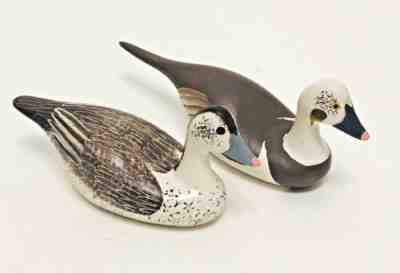
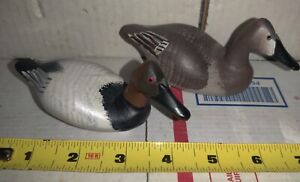
Sold on eBay February 14th, 2024