

MINT "ONE-of-KIND" SUPERB SIGNED 1957 JAMES LAPHAM 3/4-SIZE MINI WOOD DUCK Decoy
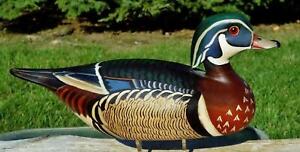
MINT "ONE-of-KIND" SUPERB SIGNED 1957 JAMES LAPHAM 3/4-SIZE MINI WOOD DUCK Decoy
SOLD $427.00 Sold: Feb 5, 2024 on eBayOriginal Listing Description
eBay IMPORTANT, PRISTINE MINT CONDITION 67+ YEAR OLD, c1957 JAMES LAPHAM of MASSACHUSETTS, 3/4-SIZE DRAKE WOOD DUCK CARVING ~EXTREMELY RARE, ONE-OF-A-KIND WORK OF ART BY ONE OF THE BEST MINIATURE TO FULL-SIZE CARVERS OF WILDFOWL IN U.S. HISTORY ~VERY MUCH INFLUENCED BY ELMER CROWELL & HIS SON CLEON CROWELL ~THE CARVING & ARTIST'S OIL PAINTING is AMAZING, AS ARE ALL OF LAPHAM'S CARVINGS ~THE CARVING ON THIS 3/4-SIZE WOOD DUCK IS BEYOND EXCEPTIONAL with an AWESOME CREST & LONG TAIL ~THE INCREDIBLE 2-5 COATS OF "WET-ON-WET" & "DRY-ON-DRY" PAINT is LIKELY THE FINEST BLENDED & STRAIGHT LINE PAINT YOU WILL EVER SEE ON A DECORATIVE CARVING, PATINA BEST EVER ~I HAVE OWNED THIS FOR OVER 20 YEARS & IT HAS BEEN A FAVORITE IN MY VAST COLLECTION IN MY MAIN SHOWCASE of DECORATIVE CARVINGS ~THIS DRAKE WOOD DUCK IS JUST LIKE THE WORK OF HIS FRIEND THE GREAT ELMER CROWELL & THIS DRAKE WOOD DUCK SIMPLY IS AS GOOD AS HIS CARVINGS GET ~DON'T MISS OUT ON THE CHANCE TO OWN ONE OF LAPHAM'S FINEST & KNOWN CARVINGS MINT "ONE-of-KIND" SUPERB SIGNED 1957 JAMES LAPHAM 3/4-SIZE MINI WOOD DUCK Decoy MINT "ONE-of-KIND" SUPERB SIGNED 1957 JAMES LAPHAM 3/4-SIZE MINI WOOD DUCK Decoy Click images to enlarge Description The World Famous Decorative Bird Carver James Lapham ....... - JAMES "LAP" LAPHAM - DENNISPORT, MASSACHUSETTS BIRTH NAME: "JAMES STANLEY LAPHAM JR." Born: .......... May 6, 1909 ............ Barnstable, Massachusetts ? Died: ........ Sept. 23, 1987 ......... Tuscaloosa, Alabama (Passed Away at the Age of 78) (Pictures Below): James Lapham is Featured Extensively (pages 120-128) of the Book: "Birds in Wood and Paint" ....... which is a "Must" Book for Miniature Collectors: This MINT, SUPER RARE, "ONE-of-a-KIND" (67+ YEAR-OLD), AMAZING c1957 "DRAKE WOOD DUCK" by JAMES LAPHAM was PRECISELY & INTRICATELY DETAIL CARVED & PAINTED .............. PLUS it is ONE of HIS MOST REALISTICALLY" and EXCEPTIONALLY CARVED & BEAUTIFULLY PAINTED EXTREMELY RARE "3/4 SIZE" CARVINGS: This Exact 3/4-Size, Drake Wood Duck is Listed in an Article in Hunting & Fishing Collectibles Magazine as One of the Known Rare 3/4-Size Decoys He Made, But Its Whereabouts was Unknown: (Pictures Below): This VERY RARE; "ONE-of-KIND" PRECISELY PAINTED ALMOST EVERY FEATHER: Superb "Crested" Drake "Woodie" Head, with "Outstanding" Paint that is Feather-Blended or Crisp Where Appropriate ....... MINT, EXTREMELY RARE, 100% ORIGINAL c1957 "DRAKE WOOD DUCK"; ONE of ONLY a FEW "3/4-SIZE", CROWELL TAUGHT DECOYS HE "EVER MADE"!!! -and- VERY "PRECISE & PERFECT", DELICATELY CARVED-IN, EYES, CREST, TAIL ........ and BILL that has "PERFECT & PRECISE" NOSTRILS, MANDIBLES, HEAD/BILL DELINEATION and AMAZING "CUT IN" NAIL on the TIP!! Photos of this "MINT & PRISTINE", VERY RARE-SIZED, FEATHER BLENDED PAINT-SCHEMED, 67-YEAR-OLD, JAMES LAPHAM, "DRAKE WOOD DUCK" -and- YOU CAN SEE the ACTUAL PARTS of MANY of the INDIVIDUAL FEATHERS ......... NOT JUST the FULL FEATHER!! LAPHAM'S CHOICE STOCK: This VERY RARE & MINT, "ONE-OF-A-KIND" DRAKE WOOD DUCK was CARVED with TWO PIECES of "AGED", SOLID RED CEDAR ........... the HEAD was PRECISELY GLUED, DOWELED & CLAMPED to the BODY .......... and IT was DONE SO PERFECTLY the SEAM is NEARLY INVISIBLE!! The "PATINA" on this ALMOST "3/4's of a CENTURY OLD", DRAKE WOOD DUCK'S, "ARTIST OILS" PAINT is NOTHING SHORT of "AMAZING" .......... and EVERY BRUSH STROKE is VISIBLE & Over 67-70 YEARS it DEVELOPED DEPTHS of COLOR & HUES that GIVE the SURFACE VARIED DIMENSIONS & LUSTRE to the AMAZING PATINA!! This Very Rare & "One-of-a-Kind" 3/4-Size "Drake Wood Duck ~and~ Has All of the Form & Paint he Learned by Studying with his Friend "Elmer Crowell" & Later his Son "Cleon Crowell: This 3/4-Sized Carving is One of Only a Handful He Made this Size -and- One of Only 2 Wood Ducks he Carved in Flat-Bottomed, Duck Decoy Fashion Measures: 10-3/8" long x 3-5/8" wide x 4-1/2" tall ? Solid Cedar "Drake Wood Duck" Weighs: 10 - oz. ____________________________________________________________ JAMES LAPHAM'S Range of Carvings in Terms of Species, Size, Posture, Quality & Paint ........ is Considered By Many to be "SECOND to ONLY ELMER CROWELL"!! ___________________________________________________________ The Perfectly Symmetrically Carved & Painted "One-of-a-Kind" Wood Duck .......... was Carved to Be Life-Like & Very Realistic Form & Feathers ........... with Its Beautiful, Stunning Style & Form including the Perfect Crest on the Head .......... Bill that Looks Like a Live Wood Duck in "EVERY WAY" -or- a "STUDY BILL"! STUNNING "GLOWING" GRADES of "FLAT-MATTE to LUSTRE" from the ALMOST CENTURY-OLD, AGED OIL-BASED, ARTIST'S PAINT has UNBELIEVABLY GORGEOUS & MINUTE DETAIL: ?Amazing, Very Thick & Multiple Layered Paint to this Entire Wood Duck "ALL" Flows in the Direction of the Feathers on this Superb Duck ........ Which Gives the Entire "Wood Duck" an Excellent "Life-Like" Feathered Surface ....... with Paint Detail that Gets Down to Almost Every Single Feather, Feather Part & Obviously Every Feather Group ....... and the Iridescence to the Head, Wings & Especially the Back is Marvelous!!!!! Perfectly Sculpted High-Neck Seat & Head Flows Perfectly into the Rounded Breast and Stunning Body ......... Stunning, Hand-Knife Carved Draped "Crest" on the Back of the Head is Superb & Starts at the Eye Indentations ........ Realistically Carved Bill, Neck, Body & Tail ........ and the Taxidermist Grade Red Glass Eyes Were Carved In & Mounted with a Jeweler's Precision!! _____________________________________________________________ (Pictures Below): CLOSE-UP PHOTOS of JUST SOME of the INCREDIBLE PAINTING DETAIL & PAINTING TECHNIQUES on this BREATHTAKING "DRAKE WOOD DUCK"!! SUPERB "WOOD DUCK" FEATHER IRIDESCENCE: STUNNING & PRECISELY PAINTED HEAD, WINGS, BACK & TAIL ...... the "WET-on-WET" INDIVIDUAL FEATHER LAYERING ...... APPEARS BLACK to BLUE to GREEN to PURPLE & ALL HUES IN-BETWEEN ........ and CHANGES FROM the DIRECTION YOU are LOOKING FROM!! AMAZING & MULTIPLE LAYERED THICK PAINT with a SUPERB, 67 to 70 YEAR-OLD PATINA: STUNNING THICK PAINT BRUSH MARKS FLOW PERFECTLY -and- "YOU CAN SEE EVERY PAINT BRUSH MARK" ....... that GIVES this DRAKE WOOD DUCK a "PERFECT" FEATHER FLOWING "LIFE-LIKE" SURFACE! ___________________________________________________________ NOTE: This DRAKE WOOD DUCK has SUPERB, PERFECTLY SYMMETRICAL CARVED in EYES & TINY CARVED IN NOSTRILS -and- The BILL was PRECISELY CARVED & PAINTED to PERFECTION with TINY PAINTED MANDIBLES, NOSTRILS & NAIL .......... the CLEAN & CRISP LINE & FEATHER BLENDED "WET-on-WET" -and- "WET-on-DRY", PAINT TECHNIQUES are MAGNIFICENT and TRULY AMAZING: ___________________________________________________________ (photos below): The Bottom of this PRECISELY CARVED, AGED RED CEDAR is PERFECTLY FLAT ....... and WAS LEFT UNFINISHED and is SIGNED with the SPECIES & HIS HOMETOWN WRITTEN!! James Lapham Personalized the Majority of His Decoys, Including this Middle Period Mallard with the Species, His Own Name and His Hometown: On the Bottom of this "DRAKE WOOD DUCK" in Blue Ball-Point Pen: HAND SIGNED: "WOOD DUCK DRAKE" ? HAND SIGNED: "J LAPHAM" -and- "DENNISPORT, MASS." ___________________________________________________________ (photo below): For a Short Period of Time Lapham Tried (2) Two Bottom Stamps in the Late 1960's & Early 1970's: The FIRST was the OVAL STAMP on the LEFT; -and- The SECOND has 3 STRAIGHT LINES. BUT these STAMPS WERE NOT USED for VERY LONG: CUSTOMERS CONVINCED HIM that the INK STAMPS were "LESS PERSONAL" ....... SO HE RETURNED to SIGNING EVERYTHING in PEN LIKE this "VERY RARE" DRAKE WOOD DUCK on ebay: ___________________________________________________________ This WOOD DUCK has SUPERB, PERFECTLY SYMMETRICALLY - MOUNTED in TAXIDERMIST GRADE RED GLASS EYES -and- BILL was PRECISELY CARVED & PAINTED to PERFECTION with TINY PAINTED MANDIBLES, NOSTRILS & "SUPERB" NAIL -and- CLEAN LINE & FEATHER BLENDED, "WET-on-WET" -and- "WET-on-DRY" PAINT is MAGNIFICENT & TRULY AMAZING: REMARKABLE HEAD & BILL: PERFECTLY CARVED-IN & LOCATED, TAXIDERMIST GRADE RED GLASS EYES with BLACK FLOATING PUPILS & HAND-POURED RED IRISES ........... with BREATH-TAKING "WOOD DUCK GREEN, BLUE & PURPLE HEAD", SUPERB PAINTED WHITE HEAD MARKINGS -and- A MARVELOUS, LIFE-LIKE, MULTI-COLORED BILL with CARVED-IN, "NOSTRILS", HEAD/BILL SEPARATION & "AMAZING CARVED NAIL" ........... then ALL BILL FEATURES were DELICATELY PAINTED in the EXACT COLORS of a DRAKE WOOD DUCK!! The HEAD & BREAST of this AMAZING LAPHAM "DRAKE WOOD DUCK" from SEVERAL ANGLES ....... SUPERBLY CARVED in BILL, COMB or CREST & EYES with AWESOME CRAZING to the BILL'S PATINA ....... and BEAUTIFUL ERECT HEAD FLOWS PERFECTLY into the BREAST ........... the BILL is a PERFECTLY CARVED "WOOD DUCK" BILL with PERFECT PROPORTIONS to the HEAD & NECK ......... and YOU CAN SEE EVERY PAINT BRUSH MARK where BLENDED "WET-on-WET" & also WHERE CONTRAST PAINTED "WET-on-DRY"!! ____________________________________________________________ This MARVELOUS & IMMACULATE, VERY-RARE 3/4-SIZE, "DRAKE WOOD DUCK" is a "ONE-of-a-KIND" PIECE that YOU'LL JUST NEVER SEE: _ (Below Photos): This 67-70+ YEAR-OLD, MINT & "ONE -of-a-KIND" DRAKE WOOD DUCK ........ with a PATINA that WILL IMPRESS YOU BEYOND WORDS WHEN YOU HOLD IT ........ and the CARVING & PAINT is SO SYMMETRICAL ........ IF HE CARVED & PAINTED a TINY, "MINUTE" DETAIL on ONE SIDE; YOU WILL "CERTAINLY" FIND it on the OTHER SIDE as WELL!! These "DRAKE WOOD DUCK" is a REMARKABLE & ELOQUENTLY CARVED & PAINTED DUCK DECOY that is "VERY OUT of the ORDINARY" of HIS WORK ....... with COMPLIMENTING "EXACTNESS" to the HEAD, PERFECT BODY and AWE-INSPIRING BACK, WINGS & PERFECT LONG TAIL ......... THIS DRAKE WOOD DUCK is as CLOSE to BEING "LIFE-LIKE" PROPORTIONED & "PERFECTLY SYMMETRICAL" as is HUMANLY POSSIBLE!! ___________________________________________________________ This AMAZING "JAMES LAPHAM" DRAKE WOOD DUCK is ONE of his FINEST, IF NOT FINEST, WOOD DUCK CARVINGS of ANY SIZE .......... AND the RESEMBLANCE to MANY of ELMER CROWELL'S FINEST 3/4-SIZE or ANY SIZE for that MATTER, is CERTAINLY NO COINCIDENCE: EXTRAORDINARY; MINT & PRISTINE, "ONLY ONE THAT EXISTS"; JAMES STANLEY LAPHAM, JR. (1909-1987); 10-3/8" SMALLER-SIZED, "DRAKE WOOD DUCK"; Wood Duck Carving (Dennisport, Massachusetts) TRULY EXCEPTIONAL & EXTREMELY FINE DETAIL to the CARVING and the PAINTING!! __________________ Elmer Crowell: The Father of Decorative Bird Carving (born): 1862 - (died): 1952 East Harwich, Massachusetts (Cape Cod) (photos below): James Lapham Frequent Visits to the Crowell's was a Mere 5 Miles or a 10 Minute Car Ride! Later, Elmer's Son Cleon (1891-1961), Became an Important Part of the Crowell Bird Carving Operation his Father Pioneered!! (Below Photo): Elmer Crowell & his Son Cleon Crowell Carve in their Shop ...... Friends of James Lapham & Both of which had a Great Influence on Lapham's Fine Carvings!! James Lapham: In the Footsteps of Elmer Crowell Dennisport, Massachusetts (Cape Cod) There is No Doubt that James Lapham's Carving Career was Significantly Influenced by that of Elmer Crowell. Over & Above the Fact that they Lived Very Close in Adjacent Towns on Cape Cod (5 Miles from East Harwich to Dennisport), the Similarities are Quite Evident Even from a Casual Look at the Work of Both Men. Most of Lapham's Later Birds are All Presented with Legs Inserted Crowell-Style into Half-Rounded Black, Gray or Dark Brown Painted Wood-carved, Rock-Shaped Bases and in Poses Very Similar to those Made by Crowell. Indeed, in a 1987 Interview, Lapham told the Magazine Sunday Cape Cod News; "Yes, I Did Learn a Lot from Crowell ...... I Got to Know him When I was Working for the Railway Express and Used to Go There (Crowell's Shop) all the Time to Pick Up Birds for Shipping". __________________ Like Many Bird Carvers, James Lapham Started Out with Waterfowl, But More So than a Great Many Decorative Carvers, he also Began to Carve Upland Birds, Birds of Prey & Others, But Never Got Pigeon-Holed into Making a Similar Pose & Experimented with Miniature Flyers, Preeners and Other Poses. James Lapham Also Followed in Crowell's Footsteps by Making Full-Size, 3/4, 2/3 -and- 1/2-Size as Well as Other Shapes and Sizes of Birds! (Below Pictures): Some OTHER "JAMES LAPHAM" CARVINGS, LIKE "ELMER CROWELL" SHOWING his DIVERSE INTEREST in MAKING DIFFERENT SPECIES, POSES, PAINT SCHEMES, SIZES of BIRDS, ETC.: _________________________________________________________ One Reason Why this 3/4-SIZE CARVING is SO "EXTREMELY RARE": After 1957, Lapham tended to Specialize in Miniature Songbirds, Waterfowl and Upland Game Birds. The Reason explained by His Family was "Practical Economics". Many More Small Carvings Could be Made from the Same Cubic Inches of Wood Required to Sculpt Larger Carvings. Additionally the Family Explained, Miniatures Could be Made Faster; Collectors Seemed to Prefer Them; and They were Easily & Safely Shipped at Minimal Cost and Risk. ___________________________________________________________ (Picture Below): This "FULL-SIZE" WOOD DUCK and the "3/4-SIZE" WOOD DUCK up for auction ........ ARE the ONLY NON-MINIATURE SIZE "WOOD DUCKS KNOWN" to EXIST! ........ WHILE I'M SURE this LATER "FULL-SIZE" is GORGEOUS IN HAND ........ this "3/4-SIZE" has a CLEANER & MORE PRECISE FORM & I WOULD THINK SIMILAR PAINT QUALITY, But a SLIGHTLY DIFFERENT SCHEME!! __________________________________________________________ (Below Picture): This MINT, "ONE-of-a-KIND" 67+ YEAR-OLD, AMAZING c1957 "DRAKE WOOD DUCK" by JAMES LAPHAM was PRECISELY & INTRICATELY DETAIL CARVED & PAINTED .............. PLUS it is ONE of HIS MOST REALISTICALLY" and EXCEPTIONALLY CARVED & BEAUTIFULLY PAINTED, KNOWN "3/4-SIZE or ANY SIZE for that MATTER": If You Like Very Rare, Vintage Carvings from Famous Master Carvers that Are Mint, Pristine, 100% Original, One of Their Best Specimens, You Couldn't Do Any Better than this Very Realistic, Known & Very Unusual Sized, Drake Wood Duck by James Lapham! Perfectly Life-Like, Slightly Angled-Up Puddle Duck, Semi-Alert, Head Pose with Crowell Form, Carving, Paint, Quality, etc. ....... THIS IS A GREAT CARVING FOR "ANY" COLLECTION!! Also, the Collector's Collection this Decoy Came from is Obviously Temperature & Direct Light Controlled and this was Certainly One of the Highlights & Most Revered Decoys of His Entire Collection!! This Immaculate Decoy Carving Doesn't Have a Crack, Chip, Dent, Paint Smudge or Even a Tiny Nick or Scratch & Absolutely Everything is as Tight on this as if He Made it Yesterday!! _ DON'T MISS OUT ON THIS ONCE IN A BLUE MOON WOODEN MINIATURE from a FRIEND & STUDENT of the MASTER HIMSELF, ELMER CROWELL: ___________________________________________________________ ? IN THE NEXT FEW WEEKS I AM PUTTING ON EBAY MORE LAWRENCE BETHEL FISH DECOYS, A RARE OLDER CARL CHRISTIANSEN WELLEYE, A FRANK MIZERA SILVER WITH BLACK AND WHITE HIGHLIGHT LINED FISH DECOY, A J.R. WELLS HEN BLUEBILL, A MINT NEVER-RIGGED ANIMAL TRAP OF PASCAGOULA HEN REDHEAD, A RALPH MALPAGE PAIR OF GREEN-WINGED TEAL, A VERY RARE c1893 100% ORIGINAL TRANSITION PERIOD MASON DRAKE BUFFLEHEAD, A NEAR MINT PAIR OF MASON GLASS EYE PINTAILS, A MINT c1905 HEDDON ARTISTIC MINNOW, A SCARCE RALPH MALPAGE ATLANTIC BRANT, A YELLOW WITH RED EYE BLUSH MOONLIGHT SINGLE-HOOK PIKAROON, A NIB CREEK CHUB MULLET COLOR STRIPER PIKIE IN CORRECT BOX, A MINT AND SUPERB HOLLOW RON KOCH DRAKE WIGEON, A NICE PAIR OF MASON GLASS EYE AND A PAIR OF TACK-EYE BLUEBILLS, AN AWESOME ERNIE NEUMANN SUCKER FISH DECOY, A RARE c1880 ST' CLAIR FLATS DRAKE CANVASBACK, A VERY NICE ERNIE NEUMANN SUCKER, A RARE 12-1/2" CHET SAWYER MINNESOTA FISH DECOY, A NEAR MINT OSCAR PETERSON PERCH FISH DECOY, A MINT PAIR OF WRAGG & BURRELL WIGEON, AN OUTRAGEOUSLY HARD TO FIND PAIR OF CHARLIE POZZINI BLUEBILLS, A WISONSIN HEN CANVASBACK VERY SIMILAR TO GUS MOAK BUT MORE REFINED AND REALISTIC THAT IS UNKNOWN TO ME, A VERY BIG & BULL-NECKED EARLY FERDINAND BACH DRAKE CANVASBACK FROM HIS PERSONAL RIG AND MORE!! ? Shipping Includes Insurance! I Don't Believe in Making a Profit on Shipping, You Pay What I Pay. If it's Less Than You Paid I Refund the Difference, If More I'll Pay For It. I COMBINE SHIPPING. I am also loading over 150 Duck Decoys, 150 Fish Decoys, 70 Scarce Fishing Lures, etc. so keep checking back. __________________________________________________________ This Extraordinary James Lapham Drake Wood Duck Carving up for Auction! ITEM DESCRIPTION: This Mint, Very Rare, Outstanding, One of a Kind Hand-Carved and Painted, 67-Year Old, Very Rare 3/4-Size and Exceptionally Carved and Painted, Solid Red Cedar "Drake Wood Duck" Puddle Duck Carving was hand painted and carved by James Stanley Lapham (born: May 6, 1909 - died: Sept. 23, 1987) that was made in or around 1957. James Lapham was formerly of Dennisport or Dennis Port, Massachusetts, an Atlantic Ocean coastal city located on the Nantucket Sound side of Cape Cod and after years of making the seasonal round-trip to Tuscaloosa, in his late years he eventually retired permanently to Alabama. ABOUT THE CARVER: James Lapham has long been identified as being a Massachusetts carver; however, a significant percentage of his colorful diminutive wooden sculptures were actually fashioned and made in Alabama during the fall and winter seasons. Then each late spring and summer his carvings journeyed north with him to be sold on Cape Cod to supplement the family income. It was a successful cycle repeated for nearly a quarter century. There was something magical in the annual passing of massive numbers of winged travelers. Like the songbirds, waterfowl and other birds he so loved to carve, James Lapham also migrated with the seasons. James Stanley Lapham, Jr. was born on May 6, 1909. He loved to hunt and fish and spent much of his youth exploring the wealth of wildlife in and around his home in Dennisport, Massachusetts. During the 1930's he was employed as a signalman for the New York, New Haven and Hartford Railroad (his death certificate lists him as a retired railroad switchman). Lapham’s connection with the railroad probably led him to his next job; as he worked as a Railway Express driver throughout the 1940's. In the 1950's, he also labored as a general handyman for Arthur Gould’s Shellfish Company in Chatham, Massachusetts, a short 6-mile drive east of his home in Dennisport on the ocean side of Cape Cod, and an even shorter 5 mile drive to Elmer Crowell's home and workshop. One of the biggest changes in the life of James Lapham was a chance meeting with a southern woman. The lady’s name was Dorothy Brooks (1913–2000), and she was from Alabama. James and Dorothy met during a summer vacation she took on the Cape shortly after World War II. They married in 1947, and at first they lived full time on the Cape. The couple made occasional visits to Dorothy’s hometown starting in the mid–1950's; then wintered in Alabama and spent the summer on Cape Cod, and they established a permanent home in Tuscaloosa, Alabama to be closer to her parents in the early 1960's. The Laphams' southern address was 738 Amanda Drive. That is where they spent their (winters), returning to the Cape each year for summer work and to sell bird carvings. The couple’s annual migration continued from the beginning of the 1960's until not long before his death in 1987. (Below Photos): One of Lapham's Hundreds of Patterns and Some of His Superb Shorebird & Waterfowl Carvings: There has been considerable speculation on exactly when James Lapham first began to carve and who might have influenced him, but in fact the answers eventually became apparent as his Birds began to more and more resemble Crowell's work, and his first known dated decoy has 1945 written on the bottom, so we at least now know he definitely carved then, but many are undated so his first carvings were obviously earlier as this 1945 bird was already very evolved. He clearly was greatly influenced by the talented father and son duo of Elmer (1862-1952) and Cleon (1891-1961) Crowell when he served as a delivery driver for the Railway Express in the 1940's. By then Elmer was in his 80's and suffering from rheumatism and no longer carving, but there was a great many of his finished decoys there for Lapham to study, obtain some and follow many of the traits, carving and painting techniques, and features of the Great Elmer Crowell. His son Cleon was in his 50's and fully in charge of the family carving business and also was available to Lapham for years to come after Elmer's passing. "Cleon appears to have handled all customers’ requests after 1933, as Elmer had begun having health issues around that time, but he was still carving as much as he was able and James Lapham was there for that experience as well. Thus, Cleon also began doing more and more of the work from the mid-thirties on, and it is clear that Cleon was assuming more and more of the carving and painting work through the decade of 1930 to 1940 and was doing all the work by 1944. (Pictures Below): James Lapham Also Accumulated Hundreds of Patterns of Which Many He Never Got Around to Use ...... But the Variety of Species & Poses of His Birds Indicates He Did Use his Fair Share of Unique Bird Carvings Such as his Anhinga & Whip-Poor-Will for instance: Frequent shipments of completed Crowell carvings were sent to distant locations, utilizing Railway Express. Elmer Crowell died in 1952; and, coincidentally, at one point in time the earliest dated Lapham carving known was a miniature common scoter dated March 20, 1952; although after that one dated 1945 was also found, so 1952 may have been the date or around the time that he started calling his shop "The Duck Blind" and advertising locally and via word-of-mouth, but certainly proves he started carving much earlier than thought. Two other fascinating local and creative acquaintances were Ralph Eugene Cahoon, Jr. (1910-1982) and his wife Martha Farham Cahoon (1905-1999), the celebrated self-styled Cape folk painters. According to Lapham family accounts, James Lapham and Ralph Cahoon fished for tuna and mackerel together. Jame's Lapham's wife at that time was Dorothy 'nee Brooks' Lapham, who shared mutual interests in tole painting and decorating with Martha Farham Cahoon and her father Axel Farham. Co-incidentally but not related, Martha Cahoon studied art at the Brooks Academy. The quality of Jame's Lapham's painted featheration, vermiculation and anatomical accuracy are both testaments to his creative abilities and perhaps indicative of inspiration from the Crowells and possibly Cahoons. Although the elder Elmer Crowell was no longer capable of producing waterfowl carvings, he certainly offered helpful advice and encouragement. Cleon, on the other hand, was actively involved in continuing the family enterprise and was fully competent to offer first hand demonstrations of skills and techniques learned from the master, which would also have put James Lapham as a student of his as well. There remains no doubt that Lapham’s carving abilities evolved through time and that the interactions between the Crowell's and James Lapham represented an enduring relationship as the characteristics are indicative of such valuable exchanges, whether taught or perceptively observed. (Pictures Below): A Gorgeous & Later James Lapham Hen Merganser, a Green-Winged Teal, a Pintail & an Atlantic Brant: James Lapham based all of his Avian Sculptures on a combination of helpful reference sources. But he also avidly watched songbirds, upland game birds and waterfowl in their natural habitats. The following is one quote from many hand written letters he mailed to a Mrs. Marie Diehl, "My peach tree seems to be fine! Flowers look alright too! We had a huge flock of Cedar Wax-Wings in the yard today. They must be migrating. I watched for them hoping they would come to my bird feeder. They didn’t. I guess they are headed North. I am sending you a Robin as a harbinger of Spring." (Diehl letter March 4, 1974 courtesy of the Late Ted Harmon). James Lapham was also much like many others including the founder of Mason Decoys, James Mason, as Lapham also studied interactions of pairs and later incorporated those observations into some of his miniature or other-sized compositions. He also utilized illustrated books to facilitate the capturing of elusive poses, coloration and gestures. Some of these include the "Natural History of American Birds of Eastern & Central North America", an "Audubon Water Bird Guide", the "Ducks and Geese of North America", and a "Sporting Field Identification Guide". (Pictures Below): James Lapham's Desire to Carved Miniatures as Well as Other Sizes and up to Life-Size, Flying Birds and Poses in Any Way his Mind Could Realistically Imagine a Bird Could Be in by either Directly Observing and Studying Them or From Books: LAPHAM'S PATTERNS: Preparations to create wooden bird sculptures started with the gathering of visual information to better familiarize Lapham with his chosen subject. The next step required him to accurately draw gestural profiles of each bird or duck onto paper or cardboard. Any available paper was OK. Drawings sometimes included penciled notations about the species or its identity and then drawings were then precisely cut out to serve as guiding patterns for the sawing of carving blanks. Existing patterns document just a small portion of the variety of subjects studied. Reportedly, patterns were used only once and they were not discarded as he evidently believed that ideas for new carvings necessitated new, original patterns. The practice of renewed thoughts resulted in subtle and consistent changes through time. On patterns, documenting Lapham’s patterns ventures beyond the realm of avian iconography. It’s a mackerel! Collectors have tended to overlook the historical value of patterns as significant aspects of an artist’s aesthetic development. They represent the germ of an idea, the inauguration of a creative process. Fortunately, a substantial number of Lapham’s original patterns have been saved for posterity both privately and at the Heritage Museum of Sandwich, Massachusetts. (Pictures Below): THREE SPECIES of SHOREBIRDS SHOWING his VARIETY of POSES & his PROGRESSION to the "ROCK" WOODEN BASES: EARLY CARVINGS: James Lapham’s earliest carvings date to approximately 1945 and he most assuredly carved earlier. He was single, the World War II had ended and rationing was over and America was re–emerging. New opportunities for enterprising individuals provided stimulus for creativity and it was a time of celebration. James Lapham's first bird carvings were only for his personal enjoyment and education. This was something he very much wanted to learn how to do. The first were quite small miniatures, ranging in size from only one inch to two inches. By comparison with the refinement of much later work, the few remaining from that initial period are less sophisticated; but, it was the beginning. Thin sheet lead was used for webbed feet of early standing carvings but was eventually rejected because it didn’t hold paint well. Driftwood appears to have been his first material selected for bases as it was free, abundant and created a complimentary natural environment for carvings. Optional base forms were carved and painted wooden shells, rocks and mounds. Cape cedar was the preferred carving wood for birds and their bases and it was utilized until it became problematic having it shipped to Alabama. Then James shifted to locally available woods in Alabama such as straight grained sugar pine, swamp cedar and tulip poplar as acceptable alternatives. Until circa 1957, Lapham produced carvings in quite a variety of sizes. He was an avid hunter; yet, no working decoy rig by him is known to exist. He did, however, make a limited number of decorative decoys. After 1957, Lapham tended to specialize in miniature songbirds, waterfowl and upland game birds. The reason explained by the family was practical economics. Many more small carvings could be fashioned from the same cubic inches of wood required to sculpt more sizable images. Miniatures could be made faster; collectors seemed to prefer them; and they were easily and safely shipped at minimal cost and risk. (Pictures Below): TWO EARLY CARVINGS that SHOW he was NATURALLY TALENTED RIGHT from HIS FIRST CARVINGS: CAREER PRODUCTION: One estimate of Lapham’s productive capabilities is four to five miniatures per week. If an active thirty-year period (1950-1980) is considered using a more conservative number of three per week, then an approximate career total could be roughly estimated. He might have completed, at the most, somewhere between 4,000 and 4,500 carvings of all sizes and most species. Many were designed as matched pairs, almost all were signed and some were dated. The totality is an educated guess that cannot account for illness, vacations, or other limiting reasons. Miniatures of several measurements represent about 90% of the total and they are what James Lapham has become best known for. His rarest carvings are three–quarter to life–size. Some of the more individual larger and unusual sculptures include a three-quarter pintail drake; a half–size flying Canada goose wall plaque; a three-quarter size drake wood duck; a pair of flying pheasants; a tern; a life–size half–bodied quail; a life–size half–bodied song sparrow plaque; a half–bodied least tern; a two–thirds size pintail drake; several life–size robins; a life–size cardinal (sold on ebay 2004); a life–size grackle, a life–size purple finch; a brown trout, rainbow trout and mackerel; and a hanging dead game plaque. Many smaller shorebirds were often depicted full–size. Known decorative decoy types include wood ducks, a ruddy duck, mallards, goldeneye, red breasted merganser, green wing teal, old squaw with open mouth (sold on eBay 2004), pintail, 1959 Pratt merganser repainted by Lapham, two–thirds size mallard pair, and a two–thirds size shoveler. There are others but these sufficiently indicate Lapham’s range of interests and they also suggest the definite likelihood that other surprises await discovery. SUMMARY: One such surprise is news of a three–inch miniature fish carved by Lapham. Almost all Lapham carvings were signed in ink or pencil on the back or bottom; fewer were dated. The chronology that follows represents over one hundred dated carvings, which reveal his pattern of activity. Most signatures also include the town of Dennisport, Mass., even the ones carved in Alabama, which mysteriously is never mentioned. Although they may all have been signed Dennisport is because that is where they were almost all sold. Often the species portrayed is identified on the bottom. Features of the best sculptures are carved wing separations, intricate tail detailing, carved wing outlines, delicately layered feathering, elaborate vermiculation, and glass eyes. When he was good, he was really good. By contrast, others exhibit rather plain carving and painting. Lapham portrayed birds in all natural positions; preeners, swimmers, calling, and many others. Most all stand on thin wire legs mounted to one of several types of bases and all are full-bodied. James developed his ideas and skills in Massachusetts (abetted through his association with Elmer Crowell and his son Cleon Crowell) and polished them in Alabama. He kindly shared them through personal lessons taught in Alabama. James Stanley Lapham, Jr. died on September 23, 1987. His friends knew him simply as "Lap". Through the years, the birds and waterfowl carvings of James Lapham, also known as James Stanley Lapham, have passed hand to hand through private individuals as well as the sales houses of Richard A. Bourne, Theodore Harmon – Decoys Unlimited, Eldreds, Guyette & Schmidt, Copley's Fine Art and Guyette and Deeter. This DRAKE WOOD DUCK up for auction: This incredibly awesome and Important 3/4-size Drake Wood Duck is One of the Rarest and Best Decorative Duck Decoy, or Sculpture, that is on ebay, measures: 10-3/8" long x 3-5/8" wide x 4-1/2" and weighs a hefty for its size 10-oz. It was wonderfully carved with detailed carving features that include the perfectly proportioned for-the-species body & head, long perfect tail, Comb on the Back of the Head and a bill carved and painted so real it looks like its from a live duck. The carving on head also includes life-like eye indentations and the head is carved semi-alert and flows realistically into the bill, and the head and neck flow flawlessly into the body. The red, taxidermist grade eyes are absolutely perfectly symmetrically located and were carved in with perfection and located on the head realistically as well. The paint is also absolutely extraordinary with feather vermiculation and detail that could have only been done with tiny artists brushes in the size range of 20-00 and in at least 2-5 coats of paint, depending on the area and the attention to detail required there. The painting was done so precisely that you can see every paint brush mark on the entire duck. The Wood Duck is in "IMMACULATE" condition as you can see by the photos. If you have any questions or would like any additional photos feel free to email me. Thanks for looking. The First Photo is of this Awesome Drake Wood Duck up for auction. The 2nd Photo is of Some of James Lapham's Patterns, Followed by 2 photos of Him and Some of His Carvings. The Next 15 Photos are of this Awesome James Lapham Drake Wood Duck 3/4-Size Decoy up for auction from a Variety of Angles, So You Can See the Incredible Form, Style, Paint, etc. that Makes this Such an Awesome Carving! The Last 5 Photos are again of other James Lapham carvings. (Again, I encourage you to use the zoom feature in this listing to get close-up looks at anywhere on this decoy as it can zoom in on the smallest of spots from the many different directions to afford you to see the decoys entire surface.) IMPORTANT DATES in JAMES LAPHAM'S LIFE, CURRENT EVENTS at the TIME, AS WELL as a CHRONOLOGY of HIS DATED CARVINGS!! Chronology of IMPORTANT EVENTS -and- Many "DATED" Songbird, Waterfowl & Other Bird Carvings: -CARVINGS IN BLACK TYPE ARE MR. LAPHAM'S MINIATURES -CARVINGS IN BURGUNDY TYPE ARE FULL, 3/4, 1/2 OR OTHER SIZES -CARVINGS IN BLUE TYPE & YELLOW ARE PICTURED IN DESCRIPTION BORN in 1909 - JAMES STANLEY LAPHAM, JR. 1930's - Great Depression 1930's - Lapham worked for New York, New Haven & Hartford Railroad as a signalman 1939–1943 - Elmer Crowell suffers from rheumatism and stops carving 1940's - Lapham works for the Railway Express Company as a driver 1940's - World War II 1945 - JAMES LAPHAM BEGINS his CARVING CAREER 1947 - Lapham Marries Dorothy Brooks from Alabama 1950's - Lapham works for Arthur Gould’s Shellfish Company as a handyman 1952 - January 2 – ELMER CROWELL DIES __________________________ Below is a List of James Lapham's Known Dated Carvings 1952 March 20 – Common Scoter Drake mini (earliest dated carving so far) 1954 December 11 – Wood Duck Drake half size 1955 (No Month) – Tern – near life-size 1955 February 5 – Ringneck Drake mini 1956 (No Month) – Least Sandpiper mini 1956 (No Month) – Mallard Drake – life-size decoy 1957 (No Month) – Hen Mallard mini with open mouth 1957 February 14 – Mallard Drake decoy half size Valentines Day 1957 February 14 – Laughing Gull mini Valentine’s Day 1957 February 18 – Mallard Drake mini 1957 February 18 – Red Breasted Merganser Drake running mini 1957 March 9 – Short Eared Owl mini 1957 April – Pintail Drake mini 1957 April 25 – Shoveler Drake mini 1957 April 26 – Brant mini (PICTURED) 1957 May 1 – Bluebill Drake mini 1957 May 1 – Widgeon Drake mini 1957 May 5 – Redhead Drake mini 1957 May 9 – Black Bellied Plover mini 1957 May 20 – Blue Wing Teal Drake mini 1957 May 21 – Eider Hen mini 1957 May 27 – Blue Jay half Size 1957 May 30 – Bufflehead Drake mini 1957 June 10 – Buff Breasted Sandpiper life-size 1957 June 16 – Canvasback Drake mini 1957 August 15 – Pintail Drake mini preener 1957 October 11 – Goldeneye Hen mini 1957 December 5 – Hudsonian Curlew mini 1957 December 14 – Widgeon Drake mini 1958 (No Month) – Quail life-size half-mount plaque 14-1/2" 1958 February 5 – Surf Scoter Drake mini 1958 February 19 – Marsh Hawk mini 1958 February 26 – King Eider Drake mini 1958 May 21 – Black Bellied Plover life-size 1958 September 10 Green Wing Teal Hen mini (PICTURED) 1958 September 19 – Goldeneye Drake decoy – three-quarter size 1958 October 1 – Ruddy Duck Drake mini 1958 October 6 – Bufflehead Hen mini 1958 November 7 – Sparrow Hawk mini 1958 November 23 – Song Sparrow life-size half-bodied plaque 1959 (No Month) – Pratt factory merganser decoy repainted by Lapham 1959 (No Month) – Life-size Woodcock 1959 January 7 – Bluebill Hen mini 1959 January 27 – Horned Grebe mini 1959 February 11 – Cinnamon Teal Drake mini 1959 March 5 – Wood Duck Drake decoy – glass eyes – full-size 1959 March 10 – Black Backed Gull mini 1959 March 28 – European Wigeon Drake mini (Easter) 1959 April 1 – Least Sandpiper life-size 1959 April 8 – Black Capped Chickadee life-size 1959 April 27 – Harlequin Drake mini 1959 April 29 – Steller’s Eider Drake mini 1959 May 19 – Green Wing Teal Drake decoy mini (PICTURED) 1959 September 17 – Mourning Dove three-quarter size 1959 October 4 – Pintail Hen mini 1959 October 13 – Gadwall Hen mini 1950 - Early in the Year the Lapham's move to Alabama 1960 (No Month) – Quail mini 1960 April 11 – Bobwhite Quail mini 1960 April 11 – Brown Capped Chickadee life-size 1960 May 11 – Wood Duck Hen preener mini 1960 May 20 – Hooded Merganser Drake mini 1960 May 20 – Hooded Merganser Hen Mini (PICTURED) 1960 June 23 – Myrtle Warbler life-size 1960 July 7 – Purple Sandpiper mini 1960 September 1 – Woodcock mini 1960 September 18 – Curlew mini 1960 September 24 – Least Sandpiper life-size 1960 September 24 – Yellowlegs – mini (PICTURED) 1960 September 24 – Yellowlegs mini 1960 November 11 – Oyster Catcher quarter size 1961 CLEON CROWELL DIES 1961 (No Month) – Kingfisher female half size 1961 (No Month) – Sanderling life-size 1961 (No Month) – Life-size Robin (PICTURED) 1961 (No Month) – Myrtle Warbler life-size 1961 (No Month) – Purple Finch mini 1961 (No Month) – Goldeneye drake half size 1961 (No Month) – Bufflehead drake half size 1961 (No Month) – Blue Jay 2/3 size 1961 (No Month) – Widgeon Drake mini 1961 March 15 – Yellowlegs mini 1961 March 15 – Black Bellied Plover mini 1961 April 9 – TURKEY MINI (PICTURED) 1961 April 16 – Goldeneye Drake 1961 April 16 – Ruddy Turnstone three-quarter size 1961 April 24 – Redhead Drake preener mini 1961 April 29 – Red Breasted Merganser Drake preener mini 1961 May 2 – Purple Finch life-size 1961 August – Mallard Drake 2/3 life size 1961 August – Mallard hen 2/3 life size 1961 September – Turnstone 2/3 size 1962 (No Month) – Cardinal life-size (PICTURED) 1962 (No Month) – Canada Goose mini 1962 (No Month) – Brant mini - (PICTURED) 1962 (No Month) – Common Tern life-size 1962 (No Month) – Redhead Drake mini 1962 (No Month) – Surf Scoter Drake mini 1962 (No Month) – Surf Scoter Hen mini 1962 (No Month) – Jack Curlew mini 1962 (No Month) – Wood Duck drake mini 1962 May 6 – Goldeneye Drake quarter size 1962 May 8 – Surf Scoter Drake mini 1962 May 11 – Flicker life-size 1962 May 17 – Ruddy Turnstone life-size 1962 June 7 – Redhead Hen mini 1962 June 7 – Hooded Merganser Hen mini 1962 July – Common Tern – half size 1962 July 5 – Blue Wing Teal Hen mini 1962 October 17 – Surf Scoter Drake mini 1963 (No Month) – Flying Least Tern half life-size 1963 (No Month) – Sanderling life-size 1963 (No Month) – Red Breasted Merganser Drake mini 1963 (No Month) – Wood Duck hen mini 1963 May 29 – Long Eared Owl mini 1963 July 30 – Piping Plover life-size 1963 September 30 – Ruffed Grouse – half size 1963 November 4 – Fox Sparrow life-size 1963 November 6 – Cormorant mini 1963 November 20 – Sora Rail life-size 1964 November 12 – Killdeer 1965 March 22 – Ruddy Duck Drake decoy life-size 1965 December 14 – Old Squaw Drake mini 1965 December 14 – Shoveler Drake mini 1965 December 18 – Old Squaw Hen mini 1966 January 1 – Red Breasted Merganser Hen decoy three-quarter size 1966 January 16 – Shoveler Hen mini 1966 November 28 – Black Duck caller mini 1966 November 28 – Wood Duck Drake calling mini 1967 (No Month) – American Merganser Drake 1/3 size 1971 July 22 – Goldeneye Drake mini 1971 July 22 – Goldeneye Hen mini 1971 October 21 – Ruddy Turnstone 1971 December 8 – Gadwall Hen mini 1972 (No month) – Cinnamon Teal mini 1972 January 4 – Green Wing Teal Drake mini (PICTURED) 1972 January 4 – Cinnamon Teal Drake mini 1972 February 28 – Ringneck Hen mini 1972 March 20 – Stellers Eider Drake mini 1972 April 3 – Canada Goose mini 1972 August 1 – Woodcock mini 1973 March 27 – Scaup Drake mini 1973 November 22 – Shoveler Drake mini 1973 November 29 – Wood Duck Drake mini 1973 November 29 – Black Duck Drake mini 1974 January 17 – Ruffed Grouse quarter size 1974 March 4 – Robin life-size 1974 March 14 – Brown Thrasher life-size 1974 March 18 – Goldeneye Drake 1/3 size 1974 June 6 – Red-Breasted Merganser Drake mini 1974 June 13 – Pintail Drake quarter size 1974 July 5 – Mallard Drake mini 1974 August 14 – Least Sandpiper life-size 1974 August 21 – Common Merganser Drake mini 1975 May 18 – House Wren life-size 1975 July 5 – Barn Swallow life-size 1976 September 28 – Dowitcher life-size 1987 JAMES LAPHAM PASSES AWAY _________ Below is Information on the 2 Men that Had the Greatest Influence on James Lapham's Career as One of the Finest Decorative Carvers to Have Ever Lived: Elmer Crowell: The Father of Decorative Bird Carving (born: 1862 - death: 1952) Elmer is Widely Known as the Most Influential Decorative Bird Carver in History!! And both Elmer & his Son Cleon had a Profound & Evolving Influence on James Lapham's Carvings! Anthony Elmer Crowell was born on December 5, 1862 in East Harwich, Massachusetts. Crowell was involved in the family cranberry farming business at a young age. At the age of 12, he received his first gun from his father. Young Elmer was fascinated by nature and loved hunting during the annual waterfowl migrations. At 14, his father bought him a large tract of land on the south shore of Pleasant Lake which had an ideal beach for his bird decoys and hunting stands. He preferred live decoys but also carved and used block decoys. Supplementing his cranberry farming wages by gunning for the market and managing hunting stands seemed to be a natural fit. Word quickly spread of his ability to work with live decoys. His ability seemingly unmatched, taking out large flocks with relative ease. He would try to tame geese by building pens and trapping them inside, using electric wires hooked down from the blind to a box. At that point, as soon as a flock would fly over the lake, he would push a button to release the ones he caught, so that they would join the flock and bring them back towards the beach. After that, it was fair game to shoot. Soon he was managing hunting stands and sporting clubs for wealthy landowners from Boston. Dr. Charles Ashley Hardy and his partners, G. Herbert Windeler and Loring Underwood of the "Three Bears Club" were amongst the first to approach this enthusiastic young bird handler. In 1900, Crowell was hired by Dr. John C. Phillips to manage his hunting camp at Wenham Lake, north of Boston. Once the practice of using live decoys became illegal, he continued hunting but returned to making his own decoys. As conservation movements began to gain momentum, Elmer could see his life changing. He witnessed the extermination of the Passenger Pigeon and the Labrador Duck, as wells as, the decline of many other species that were being sacrificed to fuel the demand for fresh meat. Perhaps he was the first of his peers to see the future testing the market with decorative carvings as early as 1900. He carved shorebirds, miniatures and ornamentals. In 1912, with the help of Dr. Charles Ashley Hardy, he purchased tools, converted an old chicken coop into a workshop, and officially declared himself to be a full time decoy maker. Crowell was and is known for paying meticulous attention to detail in carving bills and feathers, as well as painting the feathers on his decoys. His experience with live decoys allowed him to craft masterfully shaped decoys. His son Cleon, then in his early thirties, joined Elmer in the family decoy carving business. Their reputation for carving fine decorative objects for the tourist trade was proving to be quite fruitful. Demand was strong enough for him to order his first brand in 1912. This brand is referred to as the oval brand (1912-1928) a rectangular stamp was later used. The father and son carving duo worked together until 1943 when Elmer's health prevented him from participating. Cleon continued carving until his death in 1961. __________________________________________________________ Cleon Stanley Crowell (born: 1891 - death: 1961) Cleon was the Son of & Carving Collaborator with his Father, the Great Elmer Crowell After graduating from the East Harwich school in 1907, Cleon attended the newly created YMCA’s Association Institute, where he studied in the Automotive Department and learned how to operate and repair cars. Cleon graduated in 1911 and spent several years working as a “chauffeur ” A car enthusiast, Cleon took his family on many “motoring” trips and enjoyed motorcycling. Before his death, he was the proud owner of a 1958 Ford Thunderbird. Cleon was also an avid collector of Native American artifacts. In 1917, he married an East Harwich neighbor, Nellie Mae Moore, who had graduated from Burdett College in Worcester. The couple had one daughter, Dorothy. Cleon joined the Army in 1918 to serve in World War I but came down with the “Spanish Influenza” in training camp and was lucky to survive the deadly flu pandemic. After his return, he became a partner in his father’s shop. The father and son carving duo worked together until 1943, when Elmer's health prevented him from participating. Cleon continued carving until his death in 1961. Images sell!Get Supersized Images & Free Image HostingCreate your brand with Auctiva sCustomizable Templates.THE simple solution for eBay sellers. Track Page Views WithAuctiva's Counter (Condition: New (Other))
Note: This item has been sold and is no longer available. This page serves as a historical price reference for Duck Decoy collectors and appraisers.
Original Listing Description
eBay IMPORTANT, PRISTINE MINT CONDITION 67+ YEAR OLD, c1957 JAMES LAPHAM of MASSACHUSETTS, 3/4-SIZE DRAKE WOOD DUCK CARVING ~EXTREMELY RARE, ONE-OF-A-KIND WORK OF ART BY ONE OF THE BEST MINIATURE TO FULL-SIZE CARVERS OF WILDFOWL IN U.S. HISTORY ~VERY MUCH INFLUENCED BY ELMER CROWELL & HIS SON CLEON CROWELL ~THE CARVING & ARTIST'S OIL PAINTING is AMAZING, AS ARE ALL OF LAPHAM'S CARVINGS ~THE CARVING ON THIS 3/4-SIZE WOOD DUCK IS BEYOND EXCEPTIONAL with an AWESOME CREST & LONG TAIL ~THE INCREDIBLE 2-5 COATS OF "WET-ON-WET" & "DRY-ON-DRY" PAINT is LIKELY THE FINEST BLENDED & STRAIGHT LINE PAINT YOU WILL EVER SEE ON A DECORATIVE CARVING, PATINA BEST EVER ~I HAVE OWNED THIS FOR OVER 20 YEARS & IT HAS BEEN A FAVORITE IN MY VAST COLLECTION IN MY MAIN SHOWCASE of DECORATIVE CARVINGS ~THIS DRAKE WOOD DUCK IS JUST LIKE THE WORK OF HIS FRIEND THE GREAT ELMER CROWELL & THIS DRAKE WOOD DUCK SIMPLY IS AS GOOD AS HIS CARVINGS GET ~DON'T MISS OUT ON THE CHANCE TO OWN ONE OF LAPHAM'S FINEST & KNOWN CARVINGS MINT "ONE-of-KIND" SUPERB SIGNED 1957 JAMES LAPHAM 3/4-SIZE MINI WOOD DUCK Decoy MINT "ONE-of-KIND" SUPERB SIGNED 1957 JAMES LAPHAM 3/4-SIZE MINI WOOD DUCK Decoy Click images to enlarge Description The World Famous Decorative Bird Carver James Lapham ....... - JAMES "LAP" LAPHAM - DENNISPORT, MASSACHUSETTS BIRTH NAME: "JAMES STANLEY LAPHAM JR." Born: .......... May 6, 1909 ............ Barnstable, Massachusetts ? Died: ........ Sept. 23, 1987 ......... Tuscaloosa, Alabama (Passed Away at the Age of 78) (Pictures Below): James Lapham is Featured Extensively (pages 120-128) of the Book: "Birds in Wood and Paint" ....... which is a "Must" Book for Miniature Collectors: This MINT, SUPER RARE, "ONE-of-a-KIND" (67+ YEAR-OLD), AMAZING c1957 "DRAKE WOOD DUCK" by JAMES LAPHAM was PRECISELY & INTRICATELY DETAIL CARVED & PAINTED .............. PLUS it is ONE of HIS MOST REALISTICALLY" and EXCEPTIONALLY CARVED & BEAUTIFULLY PAINTED EXTREMELY RARE "3/4 SIZE" CARVINGS: This Exact 3/4-Size, Drake Wood Duck is Listed in an Article in Hunting & Fishing Collectibles Magazine as One of the Known Rare 3/4-Size Decoys He Made, But Its Whereabouts was Unknown: (Pictures Below): This VERY RARE; "ONE-of-KIND" PRECISELY PAINTED ALMOST EVERY FEATHER: Superb "Crested" Drake "Woodie" Head, with "Outstanding" Paint that is Feather-Blended or Crisp Where Appropriate ....... MINT, EXTREMELY RARE, 100% ORIGINAL c1957 "DRAKE WOOD DUCK"; ONE of ONLY a FEW "3/4-SIZE", CROWELL TAUGHT DECOYS HE "EVER MADE"!!! -and- VERY "PRECISE & PERFECT", DELICATELY CARVED-IN, EYES, CREST, TAIL ........ and BILL that has "PERFECT & PRECISE" NOSTRILS, MANDIBLES, HEAD/BILL DELINEATION and AMAZING "CUT IN" NAIL on the TIP!! Photos of this "MINT & PRISTINE", VERY RARE-SIZED, FEATHER BLENDED PAINT-SCHEMED, 67-YEAR-OLD, JAMES LAPHAM, "DRAKE WOOD DUCK" -and- YOU CAN SEE the ACTUAL PARTS of MANY of the INDIVIDUAL FEATHERS ......... NOT JUST the FULL FEATHER!! LAPHAM'S CHOICE STOCK: This VERY RARE & MINT, "ONE-OF-A-KIND" DRAKE WOOD DUCK was CARVED with TWO PIECES of "AGED", SOLID RED CEDAR ........... the HEAD was PRECISELY GLUED, DOWELED & CLAMPED to the BODY .......... and IT was DONE SO PERFECTLY the SEAM is NEARLY INVISIBLE!! The "PATINA" on this ALMOST "3/4's of a CENTURY OLD", DRAKE WOOD DUCK'S, "ARTIST OILS" PAINT is NOTHING SHORT of "AMAZING" .......... and EVERY BRUSH STROKE is VISIBLE & Over 67-70 YEARS it DEVELOPED DEPTHS of COLOR & HUES that GIVE the SURFACE VARIED DIMENSIONS & LUSTRE to the AMAZING PATINA!! This Very Rare & "One-of-a-Kind" 3/4-Size "Drake Wood Duck ~and~ Has All of the Form & Paint he Learned by Studying with his Friend "Elmer Crowell" & Later his Son "Cleon Crowell: This 3/4-Sized Carving is One of Only a Handful He Made this Size -and- One of Only 2 Wood Ducks he Carved in Flat-Bottomed, Duck Decoy Fashion Measures: 10-3/8" long x 3-5/8" wide x 4-1/2" tall ? Solid Cedar "Drake Wood Duck" Weighs: 10 - oz. ____________________________________________________________ JAMES LAPHAM'S Range of Carvings in Terms of Species, Size, Posture, Quality & Paint ........ is Considered By Many to be "SECOND to ONLY ELMER CROWELL"!! ___________________________________________________________ The Perfectly Symmetrically Carved & Painted "One-of-a-Kind" Wood Duck .......... was Carved to Be Life-Like & Very Realistic Form & Feathers ........... with Its Beautiful, Stunning Style & Form including the Perfect Crest on the Head .......... Bill that Looks Like a Live Wood Duck in "EVERY WAY" -or- a "STUDY BILL"! STUNNING "GLOWING" GRADES of "FLAT-MATTE to LUSTRE" from the ALMOST CENTURY-OLD, AGED OIL-BASED, ARTIST'S PAINT has UNBELIEVABLY GORGEOUS & MINUTE DETAIL: ?Amazing, Very Thick & Multiple Layered Paint to this Entire Wood Duck "ALL" Flows in the Direction of the Feathers on this Superb Duck ........ Which Gives the Entire "Wood Duck" an Excellent "Life-Like" Feathered Surface ....... with Paint Detail that Gets Down to Almost Every Single Feather, Feather Part & Obviously Every Feather Group ....... and the Iridescence to the Head, Wings & Especially the Back is Marvelous!!!!! Perfectly Sculpted High-Neck Seat & Head Flows Perfectly into the Rounded Breast and Stunning Body ......... Stunning, Hand-Knife Carved Draped "Crest" on the Back of the Head is Superb & Starts at the Eye Indentations ........ Realistically Carved Bill, Neck, Body & Tail ........ and the Taxidermist Grade Red Glass Eyes Were Carved In & Mounted with a Jeweler's Precision!! _____________________________________________________________ (Pictures Below): CLOSE-UP PHOTOS of JUST SOME of the INCREDIBLE PAINTING DETAIL & PAINTING TECHNIQUES on this BREATHTAKING "DRAKE WOOD DUCK"!! SUPERB "WOOD DUCK" FEATHER IRIDESCENCE: STUNNING & PRECISELY PAINTED HEAD, WINGS, BACK & TAIL ...... the "WET-on-WET" INDIVIDUAL FEATHER LAYERING ...... APPEARS BLACK to BLUE to GREEN to PURPLE & ALL HUES IN-BETWEEN ........ and CHANGES FROM the DIRECTION YOU are LOOKING FROM!! AMAZING & MULTIPLE LAYERED THICK PAINT with a SUPERB, 67 to 70 YEAR-OLD PATINA: STUNNING THICK PAINT BRUSH MARKS FLOW PERFECTLY -and- "YOU CAN SEE EVERY PAINT BRUSH MARK" ....... that GIVES this DRAKE WOOD DUCK a "PERFECT" FEATHER FLOWING "LIFE-LIKE" SURFACE! ___________________________________________________________ NOTE: This DRAKE WOOD DUCK has SUPERB, PERFECTLY SYMMETRICAL CARVED in EYES & TINY CARVED IN NOSTRILS -and- The BILL was PRECISELY CARVED & PAINTED to PERFECTION with TINY PAINTED MANDIBLES, NOSTRILS & NAIL .......... the CLEAN & CRISP LINE & FEATHER BLENDED "WET-on-WET" -and- "WET-on-DRY", PAINT TECHNIQUES are MAGNIFICENT and TRULY AMAZING: ___________________________________________________________ (photos below): The Bottom of this PRECISELY CARVED, AGED RED CEDAR is PERFECTLY FLAT ....... and WAS LEFT UNFINISHED and is SIGNED with the SPECIES & HIS HOMETOWN WRITTEN!! James Lapham Personalized the Majority of His Decoys, Including this Middle Period Mallard with the Species, His Own Name and His Hometown: On the Bottom of this "DRAKE WOOD DUCK" in Blue Ball-Point Pen: HAND SIGNED: "WOOD DUCK DRAKE" ? HAND SIGNED: "J LAPHAM" -and- "DENNISPORT, MASS." ___________________________________________________________ (photo below): For a Short Period of Time Lapham Tried (2) Two Bottom Stamps in the Late 1960's & Early 1970's: The FIRST was the OVAL STAMP on the LEFT; -and- The SECOND has 3 STRAIGHT LINES. BUT these STAMPS WERE NOT USED for VERY LONG: CUSTOMERS CONVINCED HIM that the INK STAMPS were "LESS PERSONAL" ....... SO HE RETURNED to SIGNING EVERYTHING in PEN LIKE this "VERY RARE" DRAKE WOOD DUCK on ebay: ___________________________________________________________ This WOOD DUCK has SUPERB, PERFECTLY SYMMETRICALLY - MOUNTED in TAXIDERMIST GRADE RED GLASS EYES -and- BILL was PRECISELY CARVED & PAINTED to PERFECTION with TINY PAINTED MANDIBLES, NOSTRILS & "SUPERB" NAIL -and- CLEAN LINE & FEATHER BLENDED, "WET-on-WET" -and- "WET-on-DRY" PAINT is MAGNIFICENT & TRULY AMAZING: REMARKABLE HEAD & BILL: PERFECTLY CARVED-IN & LOCATED, TAXIDERMIST GRADE RED GLASS EYES with BLACK FLOATING PUPILS & HAND-POURED RED IRISES ........... with BREATH-TAKING "WOOD DUCK GREEN, BLUE & PURPLE HEAD", SUPERB PAINTED WHITE HEAD MARKINGS -and- A MARVELOUS, LIFE-LIKE, MULTI-COLORED BILL with CARVED-IN, "NOSTRILS", HEAD/BILL SEPARATION & "AMAZING CARVED NAIL" ........... then ALL BILL FEATURES were DELICATELY PAINTED in the EXACT COLORS of a DRAKE WOOD DUCK!! The HEAD & BREAST of this AMAZING LAPHAM "DRAKE WOOD DUCK" from SEVERAL ANGLES ....... SUPERBLY CARVED in BILL, COMB or CREST & EYES with AWESOME CRAZING to the BILL'S PATINA ....... and BEAUTIFUL ERECT HEAD FLOWS PERFECTLY into the BREAST ........... the BILL is a PERFECTLY CARVED "WOOD DUCK" BILL with PERFECT PROPORTIONS to the HEAD & NECK ......... and YOU CAN SEE EVERY PAINT BRUSH MARK where BLENDED "WET-on-WET" & also WHERE CONTRAST PAINTED "WET-on-DRY"!! ____________________________________________________________ This MARVELOUS & IMMACULATE, VERY-RARE 3/4-SIZE, "DRAKE WOOD DUCK" is a "ONE-of-a-KIND" PIECE that YOU'LL JUST NEVER SEE: _ (Below Photos): This 67-70+ YEAR-OLD, MINT & "ONE -of-a-KIND" DRAKE WOOD DUCK ........ with a PATINA that WILL IMPRESS YOU BEYOND WORDS WHEN YOU HOLD IT ........ and the CARVING & PAINT is SO SYMMETRICAL ........ IF HE CARVED & PAINTED a TINY, "MINUTE" DETAIL on ONE SIDE; YOU WILL "CERTAINLY" FIND it on the OTHER SIDE as WELL!! These "DRAKE WOOD DUCK" is a REMARKABLE & ELOQUENTLY CARVED & PAINTED DUCK DECOY that is "VERY OUT of the ORDINARY" of HIS WORK ....... with COMPLIMENTING "EXACTNESS" to the HEAD, PERFECT BODY and AWE-INSPIRING BACK, WINGS & PERFECT LONG TAIL ......... THIS DRAKE WOOD DUCK is as CLOSE to BEING "LIFE-LIKE" PROPORTIONED & "PERFECTLY SYMMETRICAL" as is HUMANLY POSSIBLE!! ___________________________________________________________ This AMAZING "JAMES LAPHAM" DRAKE WOOD DUCK is ONE of his FINEST, IF NOT FINEST, WOOD DUCK CARVINGS of ANY SIZE .......... AND the RESEMBLANCE to MANY of ELMER CROWELL'S FINEST 3/4-SIZE or ANY SIZE for that MATTER, is CERTAINLY NO COINCIDENCE: EXTRAORDINARY; MINT & PRISTINE, "ONLY ONE THAT EXISTS"; JAMES STANLEY LAPHAM, JR. (1909-1987); 10-3/8" SMALLER-SIZED, "DRAKE WOOD DUCK"; Wood Duck Carving (Dennisport, Massachusetts) TRULY EXCEPTIONAL & EXTREMELY FINE DETAIL to the CARVING and the PAINTING!! __________________ Elmer Crowell: The Father of Decorative Bird Carving (born): 1862 - (died): 1952 East Harwich, Massachusetts (Cape Cod) (photos below): James Lapham Frequent Visits to the Crowell's was a Mere 5 Miles or a 10 Minute Car Ride! Later, Elmer's Son Cleon (1891-1961), Became an Important Part of the Crowell Bird Carving Operation his Father Pioneered!! (Below Photo): Elmer Crowell & his Son Cleon Crowell Carve in their Shop ...... Friends of James Lapham & Both of which had a Great Influence on Lapham's Fine Carvings!! James Lapham: In the Footsteps of Elmer Crowell Dennisport, Massachusetts (Cape Cod) There is No Doubt that James Lapham's Carving Career was Significantly Influenced by that of Elmer Crowell. Over & Above the Fact that they Lived Very Close in Adjacent Towns on Cape Cod (5 Miles from East Harwich to Dennisport), the Similarities are Quite Evident Even from a Casual Look at the Work of Both Men. Most of Lapham's Later Birds are All Presented with Legs Inserted Crowell-Style into Half-Rounded Black, Gray or Dark Brown Painted Wood-carved, Rock-Shaped Bases and in Poses Very Similar to those Made by Crowell. Indeed, in a 1987 Interview, Lapham told the Magazine Sunday Cape Cod News; "Yes, I Did Learn a Lot from Crowell ...... I Got to Know him When I was Working for the Railway Express and Used to Go There (Crowell's Shop) all the Time to Pick Up Birds for Shipping". __________________ Like Many Bird Carvers, James Lapham Started Out with Waterfowl, But More So than a Great Many Decorative Carvers, he also Began to Carve Upland Birds, Birds of Prey & Others, But Never Got Pigeon-Holed into Making a Similar Pose & Experimented with Miniature Flyers, Preeners and Other Poses. James Lapham Also Followed in Crowell's Footsteps by Making Full-Size, 3/4, 2/3 -and- 1/2-Size as Well as Other Shapes and Sizes of Birds! (Below Pictures): Some OTHER "JAMES LAPHAM" CARVINGS, LIKE "ELMER CROWELL" SHOWING his DIVERSE INTEREST in MAKING DIFFERENT SPECIES, POSES, PAINT SCHEMES, SIZES of BIRDS, ETC.: _________________________________________________________ One Reason Why this 3/4-SIZE CARVING is SO "EXTREMELY RARE": After 1957, Lapham tended to Specialize in Miniature Songbirds, Waterfowl and Upland Game Birds. The Reason explained by His Family was "Practical Economics". Many More Small Carvings Could be Made from the Same Cubic Inches of Wood Required to Sculpt Larger Carvings. Additionally the Family Explained, Miniatures Could be Made Faster; Collectors Seemed to Prefer Them; and They were Easily & Safely Shipped at Minimal Cost and Risk. ___________________________________________________________ (Picture Below): This "FULL-SIZE" WOOD DUCK and the "3/4-SIZE" WOOD DUCK up for auction ........ ARE the ONLY NON-MINIATURE SIZE "WOOD DUCKS KNOWN" to EXIST! ........ WHILE I'M SURE this LATER "FULL-SIZE" is GORGEOUS IN HAND ........ this "3/4-SIZE" has a CLEANER & MORE PRECISE FORM & I WOULD THINK SIMILAR PAINT QUALITY, But a SLIGHTLY DIFFERENT SCHEME!! __________________________________________________________ (Below Picture): This MINT, "ONE-of-a-KIND" 67+ YEAR-OLD, AMAZING c1957 "DRAKE WOOD DUCK" by JAMES LAPHAM was PRECISELY & INTRICATELY DETAIL CARVED & PAINTED .............. PLUS it is ONE of HIS MOST REALISTICALLY" and EXCEPTIONALLY CARVED & BEAUTIFULLY PAINTED, KNOWN "3/4-SIZE or ANY SIZE for that MATTER": If You Like Very Rare, Vintage Carvings from Famous Master Carvers that Are Mint, Pristine, 100% Original, One of Their Best Specimens, You Couldn't Do Any Better than this Very Realistic, Known & Very Unusual Sized, Drake Wood Duck by James Lapham! Perfectly Life-Like, Slightly Angled-Up Puddle Duck, Semi-Alert, Head Pose with Crowell Form, Carving, Paint, Quality, etc. ....... THIS IS A GREAT CARVING FOR "ANY" COLLECTION!! Also, the Collector's Collection this Decoy Came from is Obviously Temperature & Direct Light Controlled and this was Certainly One of the Highlights & Most Revered Decoys of His Entire Collection!! This Immaculate Decoy Carving Doesn't Have a Crack, Chip, Dent, Paint Smudge or Even a Tiny Nick or Scratch & Absolutely Everything is as Tight on this as if He Made it Yesterday!! _ DON'T MISS OUT ON THIS ONCE IN A BLUE MOON WOODEN MINIATURE from a FRIEND & STUDENT of the MASTER HIMSELF, ELMER CROWELL: ___________________________________________________________ ? IN THE NEXT FEW WEEKS I AM PUTTING ON EBAY MORE LAWRENCE BETHEL FISH DECOYS, A RARE OLDER CARL CHRISTIANSEN WELLEYE, A FRANK MIZERA SILVER WITH BLACK AND WHITE HIGHLIGHT LINED FISH DECOY, A J.R. WELLS HEN BLUEBILL, A MINT NEVER-RIGGED ANIMAL TRAP OF PASCAGOULA HEN REDHEAD, A RALPH MALPAGE PAIR OF GREEN-WINGED TEAL, A VERY RARE c1893 100% ORIGINAL TRANSITION PERIOD MASON DRAKE BUFFLEHEAD, A NEAR MINT PAIR OF MASON GLASS EYE PINTAILS, A MINT c1905 HEDDON ARTISTIC MINNOW, A SCARCE RALPH MALPAGE ATLANTIC BRANT, A YELLOW WITH RED EYE BLUSH MOONLIGHT SINGLE-HOOK PIKAROON, A NIB CREEK CHUB MULLET COLOR STRIPER PIKIE IN CORRECT BOX, A MINT AND SUPERB HOLLOW RON KOCH DRAKE WIGEON, A NICE PAIR OF MASON GLASS EYE AND A PAIR OF TACK-EYE BLUEBILLS, AN AWESOME ERNIE NEUMANN SUCKER FISH DECOY, A RARE c1880 ST' CLAIR FLATS DRAKE CANVASBACK, A VERY NICE ERNIE NEUMANN SUCKER, A RARE 12-1/2" CHET SAWYER MINNESOTA FISH DECOY, A NEAR MINT OSCAR PETERSON PERCH FISH DECOY, A MINT PAIR OF WRAGG & BURRELL WIGEON, AN OUTRAGEOUSLY HARD TO FIND PAIR OF CHARLIE POZZINI BLUEBILLS, A WISONSIN HEN CANVASBACK VERY SIMILAR TO GUS MOAK BUT MORE REFINED AND REALISTIC THAT IS UNKNOWN TO ME, A VERY BIG & BULL-NECKED EARLY FERDINAND BACH DRAKE CANVASBACK FROM HIS PERSONAL RIG AND MORE!! ? Shipping Includes Insurance! I Don't Believe in Making a Profit on Shipping, You Pay What I Pay. If it's Less Than You Paid I Refund the Difference, If More I'll Pay For It. I COMBINE SHIPPING. I am also loading over 150 Duck Decoys, 150 Fish Decoys, 70 Scarce Fishing Lures, etc. so keep checking back. __________________________________________________________ This Extraordinary James Lapham Drake Wood Duck Carving up for Auction! ITEM DESCRIPTION: This Mint, Very Rare, Outstanding, One of a Kind Hand-Carved and Painted, 67-Year Old, Very Rare 3/4-Size and Exceptionally Carved and Painted, Solid Red Cedar "Drake Wood Duck" Puddle Duck Carving was hand painted and carved by James Stanley Lapham (born: May 6, 1909 - died: Sept. 23, 1987) that was made in or around 1957. James Lapham was formerly of Dennisport or Dennis Port, Massachusetts, an Atlantic Ocean coastal city located on the Nantucket Sound side of Cape Cod and after years of making the seasonal round-trip to Tuscaloosa, in his late years he eventually retired permanently to Alabama. ABOUT THE CARVER: James Lapham has long been identified as being a Massachusetts carver; however, a significant percentage of his colorful diminutive wooden sculptures were actually fashioned and made in Alabama during the fall and winter seasons. Then each late spring and summer his carvings journeyed north with him to be sold on Cape Cod to supplement the family income. It was a successful cycle repeated for nearly a quarter century. There was something magical in the annual passing of massive numbers of winged travelers. Like the songbirds, waterfowl and other birds he so loved to carve, James Lapham also migrated with the seasons. James Stanley Lapham, Jr. was born on May 6, 1909. He loved to hunt and fish and spent much of his youth exploring the wealth of wildlife in and around his home in Dennisport, Massachusetts. During the 1930's he was employed as a signalman for the New York, New Haven and Hartford Railroad (his death certificate lists him as a retired railroad switchman). Lapham’s connection with the railroad probably led him to his next job; as he worked as a Railway Express driver throughout the 1940's. In the 1950's, he also labored as a general handyman for Arthur Gould’s Shellfish Company in Chatham, Massachusetts, a short 6-mile drive east of his home in Dennisport on the ocean side of Cape Cod, and an even shorter 5 mile drive to Elmer Crowell's home and workshop. One of the biggest changes in the life of James Lapham was a chance meeting with a southern woman. The lady’s name was Dorothy Brooks (1913–2000), and she was from Alabama. James and Dorothy met during a summer vacation she took on the Cape shortly after World War II. They married in 1947, and at first they lived full time on the Cape. The couple made occasional visits to Dorothy’s hometown starting in the mid–1950's; then wintered in Alabama and spent the summer on Cape Cod, and they established a permanent home in Tuscaloosa, Alabama to be closer to her parents in the early 1960's. The Laphams' southern address was 738 Amanda Drive. That is where they spent their (winters), returning to the Cape each year for summer work and to sell bird carvings. The couple’s annual migration continued from the beginning of the 1960's until not long before his death in 1987. (Below Photos): One of Lapham's Hundreds of Patterns and Some of His Superb Shorebird & Waterfowl Carvings: There has been considerable speculation on exactly when James Lapham first began to carve and who might have influenced him, but in fact the answers eventually became apparent as his Birds began to more and more resemble Crowell's work, and his first known dated decoy has 1945 written on the bottom, so we at least now know he definitely carved then, but many are undated so his first carvings were obviously earlier as this 1945 bird was already very evolved. He clearly was greatly influenced by the talented father and son duo of Elmer (1862-1952) and Cleon (1891-1961) Crowell when he served as a delivery driver for the Railway Express in the 1940's. By then Elmer was in his 80's and suffering from rheumatism and no longer carving, but there was a great many of his finished decoys there for Lapham to study, obtain some and follow many of the traits, carving and painting techniques, and features of the Great Elmer Crowell. His son Cleon was in his 50's and fully in charge of the family carving business and also was available to Lapham for years to come after Elmer's passing. "Cleon appears to have handled all customers’ requests after 1933, as Elmer had begun having health issues around that time, but he was still carving as much as he was able and James Lapham was there for that experience as well. Thus, Cleon also began doing more and more of the work from the mid-thirties on, and it is clear that Cleon was assuming more and more of the carving and painting work through the decade of 1930 to 1940 and was doing all the work by 1944. (Pictures Below): James Lapham Also Accumulated Hundreds of Patterns of Which Many He Never Got Around to Use ...... But the Variety of Species & Poses of His Birds Indicates He Did Use his Fair Share of Unique Bird Carvings Such as his Anhinga & Whip-Poor-Will for instance: Frequent shipments of completed Crowell carvings were sent to distant locations, utilizing Railway Express. Elmer Crowell died in 1952; and, coincidentally, at one point in time the earliest dated Lapham carving known was a miniature common scoter dated March 20, 1952; although after that one dated 1945 was also found, so 1952 may have been the date or around the time that he started calling his shop "The Duck Blind" and advertising locally and via word-of-mouth, but certainly proves he started carving much earlier than thought. Two other fascinating local and creative acquaintances were Ralph Eugene Cahoon, Jr. (1910-1982) and his wife Martha Farham Cahoon (1905-1999), the celebrated self-styled Cape folk painters. According to Lapham family accounts, James Lapham and Ralph Cahoon fished for tuna and mackerel together. Jame's Lapham's wife at that time was Dorothy 'nee Brooks' Lapham, who shared mutual interests in tole painting and decorating with Martha Farham Cahoon and her father Axel Farham. Co-incidentally but not related, Martha Cahoon studied art at the Brooks Academy. The quality of Jame's Lapham's painted featheration, vermiculation and anatomical accuracy are both testaments to his creative abilities and perhaps indicative of inspiration from the Crowells and possibly Cahoons. Although the elder Elmer Crowell was no longer capable of producing waterfowl carvings, he certainly offered helpful advice and encouragement. Cleon, on the other hand, was actively involved in continuing the family enterprise and was fully competent to offer first hand demonstrations of skills and techniques learned from the master, which would also have put James Lapham as a student of his as well. There remains no doubt that Lapham’s carving abilities evolved through time and that the interactions between the Crowell's and James Lapham represented an enduring relationship as the characteristics are indicative of such valuable exchanges, whether taught or perceptively observed. (Pictures Below): A Gorgeous & Later James Lapham Hen Merganser, a Green-Winged Teal, a Pintail & an Atlantic Brant: James Lapham based all of his Avian Sculptures on a combination of helpful reference sources. But he also avidly watched songbirds, upland game birds and waterfowl in their natural habitats. The following is one quote from many hand written letters he mailed to a Mrs. Marie Diehl, "My peach tree seems to be fine! Flowers look alright too! We had a huge flock of Cedar Wax-Wings in the yard today. They must be migrating. I watched for them hoping they would come to my bird feeder. They didn’t. I guess they are headed North. I am sending you a Robin as a harbinger of Spring." (Diehl letter March 4, 1974 courtesy of the Late Ted Harmon). James Lapham was also much like many others including the founder of Mason Decoys, James Mason, as Lapham also studied interactions of pairs and later incorporated those observations into some of his miniature or other-sized compositions. He also utilized illustrated books to facilitate the capturing of elusive poses, coloration and gestures. Some of these include the "Natural History of American Birds of Eastern & Central North America", an "Audubon Water Bird Guide", the "Ducks and Geese of North America", and a "Sporting Field Identification Guide". (Pictures Below): James Lapham's Desire to Carved Miniatures as Well as Other Sizes and up to Life-Size, Flying Birds and Poses in Any Way his Mind Could Realistically Imagine a Bird Could Be in by either Directly Observing and Studying Them or From Books: LAPHAM'S PATTERNS: Preparations to create wooden bird sculptures started with the gathering of visual information to better familiarize Lapham with his chosen subject. The next step required him to accurately draw gestural profiles of each bird or duck onto paper or cardboard. Any available paper was OK. Drawings sometimes included penciled notations about the species or its identity and then drawings were then precisely cut out to serve as guiding patterns for the sawing of carving blanks. Existing patterns document just a small portion of the variety of subjects studied. Reportedly, patterns were used only once and they were not discarded as he evidently believed that ideas for new carvings necessitated new, original patterns. The practice of renewed thoughts resulted in subtle and consistent changes through time. On patterns, documenting Lapham’s patterns ventures beyond the realm of avian iconography. It’s a mackerel! Collectors have tended to overlook the historical value of patterns as significant aspects of an artist’s aesthetic development. They represent the germ of an idea, the inauguration of a creative process. Fortunately, a substantial number of Lapham’s original patterns have been saved for posterity both privately and at the Heritage Museum of Sandwich, Massachusetts. (Pictures Below): THREE SPECIES of SHOREBIRDS SHOWING his VARIETY of POSES & his PROGRESSION to the "ROCK" WOODEN BASES: EARLY CARVINGS: James Lapham’s earliest carvings date to approximately 1945 and he most assuredly carved earlier. He was single, the World War II had ended and rationing was over and America was re–emerging. New opportunities for enterprising individuals provided stimulus for creativity and it was a time of celebration. James Lapham's first bird carvings were only for his personal enjoyment and education. This was something he very much wanted to learn how to do. The first were quite small miniatures, ranging in size from only one inch to two inches. By comparison with the refinement of much later work, the few remaining from that initial period are less sophisticated; but, it was the beginning. Thin sheet lead was used for webbed feet of early standing carvings but was eventually rejected because it didn’t hold paint well. Driftwood appears to have been his first material selected for bases as it was free, abundant and created a complimentary natural environment for carvings. Optional base forms were carved and painted wooden shells, rocks and mounds. Cape cedar was the preferred carving wood for birds and their bases and it was utilized until it became problematic having it shipped to Alabama. Then James shifted to locally available woods in Alabama such as straight grained sugar pine, swamp cedar and tulip poplar as acceptable alternatives. Until circa 1957, Lapham produced carvings in quite a variety of sizes. He was an avid hunter; yet, no working decoy rig by him is known to exist. He did, however, make a limited number of decorative decoys. After 1957, Lapham tended to specialize in miniature songbirds, waterfowl and upland game birds. The reason explained by the family was practical economics. Many more small carvings could be fashioned from the same cubic inches of wood required to sculpt more sizable images. Miniatures could be made faster; collectors seemed to prefer them; and they were easily and safely shipped at minimal cost and risk. (Pictures Below): TWO EARLY CARVINGS that SHOW he was NATURALLY TALENTED RIGHT from HIS FIRST CARVINGS: CAREER PRODUCTION: One estimate of Lapham’s productive capabilities is four to five miniatures per week. If an active thirty-year period (1950-1980) is considered using a more conservative number of three per week, then an approximate career total could be roughly estimated. He might have completed, at the most, somewhere between 4,000 and 4,500 carvings of all sizes and most species. Many were designed as matched pairs, almost all were signed and some were dated. The totality is an educated guess that cannot account for illness, vacations, or other limiting reasons. Miniatures of several measurements represent about 90% of the total and they are what James Lapham has become best known for. His rarest carvings are three–quarter to life–size. Some of the more individual larger and unusual sculptures include a three-quarter pintail drake; a half–size flying Canada goose wall plaque; a three-quarter size drake wood duck; a pair of flying pheasants; a tern; a life–size half–bodied quail; a life–size half–bodied song sparrow plaque; a half–bodied least tern; a two–thirds size pintail drake; several life–size robins; a life–size cardinal (sold on ebay 2004); a life–size grackle, a life–size purple finch; a brown trout, rainbow trout and mackerel; and a hanging dead game plaque. Many smaller shorebirds were often depicted full–size. Known decorative decoy types include wood ducks, a ruddy duck, mallards, goldeneye, red breasted merganser, green wing teal, old squaw with open mouth (sold on eBay 2004), pintail, 1959 Pratt merganser repainted by Lapham, two–thirds size mallard pair, and a two–thirds size shoveler. There are others but these sufficiently indicate Lapham’s range of interests and they also suggest the definite likelihood that other surprises await discovery. SUMMARY: One such surprise is news of a three–inch miniature fish carved by Lapham. Almost all Lapham carvings were signed in ink or pencil on the back or bottom; fewer were dated. The chronology that follows represents over one hundred dated carvings, which reveal his pattern of activity. Most signatures also include the town of Dennisport, Mass., even the ones carved in Alabama, which mysteriously is never mentioned. Although they may all have been signed Dennisport is because that is where they were almost all sold. Often the species portrayed is identified on the bottom. Features of the best sculptures are carved wing separations, intricate tail detailing, carved wing outlines, delicately layered feathering, elaborate vermiculation, and glass eyes. When he was good, he was really good. By contrast, others exhibit rather plain carving and painting. Lapham portrayed birds in all natural positions; preeners, swimmers, calling, and many others. Most all stand on thin wire legs mounted to one of several types of bases and all are full-bodied. James developed his ideas and skills in Massachusetts (abetted through his association with Elmer Crowell and his son Cleon Crowell) and polished them in Alabama. He kindly shared them through personal lessons taught in Alabama. James Stanley Lapham, Jr. died on September 23, 1987. His friends knew him simply as "Lap". Through the years, the birds and waterfowl carvings of James Lapham, also known as James Stanley Lapham, have passed hand to hand through private individuals as well as the sales houses of Richard A. Bourne, Theodore Harmon – Decoys Unlimited, Eldreds, Guyette & Schmidt, Copley's Fine Art and Guyette and Deeter. This DRAKE WOOD DUCK up for auction: This incredibly awesome and Important 3/4-size Drake Wood Duck is One of the Rarest and Best Decorative Duck Decoy, or Sculpture, that is on ebay, measures: 10-3/8" long x 3-5/8" wide x 4-1/2" and weighs a hefty for its size 10-oz. It was wonderfully carved with detailed carving features that include the perfectly proportioned for-the-species body & head, long perfect tail, Comb on the Back of the Head and a bill carved and painted so real it looks like its from a live duck. The carving on head also includes life-like eye indentations and the head is carved semi-alert and flows realistically into the bill, and the head and neck flow flawlessly into the body. The red, taxidermist grade eyes are absolutely perfectly symmetrically located and were carved in with perfection and located on the head realistically as well. The paint is also absolutely extraordinary with feather vermiculation and detail that could have only been done with tiny artists brushes in the size range of 20-00 and in at least 2-5 coats of paint, depending on the area and the attention to detail required there. The painting was done so precisely that you can see every paint brush mark on the entire duck. The Wood Duck is in "IMMACULATE" condition as you can see by the photos. If you have any questions or would like any additional photos feel free to email me. Thanks for looking. The First Photo is of this Awesome Drake Wood Duck up for auction. The 2nd Photo is of Some of James Lapham's Patterns, Followed by 2 photos of Him and Some of His Carvings. The Next 15 Photos are of this Awesome James Lapham Drake Wood Duck 3/4-Size Decoy up for auction from a Variety of Angles, So You Can See the Incredible Form, Style, Paint, etc. that Makes this Such an Awesome Carving! The Last 5 Photos are again of other James Lapham carvings. (Again, I encourage you to use the zoom feature in this listing to get close-up looks at anywhere on this decoy as it can zoom in on the smallest of spots from the many different directions to afford you to see the decoys entire surface.) IMPORTANT DATES in JAMES LAPHAM'S LIFE, CURRENT EVENTS at the TIME, AS WELL as a CHRONOLOGY of HIS DATED CARVINGS!! Chronology of IMPORTANT EVENTS -and- Many "DATED" Songbird, Waterfowl & Other Bird Carvings: -CARVINGS IN BLACK TYPE ARE MR. LAPHAM'S MINIATURES -CARVINGS IN BURGUNDY TYPE ARE FULL, 3/4, 1/2 OR OTHER SIZES -CARVINGS IN BLUE TYPE & YELLOW ARE PICTURED IN DESCRIPTION BORN in 1909 - JAMES STANLEY LAPHAM, JR. 1930's - Great Depression 1930's - Lapham worked for New York, New Haven & Hartford Railroad as a signalman 1939–1943 - Elmer Crowell suffers from rheumatism and stops carving 1940's - Lapham works for the Railway Express Company as a driver 1940's - World War II 1945 - JAMES LAPHAM BEGINS his CARVING CAREER 1947 - Lapham Marries Dorothy Brooks from Alabama 1950's - Lapham works for Arthur Gould’s Shellfish Company as a handyman 1952 - January 2 – ELMER CROWELL DIES __________________________ Below is a List of James Lapham's Known Dated Carvings 1952 March 20 – Common Scoter Drake mini (earliest dated carving so far) 1954 December 11 – Wood Duck Drake half size 1955 (No Month) – Tern – near life-size 1955 February 5 – Ringneck Drake mini 1956 (No Month) – Least Sandpiper mini 1956 (No Month) – Mallard Drake – life-size decoy 1957 (No Month) – Hen Mallard mini with open mouth 1957 February 14 – Mallard Drake decoy half size Valentines Day 1957 February 14 – Laughing Gull mini Valentine’s Day 1957 February 18 – Mallard Drake mini 1957 February 18 – Red Breasted Merganser Drake running mini 1957 March 9 – Short Eared Owl mini 1957 April – Pintail Drake mini 1957 April 25 – Shoveler Drake mini 1957 April 26 – Brant mini (PICTURED) 1957 May 1 – Bluebill Drake mini 1957 May 1 – Widgeon Drake mini 1957 May 5 – Redhead Drake mini 1957 May 9 – Black Bellied Plover mini 1957 May 20 – Blue Wing Teal Drake mini 1957 May 21 – Eider Hen mini 1957 May 27 – Blue Jay half Size 1957 May 30 – Bufflehead Drake mini 1957 June 10 – Buff Breasted Sandpiper life-size 1957 June 16 – Canvasback Drake mini 1957 August 15 – Pintail Drake mini preener 1957 October 11 – Goldeneye Hen mini 1957 December 5 – Hudsonian Curlew mini 1957 December 14 – Widgeon Drake mini 1958 (No Month) – Quail life-size half-mount plaque 14-1/2" 1958 February 5 – Surf Scoter Drake mini 1958 February 19 – Marsh Hawk mini 1958 February 26 – King Eider Drake mini 1958 May 21 – Black Bellied Plover life-size 1958 September 10 Green Wing Teal Hen mini (PICTURED) 1958 September 19 – Goldeneye Drake decoy – three-quarter size 1958 October 1 – Ruddy Duck Drake mini 1958 October 6 – Bufflehead Hen mini 1958 November 7 – Sparrow Hawk mini 1958 November 23 – Song Sparrow life-size half-bodied plaque 1959 (No Month) – Pratt factory merganser decoy repainted by Lapham 1959 (No Month) – Life-size Woodcock 1959 January 7 – Bluebill Hen mini 1959 January 27 – Horned Grebe mini 1959 February 11 – Cinnamon Teal Drake mini 1959 March 5 – Wood Duck Drake decoy – glass eyes – full-size 1959 March 10 – Black Backed Gull mini 1959 March 28 – European Wigeon Drake mini (Easter) 1959 April 1 – Least Sandpiper life-size 1959 April 8 – Black Capped Chickadee life-size 1959 April 27 – Harlequin Drake mini 1959 April 29 – Steller’s Eider Drake mini 1959 May 19 – Green Wing Teal Drake decoy mini (PICTURED) 1959 September 17 – Mourning Dove three-quarter size 1959 October 4 – Pintail Hen mini 1959 October 13 – Gadwall Hen mini 1950 - Early in the Year the Lapham's move to Alabama 1960 (No Month) – Quail mini 1960 April 11 – Bobwhite Quail mini 1960 April 11 – Brown Capped Chickadee life-size 1960 May 11 – Wood Duck Hen preener mini 1960 May 20 – Hooded Merganser Drake mini 1960 May 20 – Hooded Merganser Hen Mini (PICTURED) 1960 June 23 – Myrtle Warbler life-size 1960 July 7 – Purple Sandpiper mini 1960 September 1 – Woodcock mini 1960 September 18 – Curlew mini 1960 September 24 – Least Sandpiper life-size 1960 September 24 – Yellowlegs – mini (PICTURED) 1960 September 24 – Yellowlegs mini 1960 November 11 – Oyster Catcher quarter size 1961 CLEON CROWELL DIES 1961 (No Month) – Kingfisher female half size 1961 (No Month) – Sanderling life-size 1961 (No Month) – Life-size Robin (PICTURED) 1961 (No Month) – Myrtle Warbler life-size 1961 (No Month) – Purple Finch mini 1961 (No Month) – Goldeneye drake half size 1961 (No Month) – Bufflehead drake half size 1961 (No Month) – Blue Jay 2/3 size 1961 (No Month) – Widgeon Drake mini 1961 March 15 – Yellowlegs mini 1961 March 15 – Black Bellied Plover mini 1961 April 9 – TURKEY MINI (PICTURED) 1961 April 16 – Goldeneye Drake 1961 April 16 – Ruddy Turnstone three-quarter size 1961 April 24 – Redhead Drake preener mini 1961 April 29 – Red Breasted Merganser Drake preener mini 1961 May 2 – Purple Finch life-size 1961 August – Mallard Drake 2/3 life size 1961 August – Mallard hen 2/3 life size 1961 September – Turnstone 2/3 size 1962 (No Month) – Cardinal life-size (PICTURED) 1962 (No Month) – Canada Goose mini 1962 (No Month) – Brant mini - (PICTURED) 1962 (No Month) – Common Tern life-size 1962 (No Month) – Redhead Drake mini 1962 (No Month) – Surf Scoter Drake mini 1962 (No Month) – Surf Scoter Hen mini 1962 (No Month) – Jack Curlew mini 1962 (No Month) – Wood Duck drake mini 1962 May 6 – Goldeneye Drake quarter size 1962 May 8 – Surf Scoter Drake mini 1962 May 11 – Flicker life-size 1962 May 17 – Ruddy Turnstone life-size 1962 June 7 – Redhead Hen mini 1962 June 7 – Hooded Merganser Hen mini 1962 July – Common Tern – half size 1962 July 5 – Blue Wing Teal Hen mini 1962 October 17 – Surf Scoter Drake mini 1963 (No Month) – Flying Least Tern half life-size 1963 (No Month) – Sanderling life-size 1963 (No Month) – Red Breasted Merganser Drake mini 1963 (No Month) – Wood Duck hen mini 1963 May 29 – Long Eared Owl mini 1963 July 30 – Piping Plover life-size 1963 September 30 – Ruffed Grouse – half size 1963 November 4 – Fox Sparrow life-size 1963 November 6 – Cormorant mini 1963 November 20 – Sora Rail life-size 1964 November 12 – Killdeer 1965 March 22 – Ruddy Duck Drake decoy life-size 1965 December 14 – Old Squaw Drake mini 1965 December 14 – Shoveler Drake mini 1965 December 18 – Old Squaw Hen mini 1966 January 1 – Red Breasted Merganser Hen decoy three-quarter size 1966 January 16 – Shoveler Hen mini 1966 November 28 – Black Duck caller mini 1966 November 28 – Wood Duck Drake calling mini 1967 (No Month) – American Merganser Drake 1/3 size 1971 July 22 – Goldeneye Drake mini 1971 July 22 – Goldeneye Hen mini 1971 October 21 – Ruddy Turnstone 1971 December 8 – Gadwall Hen mini 1972 (No month) – Cinnamon Teal mini 1972 January 4 – Green Wing Teal Drake mini (PICTURED) 1972 January 4 – Cinnamon Teal Drake mini 1972 February 28 – Ringneck Hen mini 1972 March 20 – Stellers Eider Drake mini 1972 April 3 – Canada Goose mini 1972 August 1 – Woodcock mini 1973 March 27 – Scaup Drake mini 1973 November 22 – Shoveler Drake mini 1973 November 29 – Wood Duck Drake mini 1973 November 29 – Black Duck Drake mini 1974 January 17 – Ruffed Grouse quarter size 1974 March 4 – Robin life-size 1974 March 14 – Brown Thrasher life-size 1974 March 18 – Goldeneye Drake 1/3 size 1974 June 6 – Red-Breasted Merganser Drake mini 1974 June 13 – Pintail Drake quarter size 1974 July 5 – Mallard Drake mini 1974 August 14 – Least Sandpiper life-size 1974 August 21 – Common Merganser Drake mini 1975 May 18 – House Wren life-size 1975 July 5 – Barn Swallow life-size 1976 September 28 – Dowitcher life-size 1987 JAMES LAPHAM PASSES AWAY _________ Below is Information on the 2 Men that Had the Greatest Influence on James Lapham's Career as One of the Finest Decorative Carvers to Have Ever Lived: Elmer Crowell: The Father of Decorative Bird Carving (born: 1862 - death: 1952) Elmer is Widely Known as the Most Influential Decorative Bird Carver in History!! And both Elmer & his Son Cleon had a Profound & Evolving Influence on James Lapham's Carvings! Anthony Elmer Crowell was born on December 5, 1862 in East Harwich, Massachusetts. Crowell was involved in the family cranberry farming business at a young age. At the age of 12, he received his first gun from his father. Young Elmer was fascinated by nature and loved hunting during the annual waterfowl migrations. At 14, his father bought him a large tract of land on the south shore of Pleasant Lake which had an ideal beach for his bird decoys and hunting stands. He preferred live decoys but also carved and used block decoys. Supplementing his cranberry farming wages by gunning for the market and managing hunting stands seemed to be a natural fit. Word quickly spread of his ability to work with live decoys. His ability seemingly unmatched, taking out large flocks with relative ease. He would try to tame geese by building pens and trapping them inside, using electric wires hooked down from the blind to a box. At that point, as soon as a flock would fly over the lake, he would push a button to release the ones he caught, so that they would join the flock and bring them back towards the beach. After that, it was fair game to shoot. Soon he was managing hunting stands and sporting clubs for wealthy landowners from Boston. Dr. Charles Ashley Hardy and his partners, G. Herbert Windeler and Loring Underwood of the "Three Bears Club" were amongst the first to approach this enthusiastic young bird handler. In 1900, Crowell was hired by Dr. John C. Phillips to manage his hunting camp at Wenham Lake, north of Boston. Once the practice of using live decoys became illegal, he continued hunting but returned to making his own decoys. As conservation movements began to gain momentum, Elmer could see his life changing. He witnessed the extermination of the Passenger Pigeon and the Labrador Duck, as wells as, the decline of many other species that were being sacrificed to fuel the demand for fresh meat. Perhaps he was the first of his peers to see the future testing the market with decorative carvings as early as 1900. He carved shorebirds, miniatures and ornamentals. In 1912, with the help of Dr. Charles Ashley Hardy, he purchased tools, converted an old chicken coop into a workshop, and officially declared himself to be a full time decoy maker. Crowell was and is known for paying meticulous attention to detail in carving bills and feathers, as well as painting the feathers on his decoys. His experience with live decoys allowed him to craft masterfully shaped decoys. His son Cleon, then in his early thirties, joined Elmer in the family decoy carving business. Their reputation for carving fine decorative objects for the tourist trade was proving to be quite fruitful. Demand was strong enough for him to order his first brand in 1912. This brand is referred to as the oval brand (1912-1928) a rectangular stamp was later used. The father and son carving duo worked together until 1943 when Elmer's health prevented him from participating. Cleon continued carving until his death in 1961. __________________________________________________________ Cleon Stanley Crowell (born: 1891 - death: 1961) Cleon was the Son of & Carving Collaborator with his Father, the Great Elmer Crowell After graduating from the East Harwich school in 1907, Cleon attended the newly created YMCA’s Association Institute, where he studied in the Automotive Department and learned how to operate and repair cars. Cleon graduated in 1911 and spent several years working as a “chauffeur ” A car enthusiast, Cleon took his family on many “motoring” trips and enjoyed motorcycling. Before his death, he was the proud owner of a 1958 Ford Thunderbird. Cleon was also an avid collector of Native American artifacts. In 1917, he married an East Harwich neighbor, Nellie Mae Moore, who had graduated from Burdett College in Worcester. The couple had one daughter, Dorothy. Cleon joined the Army in 1918 to serve in World War I but came down with the “Spanish Influenza” in training camp and was lucky to survive the deadly flu pandemic. After his return, he became a partner in his father’s shop. The father and son carving duo worked together until 1943, when Elmer's health prevented him from participating. Cleon continued carving until his death in 1961. Images sell!Get Supersized Images & Free Image HostingCreate your brand with Auctiva sCustomizable Templates.THE simple solution for eBay sellers. Track Page Views WithAuctiva's Counter (Condition: New (Other))
Note: This item has been sold and is no longer available. This page serves as a historical price reference for Duck Decoy collectors and appraisers.